

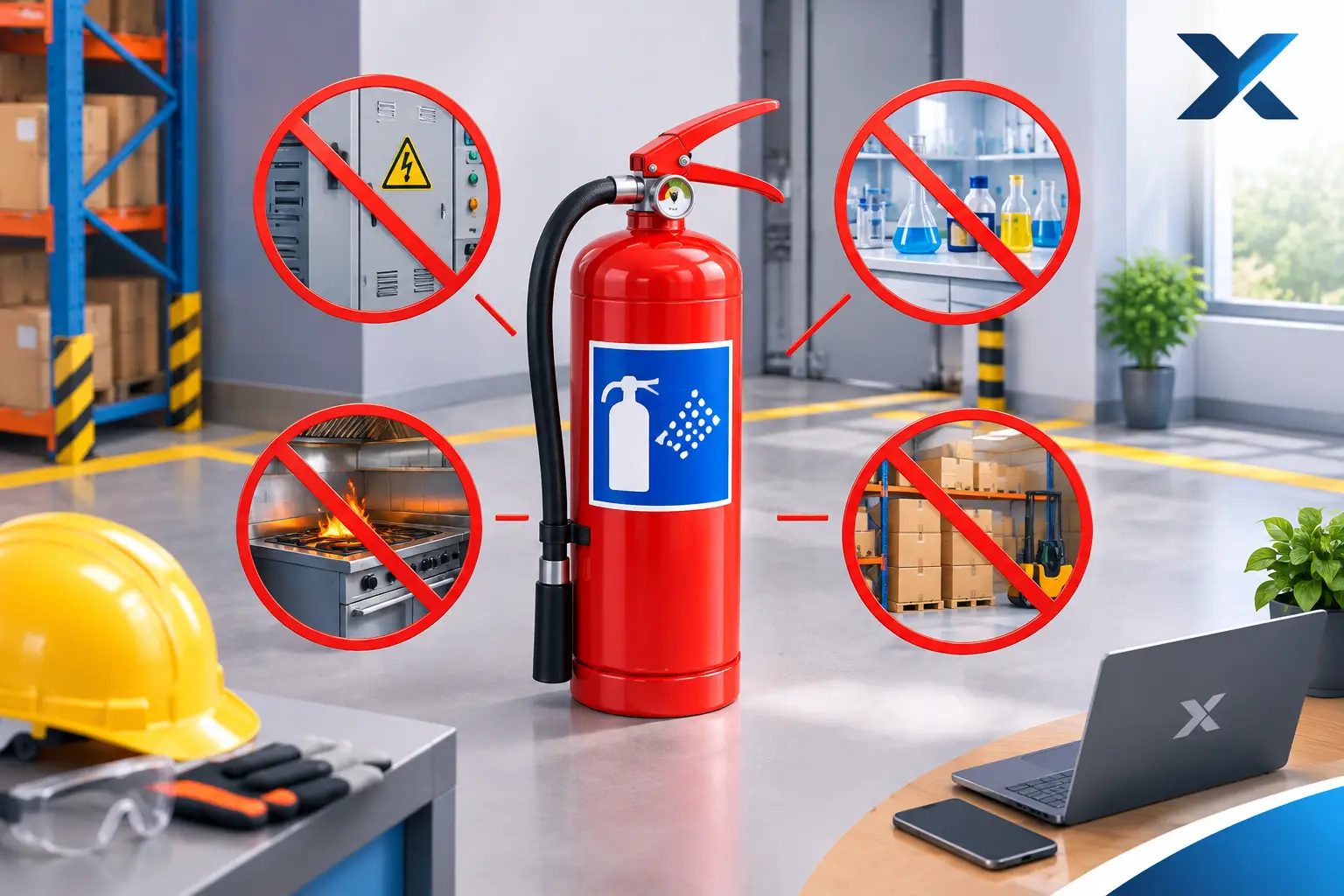
A powder extinguisher can deal with several classes of fire, but that does not automatically make it the right extinguisher for every workplace. Powder extinguisher workplace restrictions exist for a practical reason: discharging dry powder indoors can create a serious secondary hazard for the people trying to escape.
For many businesses, the question is not whether powder works on a fire. It does. The question is whether its use is proportionate to the risks within the premises, the likely occupants and the potential consequences of releasing a dense cloud of powder. This decision should form part of a suitable and sufficient fire risk assessment, rather than being based on an extinguisher’s broad fire rating alone.
Why powder extinguishers are restricted in workplaces
ABC dry powder extinguishers are highly versatile. They are commonly suitable for Class A fires involving combustible materials such as wood, paper and textiles; Class B flammable liquid fires; and Class C gas fires. They can also be used on fires involving electrical equipment, although the extinguisher should be operated with care and the electricity isolated where possible.
The difficulty is what happens after the extinguisher is discharged. Powder emerges with force and quickly fills the surrounding area. In an enclosed office, shop, communal corridor, workshop or short-term let, this can sharply reduce visibility. A person who is already under pressure may struggle to find an escape route, see signage or assist someone else from the building.
The powder is also an irritant. It can affect breathing and obscure vision, particularly for people with asthma or other respiratory conditions. It may contaminate stock, food, computers, electrical panels, machinery and sensitive production equipment. Even where a small fire is put out promptly, a powder discharge can lead to extensive clean-up, equipment failure and operational downtime.
For this reason, BS 5306-8 advises that powder extinguishers should not generally be used indoors unless a fire risk assessment identifies a specific need. This is not a blanket legal prohibition. It is a restriction based on suitability, and duty holders need a clear, defensible reason if powder is selected for internal areas.
What the law requires from duty holders
In Scotland, fire safety duties require those responsible for relevant premises to assess fire risk and put appropriate fire-fighting equipment in place where necessary. The law does not prescribe one extinguisher type for every property. Instead, it requires equipment that is suitable for the nature of the risks, accessible to those who may use it and properly maintained.
That means an extinguisher selection must reflect more than the floor area of the building. The responsible person should consider the materials and processes present, whether members of the public visit, the number and mobility of occupants, escape routes, and the effect of extinguishing media on the premises.
British Standards provide the recognised route for selecting, commissioning and maintaining extinguishers. BS 5306-8 addresses selection and positioning, while BS 5306-3 covers servicing and maintenance. Following these standards helps demonstrate that equipment has been chosen and managed responsibly, which matters when insurers, enforcing authorities or investigators review an incident.
A powder extinguisher positioned inside simply because it is inexpensive or covers several fire classes can be difficult to justify. A documented risk assessment that explains why it is needed, where it is placed and how users are expected to respond is far stronger.
Where powder can still be appropriate
Powder remains useful in the right setting. It is often a sensible choice in external locations where ventilation is unrestricted and the effects of a powder cloud are less likely to compromise escape. Examples can include open yards, fuel storage areas, plant compounds, construction sites and some vehicle or mobile plant applications.
It can also be appropriate in certain industrial environments where flammable liquids, gases or mixed fire risks are present, provided the location and working conditions support its use. A detached boiler house, an external generator enclosure or an open-sided workshop may present a different case from a customer-facing retail unit.
The key point is that “workplace” covers very different environments. A powder extinguisher may be justified near an external LPG installation, but not in the corridor leading to an office’s only exit. The assessment must distinguish between the specific hazard being protected and the consequences of discharge in that precise location.
Indoor alternatives are often safer
For many indoor commercial premises, other extinguisher types provide more controlled protection. Water-based extinguishers are commonly suitable for ordinary combustible materials. Foam may be appropriate where there is a flammable liquid risk, subject to the particular product, environmental considerations and the premises’ needs. Carbon dioxide extinguishers are widely used near electrical equipment because they leave no residue, though they have their own limitations in small or poorly ventilated spaces.
Wet chemical extinguishers are designed for commercial cooking risks involving cooking oils and fats. They are not a substitute for the correct kitchen suppression arrangements, but they are usually the appropriate portable extinguisher where deep-fat frying is undertaken.
There is no universal replacement for powder. A garage, joinery workshop, office and café will each need a different combination of protection. In many cases, a mixture of extinguisher types is the safer solution because it allows staff to tackle foreseeable small fires without creating avoidable damage or danger.
Do not select by colour or price alone
Older premises sometimes retain extinguishers chosen years ago, with little evidence that their position still matches the current risk. Changes such as new machinery, altered storage, a refurbished kitchen, increased occupancy or a move to open-plan working can all affect extinguisher suitability.
A competent review should check the extinguisher’s fire rating, media type, location, signage, mounting height, access and service condition. It should also consider whether staff have been told that extinguishers are for escape support and only for tackling an incipient fire when it is safe to do so. Nobody should be expected to fight a fire that is spreading, producing heavy smoke or blocking an exit.
Powder extinguisher workplace restrictions in practice
The most common mistake is treating the powder unit as a general-purpose answer to every fire risk. In practice, its placement should be limited where indoor discharge could impair evacuation, harm occupants or cause disproportionate contamination.
A practical assessment asks several direct questions. Is the extinguisher in an enclosed room or escape route? Could a discharge make it harder for people to leave? Are there vulnerable occupants, customers or residents? Would powder damage critical electronics, stock or production equipment? Is there another extinguishing medium that controls the identified risk with fewer consequences?
If the answer points away from powder, replacement should be considered rather than waiting until the next scheduled review. An extinguisher that is still in date is not necessarily suitable for its current location.
Duty holders should also avoid moving extinguishers casually between areas. Relocating a powder unit from an external compound into an indoor store room may alter the risk entirely. Equipment should be sited, commissioned and recorded properly so staff can rely on it in an emergency and servicing records accurately reflect what is on site.
Maintenance does not fix an unsuitable choice
Annual servicing is essential, but servicing confirms an extinguisher’s condition. It does not make an inappropriate extinguisher appropriate. A fully operational powder extinguisher may still be the wrong provision for an enclosed workplace.
Regular inspections should identify obvious issues between services, including obstructed access, missing tamper seals, damaged hoses, unreadable instructions or pressure gauge concerns. More importantly, planned reviews give businesses a chance to identify changes in risk before they become a compliance problem.
For workplaces across Glasgow and the central belt, EXSERVICE can assess existing extinguisher provision against the premises’ actual risks, replace unsuitable or end-of-life units, and maintain clear servicing records. This gives duty holders a practical basis for showing that their fire protection has been considered, not merely installed.
The right extinguisher is the one that gives a person a realistic chance to stop a small fire without placing themselves or others in greater danger. Where powder is justified, it should be there for a clear reason. Where it is not, changing it is a straightforward step towards safer evacuation, better business continuity and stronger fire safety compliance.
Leave a Reply