

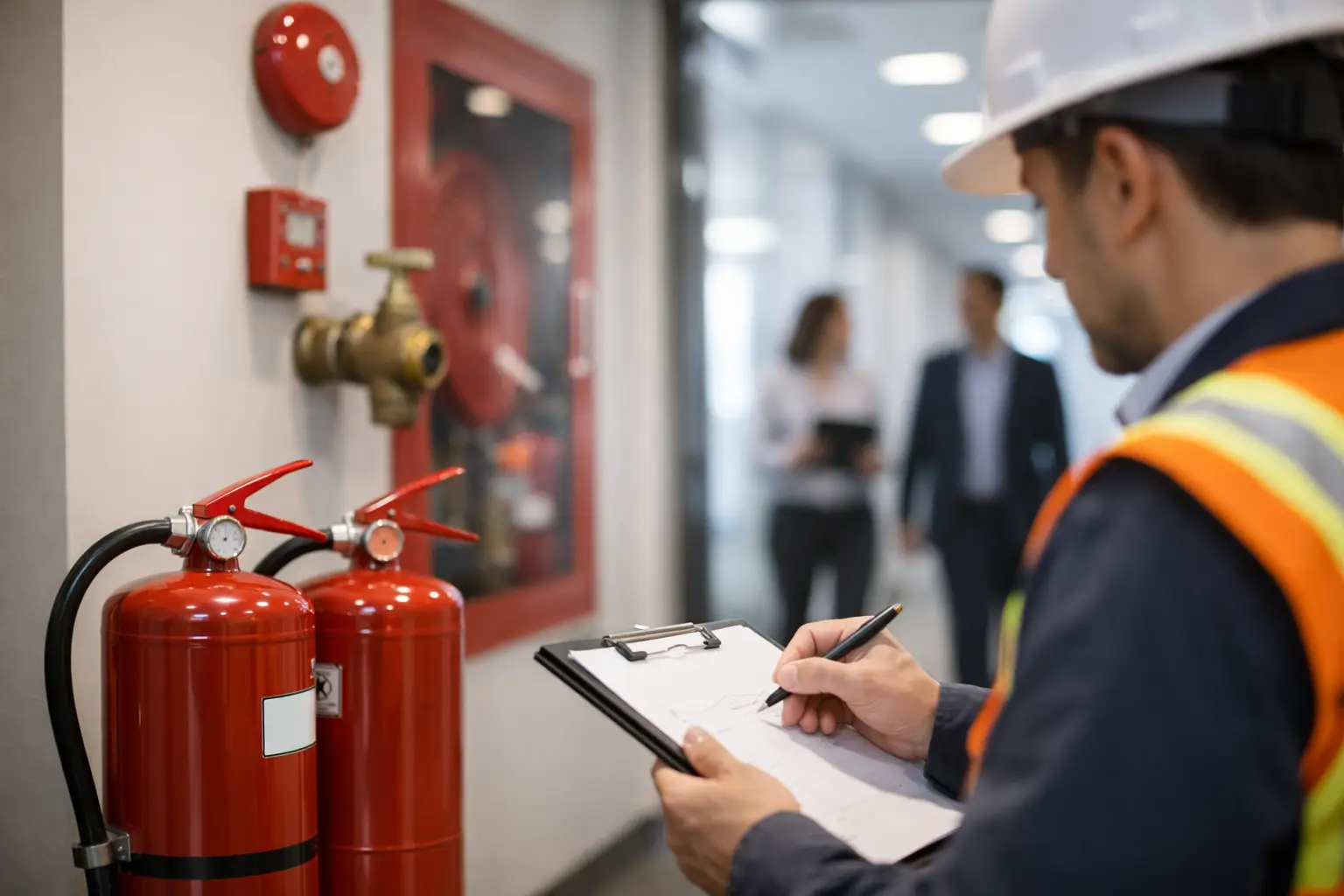
A fire door wedged open for convenience, a portable heater beneath a desk, or an extinguisher hidden behind stored stock can turn a manageable incident into a serious loss. A commercial fire risk assessment guide is therefore not simply a compliance document. It is a practical process for finding the conditions that allow fire to start, spread or prevent people escaping safely.
For business owners, landlords and facilities managers, the assessment should lead to clear decisions: what needs fixing, who is responsible, and when the work will be completed. It should also support business continuity. A fire can close premises, disrupt staff and customers, damage stock and equipment, and create difficult questions from insurers. Proper assessment and maintenance reduce those risks before an emergency tests your arrangements.
What a commercial fire risk assessment must achieve
In Scotland, the person with control of relevant premises has duties under fire safety legislation to take reasonable measures to safeguard occupants from harm caused by fire. In practice, this means carrying out a suitable fire safety risk assessment, acting on its findings and keeping it under review. The responsible person may be an employer, owner, managing agent, tenant or another duty holder, depending on who controls the building and day-to-day operation.
A useful assessment does more than list fire extinguishers and exits. It considers the building, the people using it, the work carried out there and the reliability of the precautions already in place. The result should be proportionate to the premises. A small office with a straightforward layout has different risks from a workshop, restaurant kitchen, care setting, warehouse or mixed-use building.
The assessment should be recorded where required and made available to those who need to act on it. Recording matters because verbal assurances do not demonstrate that hazards were considered, actions were assigned or checks were completed. Clear records also help when responsibilities change, a lease is renewed, an insurer asks for evidence or an enforcing authority visits.
Start with how fire could begin
The most effective assessments look at real working practices rather than relying on a generic checklist. Walk through the property at a normal operating time where possible. Look at plant rooms, kitchens, electrical intake areas, storage spaces, staff areas and any place where contractors work. Ask staff what regularly goes wrong, what is bypassed for convenience and where clutter tends to build up.
Common ignition sources include overloaded electrical circuits, damaged plugs and leads, cooking equipment, heaters, hot works, smoking materials and poorly maintained machinery. Ignition alone is not the whole problem. It becomes more dangerous where there is fuel nearby, such as waste, packaging, flammable liquids, textiles, paper records or accumulated dust.
Controls should be specific. If waste is routinely held beside a rear exit, move it to a managed collection point. If staff use portable heaters because a room is cold, address the heating issue rather than repeatedly removing heaters. If contractors carry out welding or roofing work, use a permit-to-work process, remove combustible materials and ensure appropriate fire watch arrangements are in place.
Consider who may be at greater risk
The question is not only whether an able-bodied employee can leave quickly. Consider everyone who may be on the premises: visitors unfamiliar with the layout, lone workers, contractors, customers, young people and anyone whose mobility, hearing, sight or understanding may affect evacuation.
This is where a standard evacuation plan can fall short. A multi-storey office may need personal emergency evacuation plans for named staff. A retail premises may need staff positioned to guide customers towards alternative exits. A building with sleeping accommodation has a far higher potential consequence because occupants may not detect or respond to a fire promptly.
Staffing levels also matter. An escape strategy that works when five trained people are on duty may not work during an early delivery, a late shift or a busy event. Your assessment should reflect actual occupancy and operating hours, not an idealised version of them.
Check escape routes, alarms and fire separation
People must be able to recognise a fire warning and leave by a safe route. Escape routes should be clear, adequately lit, signed where necessary and capable of being opened without delay. Do not treat corridors, stairways or final exits as overflow storage, even temporarily. A delivery left in the wrong place can reduce an escape route at precisely the moment it is needed.
Fire doors deserve particular attention. They are designed to limit smoke and flames, but only when they close properly and are not damaged, altered or wedged open. Check that doors shut into their frames, seals are intact where fitted, self-closing devices function and glazing is not compromised. Hold-open devices may be suitable where they are designed and maintained for that purpose, but improvised wedges are not.
Alarm and detection arrangements must match the premises and its occupants. In a small, open-plan workplace, a simple arrangement may be appropriate. In larger, noisier or higher-risk premises, you may need more extensive detection, audible warning or visual alarms. Emergency lighting, signage and fire-resisting construction should also be considered as part of the overall escape strategy rather than as isolated items.
Provide the right extinguishers and keep them usable
Portable fire extinguishers can support a safe response to a small, developing fire, but they are not a substitute for evacuation. Their purpose is to allow trained people to tackle a fire only where it is safe to do so and where they have a clear escape route behind them.
The correct type, number and location depend on the risks present. Water-based extinguishers may suit ordinary combustible materials, while electrical, flammable-liquid, cooking-oil and lithium-ion battery risks require different considerations. Providing the wrong extinguisher can expose staff to greater danger. For example, water should not be used on live electrical equipment or burning cooking oil.
Extinguishers must be visible, accessible, correctly sited and identified. They also need routine inspection and competent servicing in line with the relevant standards, including BS 5306. An extinguisher that has lost pressure, is obstructed, has been discharged, or has reached the end of its serviceable life cannot be assumed ready for use. Maintenance labels and servicing records provide useful evidence, but the day-to-day condition and access to equipment still need checking by the person on site.
For workplaces in Glasgow and the surrounding area, EXSERVICE can support this practical part of compliance through extinguisher supply, siting, commissioning and ongoing maintenance. The priority is simple: equipment should be suitable for the risk and ready to use when seconds matter.
Turn findings into an action plan
A risk assessment has value only when its findings are acted upon. Separate immediate dangers from improvements that require planning or investment. A blocked exit, defective fire door or missing extinguisher should be addressed without delay. Replacing an ageing alarm system or improving compartmentation may need quotations, budgeting and a defined completion date, but it should not disappear into a general maintenance list.
For each action, record the issue, the required control, the responsible person and the target date. Review progress and retain evidence such as invoices, inspection records, photographs, training records and test logs. This creates accountability and makes it easier to show that known issues were managed.
Training should match the risks and roles within the building. Staff need to know how to raise the alarm, leave safely, where to assemble and who will call the fire and rescue service. Fire warden duties, extinguisher familiarisation and evacuation drills may be appropriate, but the level of training should reflect the complexity of the premises. Training that is never refreshed is easily forgotten, especially where staff turnover is high.
Review the assessment when circumstances change
An annual review is sensible for many commercial premises, but waiting for a date in the diary is not enough. Review the assessment whenever there is a material change: alterations to the layout, new machinery, a change in occupancy, a different use of a room, a fire incident or near miss, significant staff changes, or evidence that an existing control is failing.
A new tenant in part of a building, for example, can alter escape routes, ignition risks and responsibilities. Likewise, increased storage may change the fire loading in a warehouse long before anyone recognises it as a formal change. Regular checks allow small problems to be corrected before they become embedded practice.
A well-managed fire risk assessment gives duty holders a working picture of their premises, not a report filed away after an inspection. Keep it current, act on it decisively and make sure the people, routes and equipment relied upon in an emergency are protected every day.
Leave a Reply