

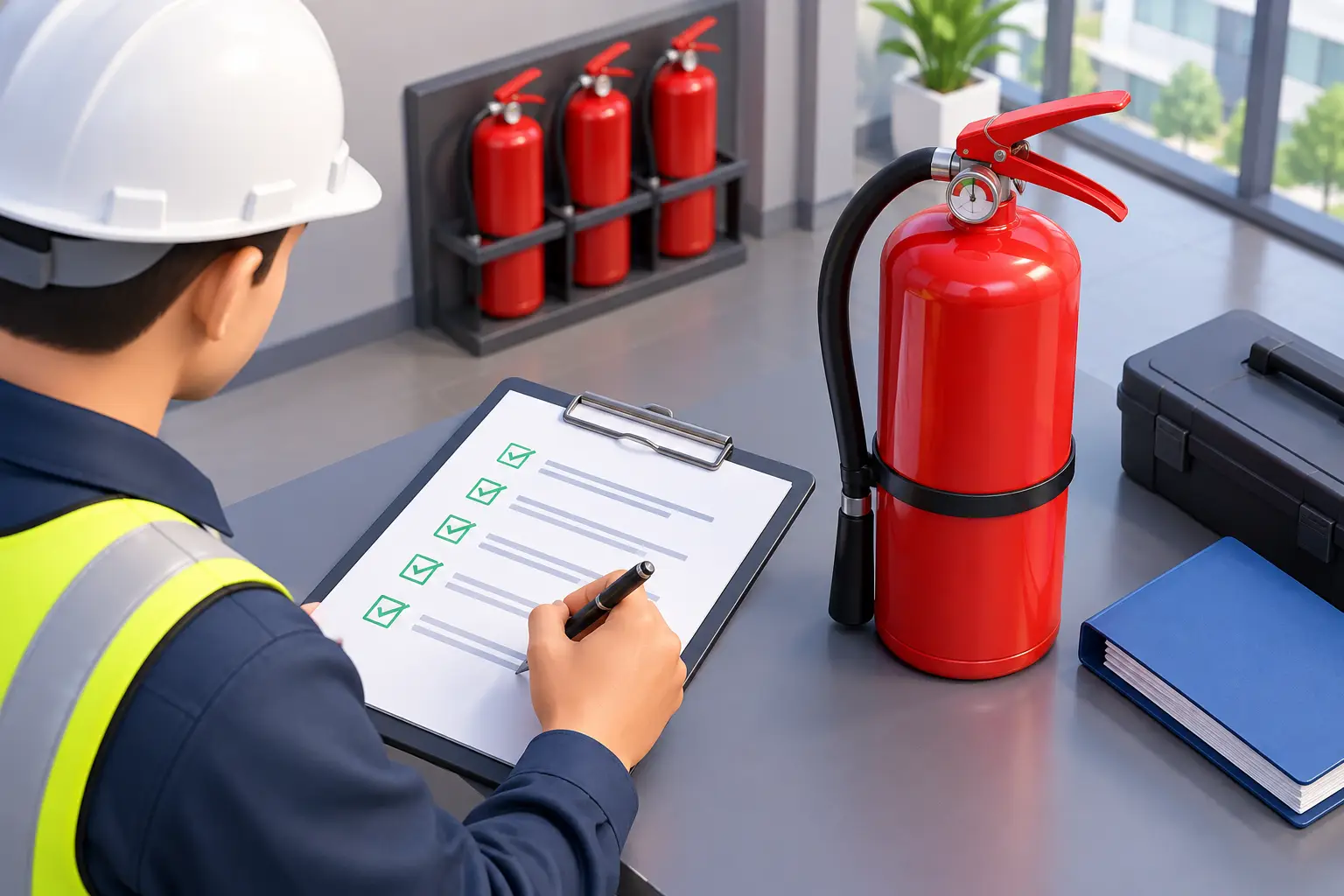
A new extinguisher is not ready simply because it has been delivered and fixed to a wall. Commercial extinguisher commissioning records provide the evidence that each unit has been selected, sited, assembled, checked and labelled for use at your premises. For a duty holder, that record is the starting point for proving that portable firefighting equipment was put into service properly.
This matters when a fire risk assessment is reviewed, an insurer requests evidence following an incident, or a maintenance contractor takes over an existing site. It also matters in the first moments of a small fire. An extinguisher must be suitable for the risk, accessible, correctly pressurised where applicable, and ready for a trained person to use. A certificate alone will not put out a fire, but accurate records help ensure the practical checks behind it have happened.
What commissioning means for a commercial extinguisher
Commissioning is the formal process carried out when a new extinguisher is first installed, or when an extinguisher is brought into use at a new location. It is more than a visual look-over. The competent person confirms that the extinguisher is appropriate for the hazards identified at the premises and that it has been installed in line with the relevant recommendations of BS 5306-8.
For example, a water-based extinguisher may be suitable for ordinary combustible materials such as paper, wood and textiles, but it is not the answer for every workplace risk. A commercial kitchen, electrical plant area, workshop or premises storing flammable liquids may require different media and additional protection. Commissioning is the point at which equipment selection meets the actual conditions on site.
The engineer will also check the extinguisher’s condition, manufacture date, pressure indication where fitted, hose and horn arrangement, tamper indicator, anti-tamper seal, wall bracket or stand, identification signs and clear access. The unit should be marked with service information and assigned to the site’s fire safety records. Where relevant, the engineer may fit a transport bracket, a fire point sign or an extinguisher identification label.
A unit that has been moved from another property should not be assumed suitable without review. Its age, service history, condition and position all need consideration before it is relied upon in a new workplace.
What commercial extinguisher commissioning records should contain
A useful commissioning record should allow another competent person to understand exactly what was installed and when. It should connect the physical extinguisher on the wall with the entry in your fire safety logbook or digital compliance file.
The record will normally identify the premises, the commissioning date, the extinguisher type and capacity, manufacturer or model, serial number, location and the name or identification of the competent engineer. It should also confirm the equipment was commissioned in accordance with the applicable standard and record the next scheduled maintenance visit.
Where several extinguishers are installed, a location plan or asset register is particularly valuable. “Reception”, “first-floor corridor” and “rear store” are clearer than a line of serial numbers with no indication of where the equipment is kept. If an extinguisher is discharged, removed, damaged or relocated later, that register gives the responsible person a reliable baseline to update.
Records should be retained for the life of the equipment and kept with other fire safety documentation. In a small office, this may be a well-maintained fire logbook. On larger or multi-site estates, a digital register can make dates, locations and service status easier to manage. The format is less important than accuracy, accessibility and regular updating.
Why the paperwork supports real compliance
Under fire safety legislation in Scotland, the duty holder must take reasonable fire safety measures for people on the premises. The precise duty holder can vary: it may be an employer, landlord, managing agent, occupier or another person with control of the building. A suitable fire risk assessment should identify whether portable fire extinguishers are needed, what types are appropriate and where they should be positioned.
BS 5306 is not legislation in itself, but it provides recognised good practice for the selection, installation, commissioning and maintenance of portable fire extinguishers. Following it helps demonstrate that decisions have been made competently. It also gives insurers, enforcing authorities and clients confidence that equipment is not being managed casually.
Commissioning documentation is especially useful where responsibility changes hands. A new facilities manager should not have to guess whether extinguishers were installed last month, five years ago or before the current business occupied the building. Clear records reduce the chance of missed service dates, unsuitable equipment remaining in place, or duplicate units being ordered unnecessarily.
There is a business continuity issue as well. Fire damage, evacuation, investigation and temporary closure can have consequences far beyond the cost of replacing a discharged extinguisher. Properly commissioned equipment is one practical part of reducing the severity of a manageable incident, provided it is safe to tackle and staff have been instructed not to take unnecessary risks.
Commissioning is not the same as annual servicing
This distinction is often overlooked. Commissioning confirms that a new extinguisher is ready to enter service. Ongoing maintenance confirms that it remains ready to use.
After commissioning, extinguishers need regular visual checks by a nominated person on site and periodic maintenance by a competent technician. The usual annual basic service checks condition, accessibility, pressure where relevant, components, labelling and the service record. Certain extinguisher types also require extended servicing or replacement at defined intervals, depending on the unit and manufacturer guidance.
A commissioning label is therefore not a permanent guarantee. If an extinguisher has been blocked by stock, knocked from its bracket, used partially, exposed to damage or allowed to pass its maintenance date, the original record cannot correct that problem. Your fire safety arrangements need both a sound starting point and ongoing attention.
Common gaps found at commercial premises
The most frequent issue is not the absence of an extinguisher. It is an absence of certainty. Equipment may be present, but no one knows who installed it, whether it matches the risks, or whether it has been serviced since the business moved in.
Other avoidable gaps include extinguishers hidden behind furniture, signs missing or unclear, units placed too high or too low, damaged wall brackets, obsolete equipment left in service and fire points altered after an office refit. Changes to a premises can create new risks too. A former filing room may become a server area; a basic staff kitchen may become a food preparation space; a warehouse may begin storing aerosols or chemicals.
When the layout, use or occupancy changes, review the fire risk assessment and extinguisher provision rather than assuming the existing arrangement still works. This is where a competent fire safety provider can identify practical improvements before they become a compliance concern.
How to keep records useful between visits
The responsible person should know where commissioning records are stored and who can access them. If you operate from rented commercial space, establish early whether the landlord, managing agent or tenant is responsible for each extinguisher. Shared corridors, plant rooms and common areas can create uncertainty unless duties are clearly agreed.
Keep a simple record of any change between professional maintenance visits. If an extinguisher is used, even briefly, arrange for it to be replaced or serviced promptly. If it is moved during refurbishment, record the new location and make sure it remains visible and accessible. If a member of staff reports damage, act on it rather than waiting for the annual visit.
For businesses in Glasgow and the surrounding area, EXSERVICE can supply, site, commission and maintain workplace extinguishers while keeping the documentation clear and current. The objective is not paperwork for its own sake. It is to ensure your equipment, records and fire risk controls all support the same outcome: protecting people and keeping the business prepared.
A commissioning record should give you a straightforward answer to a serious question: when a person reaches for that extinguisher, can you show it was correctly put in place and properly looked after? Keeping that answer clear is a sensible part of responsible workplace management.
Leave a Reply