

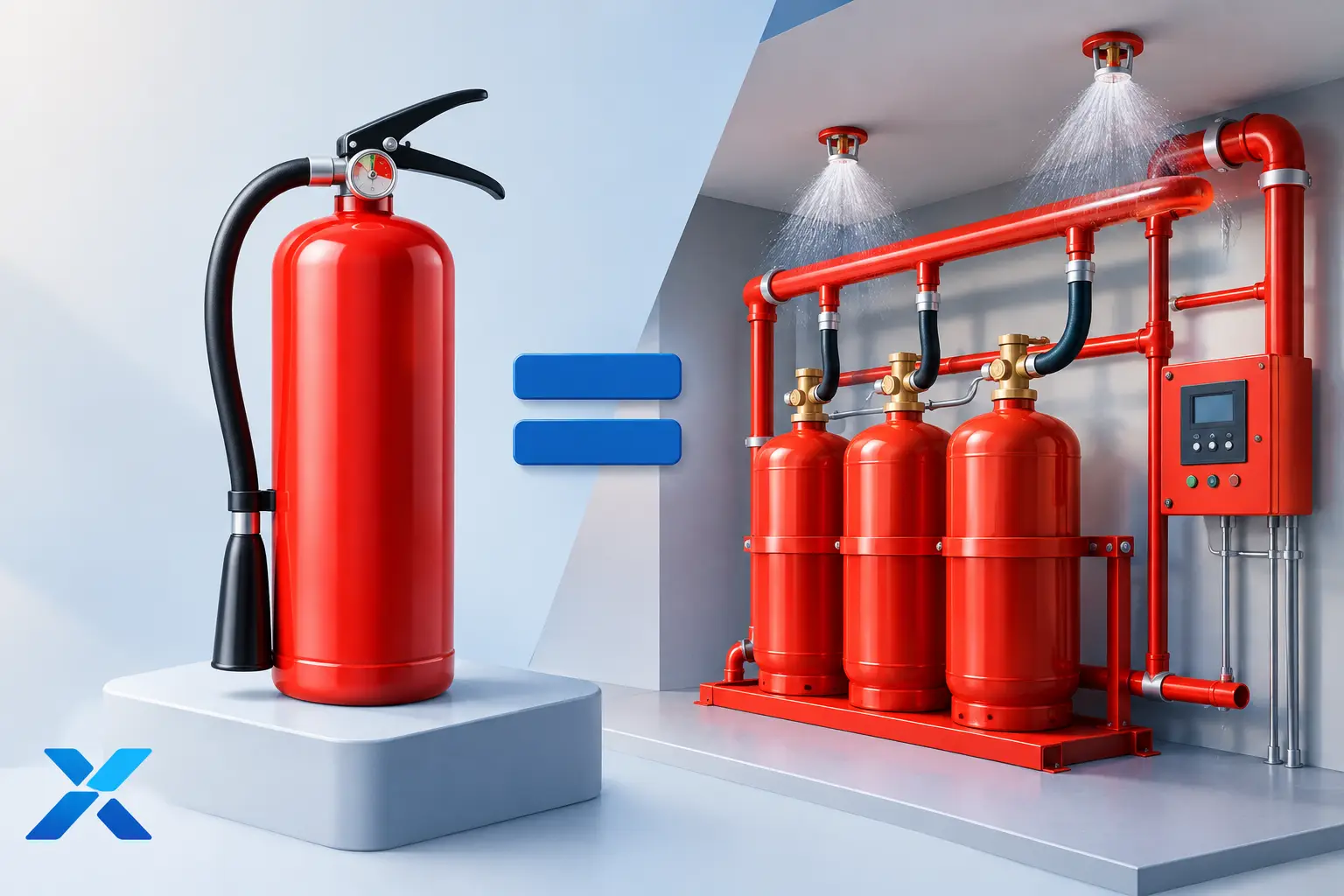
A small fire starts in a staff kitchen, workshop or bin store. The right extinguisher may stop it before it damages the premises or forces a lengthy closure. But is a fire extinguisher a fire suppression system? Not in the usual technical sense. A portable extinguisher is firefighting equipment that can form part of a premises’ wider fire protection strategy. A fire suppression system normally refers to a fixed, often automatic, installation designed to control or extinguish a fire.
For business owners, landlords and responsible persons, the distinction matters. It affects fire risk assessment decisions, equipment selection, staff training, maintenance arrangements and the level of protection your insurer may expect.
Is a fire extinguisher a fire suppression system?
A fire extinguisher is a portable first-aid firefighting appliance. It is intended for use on a small, developing fire, usually by a person who has been trained and can do so without putting themselves at risk. It requires someone to identify the fire, choose the correct extinguisher, operate it properly and have a clear escape route.
A fire suppression system is typically fixed in place and may activate automatically or be manually released. Examples include sprinkler systems, water mist installations, gaseous suppression systems for server rooms, and wet chemical systems protecting commercial cooking equipment. These systems are designed around the specific risks in a building or area.
Both can suppress fire. That is where the confusion comes from. However, they work in very different ways and should not be treated as interchangeable controls. A portable extinguisher gives a trained person an opportunity to tackle an incipient fire. A fixed system provides more consistent, area-based protection, often when nobody is present or when it is unsafe to intervene directly.
Why the difference matters for your fire risk assessment
Your fire risk assessment should identify the hazards in the premises, the people at risk and the measures needed to reduce the likelihood and consequences of fire. Extinguishers are one of those measures, but they are not a substitute for prevention, warning systems, safe escape routes or appropriate building protection.
In Scotland, fire safety duties require responsible persons and duty holders to take suitable precautions based on the risks present. For many offices, shops, short-term lets and lower-risk workplaces, correctly selected and maintained extinguishers may be an appropriate part of the fire safety arrangement. A sprinkler or specialist suppression system may not be necessary.
The position changes where the fire risk is higher, the consequences of fire are greater, or a fire could develop quickly before people can respond. A commercial kitchen with deep-fat frying, for example, may require a wet chemical suppression system over the cooking range. A server room containing essential business data may need a clean-agent system that does not damage electronic equipment. In these settings, portable extinguishers remain useful, but they do not provide the same level of protection as a system designed for the hazard.
A suitable assessment considers the building, occupancy, activities, ignition sources, combustible materials and business continuity implications. It should not simply count the number of extinguishers on the wall.
What portable extinguishers are designed to do
An extinguisher is there to deal with a fire at its earliest stage. It can be highly effective when the correct type is immediately available and the user understands its limitations. It is not intended to encourage staff, tenants or visitors to fight a fire that has already spread, filled an area with smoke or blocked the exit route.
The basic priority is always life safety. Anyone discovering a fire should raise the alarm, ensure people begin evacuating and call the fire and rescue service when required. A trained person should only attempt to use an extinguisher if the fire is small, they have the right appliance, and they can leave immediately if the attempt fails.
Different extinguishers are suitable for different fuels. Water-based extinguishers are commonly used for materials such as paper, wood and textiles. Foam may be appropriate for certain flammable liquids. Carbon dioxide is often selected for electrical equipment, while wet chemical extinguishers are designed for cooking oils and fats. Using the wrong type can make a fire worse or create a serious risk to the user.
This is why siting, signage and selection matter as much as supply. An extinguisher hidden in a cupboard, installed too far from the risk, or chosen without considering the activities in the premises may offer little practical protection in an emergency.
Fixed suppression systems protect when people cannot
The defining advantage of a fixed suppression system is that it is engineered to respond to a specific risk, frequently without waiting for a person to take action. A sprinkler head can operate near a developing fire. A kitchen suppression system can discharge when heat activates its detection arrangement. A gaseous system can protect critical equipment where water damage would be unacceptable.
That does not mean every premises needs one. Fixed systems involve design, installation, inspection and ongoing maintenance requirements. They may also require changes to the building, specialist testing and careful coordination with alarms, ventilation and emergency procedures.
For a small office or retail unit with ordinary combustible materials, a well-managed fire alarm, clear escape routes, suitable extinguishers and sound housekeeping may provide the appropriate level of protection. For a manufacturing process, commercial kitchen, plant room or high-value technical environment, relying on extinguishers alone may leave an unacceptable gap.
The correct decision is risk-based. It should be supported by a competent fire risk assessment and, where appropriate, specialist system design advice.
Extinguishers still have compliance requirements
Because extinguishers are portable, it is easy to underestimate the attention they need. An appliance can look intact while suffering from lost pressure, corrosion, damaged hoses, missing safety pins or an expired service life. It may then fail when it is needed most.
BS 5306 sets out recognised good practice for the selection, siting and maintenance of portable fire extinguishers. For workplaces, this normally means providing suitable units, positioning them where they can be accessed quickly, carrying out regular visual checks and arranging competent servicing. Service labels and records should be kept up to date so you can demonstrate that equipment has been maintained.
Annual servicing is a key part of this process, but it is not the only consideration. Some extinguishers require extended service or replacement at specified intervals. Units that have been discharged, damaged, corroded or taken from an unsuitable environment should be dealt with promptly rather than left in place for the next scheduled visit.
For landlords and operators of short-term lets, the same principle applies. The accommodation’s risk profile, layout and occupancy arrangements should determine what is needed. Equipment should never be installed simply because it appears reassuring. It must be suitable, maintained and supported by clear emergency arrangements.
Training changes the value of an extinguisher
A fixed suppression system is designed to operate without someone making a judgement under pressure. A portable extinguisher is different. Its effectiveness depends heavily on human action.
Staff should understand the alarm and evacuation procedure first. Fire extinguisher training should reinforce that nobody is expected to tackle a fire. It should explain when an attempt may be safe, which extinguisher types are provided, and when to leave immediately. New starters, shift workers and people working in higher-risk areas should not be overlooked.
Training also prevents a common mistake: treating extinguishers as a replacement for good fire prevention. Controlling ignition sources, managing waste, maintaining electrical equipment, keeping fire doors closed and protecting escape routes will usually do more to prevent a serious incident than any appliance used after a fire has started.
A practical approach for duty holders
Start with the risks in your premises rather than the equipment you think you ought to have. Review the activities carried out, the likely fire types, the people who may need assistance to evacuate, and the areas where a fire could cause disproportionate disruption.
Then ensure your fire risk assessment, alarm arrangements, escape routes, extinguishers and any fixed suppression measures work together. If your premises has portable extinguishers, make sure they are the correct types, properly located, clearly identified and maintained in line with the relevant standards. If the risk calls for fixed suppression, treat it as a designed safety measure, not an optional extra.
EXSERVICE supports workplaces, rental accommodation and commercial premises across Glasgow and the central belt with extinguisher supply, siting, commissioning and maintenance. The objective is straightforward: keep equipment compliant, ready to use and appropriate to the real risks on site.
A fire extinguisher can be the difference between a minor incident and a major loss, but only when it is one part of a considered fire safety plan. The right question is not simply whether you have extinguishers. It is whether your premises has the protection needed for the risks it actually faces.
Leave a Reply