

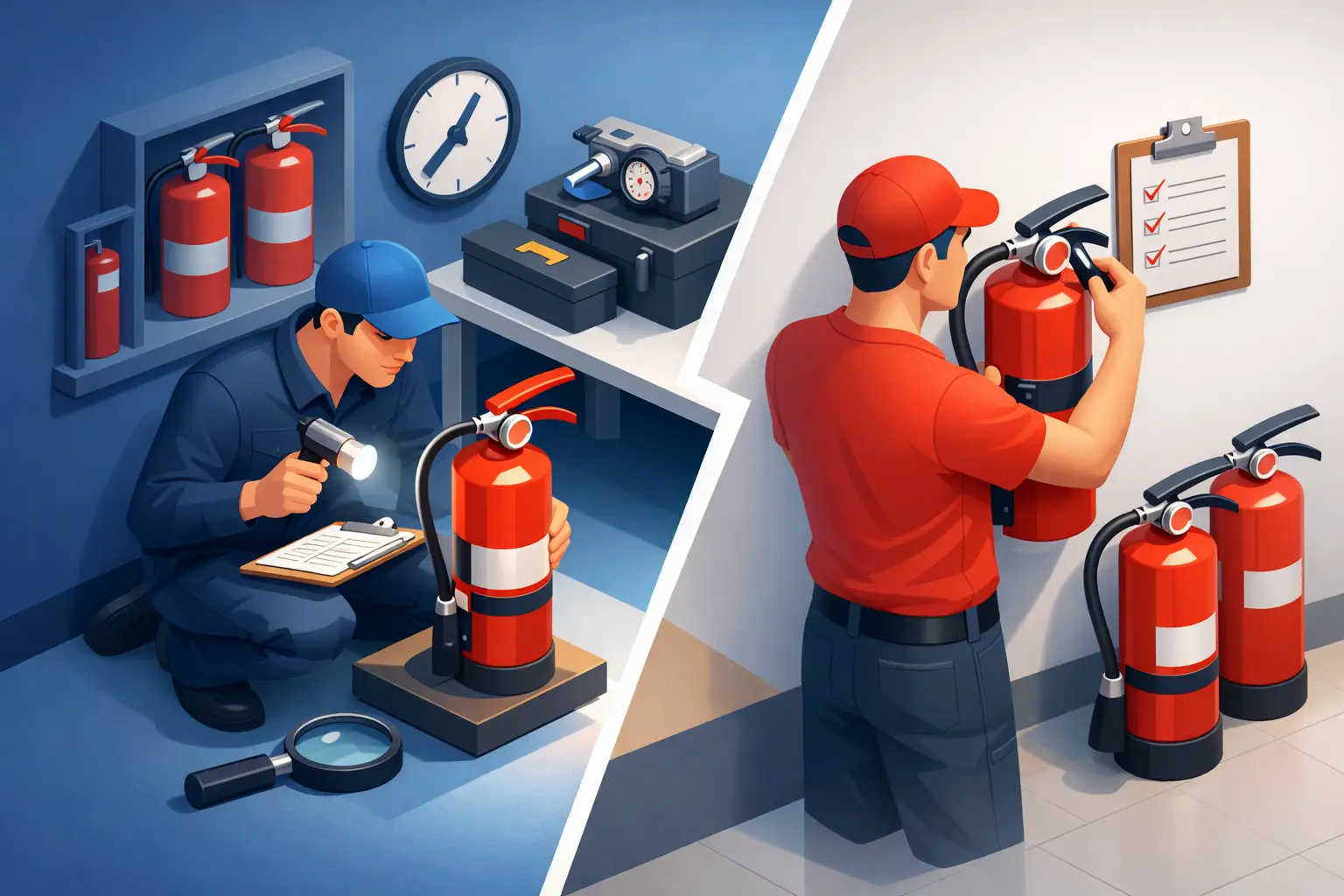
A fire extinguisher can remain on the wall for years and still appear perfectly serviceable. That does not prove it will work when someone needs it. Annual inspection vs monthly checks is not a choice between two similar tasks. They are separate controls, carried out at different levels, which together keep firefighting equipment ready for use.
For a duty holder, the practical question is simple: can you show that extinguishers are suitable, accessible, maintained and checked between professional visits? If the answer is no, a damaged seal, missing unit or unsuitable extinguisher could remain unnoticed until a fire or an inspection exposes the problem.
Why annual inspection and monthly checks both matter
Fire extinguishers are life-safety equipment. They need to be in the right position, selected for the risks on site and capable of operating immediately. A formal annual service by a competent person provides technical assurance. Regular user checks provide day-to-day oversight.
Neither replaces the other. An annual engineer visit cannot identify that an extinguisher was moved behind stock six months later, discharged during an incident, or knocked off its bracket yesterday. Equally, a monthly visual check cannot confirm all of the technical matters examined during professional servicing.
For commercial premises, this distinction supports compliance, business continuity and insurer confidence. It also gives staff a clearer process: report a fault when it is found, rather than waiting for the next scheduled service.
What an annual fire extinguisher inspection involves
In practice, an annual inspection usually means a basic service of each portable fire extinguisher by a competent person. BS 5306-3 is the recognised British Standard for the commissioning and maintenance of portable fire extinguishers, and it provides a strong framework for demonstrating that equipment is being properly maintained.
The engineer examines each extinguisher individually. This includes confirming that the unit is the correct type and size for the fire risks present, that it is appropriately located and clearly identified, and that it has not been damaged, tampered with or discharged. They will check the operating condition, pressure indication where fitted, hose and horn condition, safety pin and tamper seal, labels, body corrosion and the unit’s service history.
The visit is also an opportunity to identify wider issues. A change to your premises, processes or stock may mean the original extinguisher provision is no longer suitable. For example, a workshop introducing battery charging, a kitchen adding cooking equipment or an office converting storage space can alter the fire risk. Simply retaining the same number of extinguishers is not necessarily enough.
Following service, your records should show what has been inspected, any defects found, actions taken and the next service due date. A clear service label and certificate give duty holders evidence that maintenance has been completed. They are also useful when responding to insurer queries, audits or fire risk assessment recommendations.
Some extinguishers require additional periodic work beyond the basic annual service. Depending on the extinguisher type and age, this may include an extended service or overhaul. A competent provider can identify when this is due and advise whether replacement is safer and more cost-effective than further maintenance.
What monthly extinguisher checks should cover
Monthly checks are straightforward visual inspections carried out by the responsible person or a nominated, trained member of staff. They do not involve dismantling an extinguisher or attempting repairs. Their value lies in catching visible changes quickly.
The check should be recorded, even where no fault is found. A short entry in a fire safety logbook or digital record creates an accountable routine and demonstrates that equipment is being monitored between annual services.
A practical monthly check
Walk the premises and confirm that each extinguisher is present, visible and accessible. Look for the following:
- the extinguisher remains in its allocated position and has not been moved, removed or obstructed;
- the identification sign is present and can be seen clearly;
- the body, hose, horn, handle, bracket and wall fixing show no obvious damage or corrosion;
- the safety pin and tamper seal are intact, and the pressure gauge, where fitted, is in the correct operating range;
- the service label is current and there is no indication that the extinguisher has been used; and
- any nearby change, such as new machinery, stored materials or building work, has not made the extinguisher difficult to reach or unsuitable for the risk.
If a unit is missing, damaged, obstructed, showing a low pressure reading or suspected of having been discharged, treat it as unavailable. Do not rely on it until it has been assessed or replaced. Arrange a suitable temporary replacement where necessary so that the area is not left without appropriate fire cover.
Annual inspection vs monthly checks: who is responsible?
The duty holder remains responsible for fire safety arrangements. In a small business, that may be the owner or manager. In larger premises, responsibilities may be shared between a facilities manager, site supervisor, landlord and tenants. Delegating a check does not remove the duty holder’s responsibility to make sure it happens and that faults are dealt with.
A monthly inspection can be completed internally by someone who understands what they are looking for and knows how to escalate concerns. Annual servicing should be completed by a competent fire extinguisher technician working to the relevant maintenance standard.
This division is sensible. Your team has regular access to the building and can spot everyday issues quickly. A specialist has the technical knowledge and equipment to carry out detailed maintenance, determine whether an extinguisher remains serviceable and provide the appropriate documentation.
For multi-occupied buildings, responsibilities should be agreed in writing. A landlord may manage extinguishers in common areas, while individual occupiers are responsible for equipment inside their own units. Assumptions are risky, particularly after a tenancy change or refurbishment. The person who believes someone else is checking an extinguisher may be wrong.
Compliance is about suitability, not just a service sticker
Scottish fire safety duties require relevant fire safety measures to be maintained in an efficient state, in efficient working order and in good repair. The exact arrangements should reflect the premises and the findings of the fire risk assessment. There is no benefit in collecting certificates if extinguishers are hidden, poorly chosen or inaccessible to staff.
A current service label alone is therefore not a complete answer. Consider a café where a wet chemical extinguisher has been moved away from the kitchen, or a warehouse where pallet storage blocks the route to equipment. Both sites may have annual servicing records, yet neither has effective provision at the point of need.
The same principle applies to fire risk assessments. An annual review may be appropriate for many businesses, but it is not a substitute for reviewing the assessment when significant changes occur. Alterations to the building, new work activities, different occupants, increased storage or a fire incident can all require earlier action.
Records that protect your business
Good records should make compliance easier, not create paperwork for its own sake. Keep annual service certificates, extinguisher schedules, monthly check records, fault reports and evidence that defects have been corrected together. If equipment is replaced, retain details of what was removed, why it was replaced and what has been installed in its place.
This history helps identify recurring problems. If a particular extinguisher is repeatedly blocked by deliveries or moved by contractors, the answer may be to improve its siting, signage or staff instruction. If several units are reaching the end of their recommended service life, planned replacement avoids a last-minute compliance gap.
For businesses in Glasgow and the surrounding area, a specialist provider such as EXSERVICE can combine professional extinguisher servicing with practical advice on siting, replacement and records. The aim is not to add complexity. It is to make sure the equipment on your premises is suitable, maintained and ready when it matters.
Set a routine that does not leave gaps
Put the monthly check on a named person’s calendar, with cover arranged for holidays and absences. Review findings promptly, and schedule annual servicing before the due date rather than after it. Where site conditions change frequently, such as busy workshops, communal buildings or storage areas, more frequent visual checks may be justified.
The strongest fire safety arrangements are usually the simplest ones: a competent annual service, regular documented checks and immediate action when something is wrong. That routine keeps extinguishers from becoming wall decorations and helps protect the people, premises and operations that depend on them.
Leave a Reply