

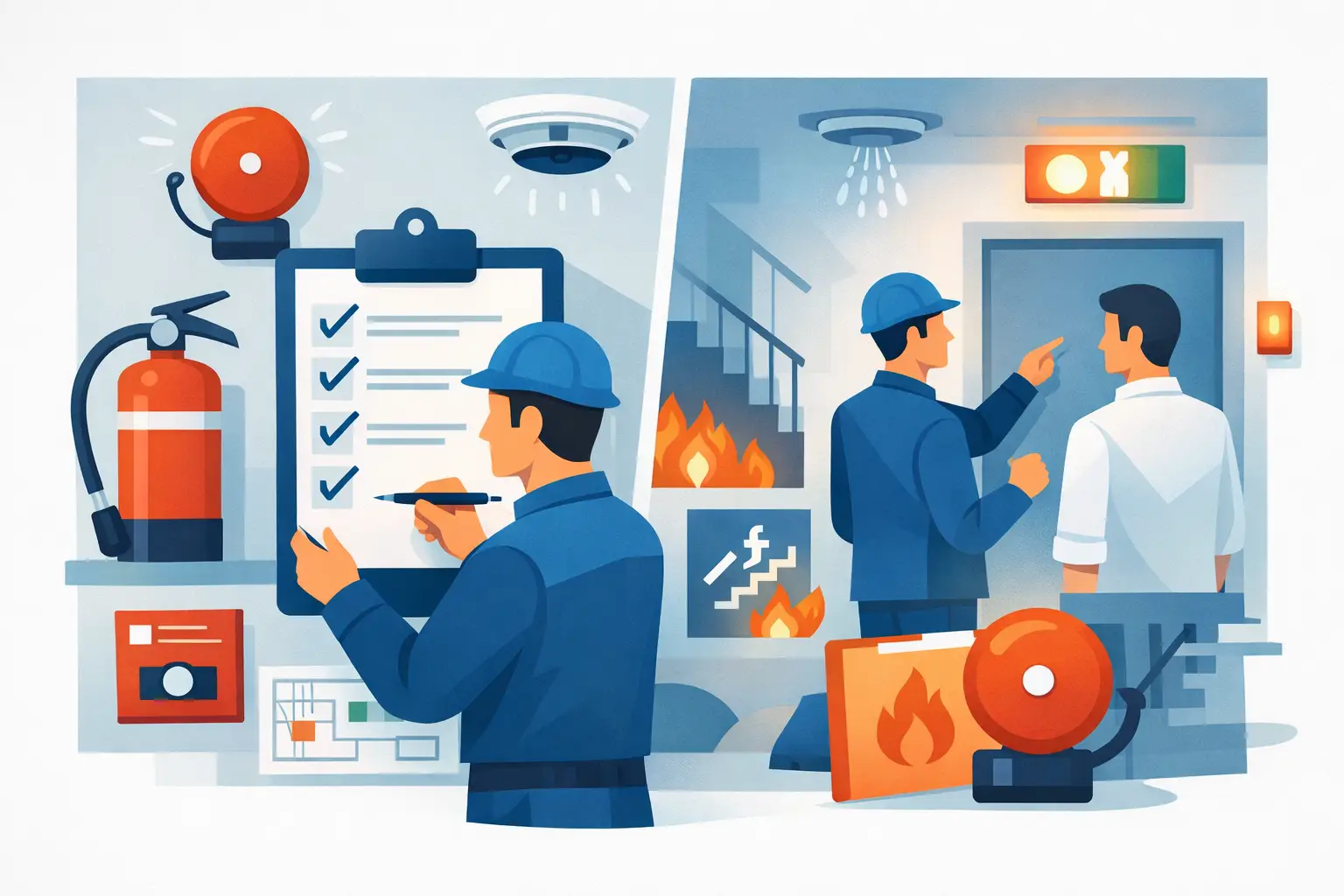
A fire safety inspection rarely fails because of one dramatic issue. More often, it is the small things that create problems – a missing service label, a wedged fire door, an obstructed extinguisher or records that cannot be produced when asked. For any duty holder wondering how to pass fire safety inspection, the answer is not guesswork. It is preparation, documented control and equipment that is ready to perform.
If you are responsible for a workplace, rental property or commercial premises in Scotland, an inspection is a check on more than paperwork. It is a test of whether people could get out safely and whether your fire precautions would work under pressure. That means your approach needs to be practical, not cosmetic.
How to pass fire safety inspection without last-minute panic
The best inspections are usually the least dramatic because the site is already being managed properly. Inspectors tend to look for evidence that fire safety is part of routine operations rather than a rushed clean-up the day before. If your extinguishers are maintained, escape routes are clear, staff know what to do and records are up to date, you are already in a strong position.
That said, every premises is different. A small office will not be inspected in the same way as a warehouse, restaurant or block with sleeping accommodation. The core expectation remains the same: suitable precautions, maintained equipment and clear management responsibility.
Start with your fire risk assessment
Your fire risk assessment is often the foundation of the inspection. It should be suitable for the premises, reflect actual working conditions and show that significant findings have been acted on. An old document that no longer matches the building layout, staffing levels or processes can quickly raise concerns.
Inspectors will usually want to see that hazards have been identified, people at risk have been considered, and control measures are proportionate. If you have made changes to the premises, introduced new equipment, altered storage arrangements or increased occupancy, your assessment should reflect that. A fire risk assessment is not a formality. It is the document that ties your precautions together.
Make sure extinguishers are compliant and serviceable
Fire extinguishers are one of the first things people notice during an inspection because they are visible, easy to check and critical in the early stages of a fire. They should be the correct type for the risks present, mounted or positioned properly, clearly visible and accessible.
Just as important, they must be maintained in line with the relevant standards. Missing annual service labels, damaged units, incorrect siting or expired extinguishers can all undermine compliance. In many workplaces, the issue is not the absence of extinguishers but the assumption that once installed, they can be forgotten.
For businesses that want to know how to pass fire safety inspection, this is one of the simplest areas to get right in advance. Check that each unit is where it should be, unobstructed, in good condition and supported by servicing records. If an extinguisher has reached end of life or is no longer suitable for the risk, replacing it before the inspection is far better than explaining it afterwards.
Pay attention to escape routes and fire doors
A clear escape route is basic, but it is also where many premises fall short. Corridors become temporary storage areas, final exits are partly blocked, and fire doors are held open for convenience. These are the types of issues that can turn a manageable inspection into an enforcement conversation.
Walk your site as if you were trying to leave it in a smoke-filled emergency. Are routes obvious, unobstructed and usable? Do final exits open easily? Are fire doors closing properly and free from damage? If doors are fitted with self-closers, they should work as intended. Wedging open a fire door may seem minor in day-to-day operations, but it defeats a key part of compartmentation.
Signage matters here too. Fire exit signs should be clear and consistent with the route people are expected to take. Where emergency lighting is required, it should be maintained and tested.
Records matter when passing a fire safety inspection
A compliant building without supporting records can still create problems. Inspectors often want evidence that checks are taking place, faults are identified and action is being taken. If you cannot show this, it becomes harder to demonstrate control.
Keep your fire safety documentation organised and easy to access. That usually includes your fire risk assessment, records of alarm tests, emergency lighting tests, fire drill details, staff training records and extinguisher servicing documentation. Depending on the premises, there may also be maintenance records for detection systems, sprinklers, dry risers or smoke control systems.
The point is not to create paperwork for its own sake. It is to show that fire safety is being managed consistently. A tidy folder or digital file structure can make a real difference on inspection day because it shows competence and readiness.
Train staff and prove they understand procedures
An inspector may ask basic questions of staff, not just management. They may want to know how a fire is reported, where people should assemble, who helps with evacuation and whether staff understand the role of extinguishers. If the answers are vague, that suggests procedures exist on paper but not in practice.
Training should be suitable for the workplace and refreshed when needed, especially after changes in layout, staffing or risk. New starters should not be left out, and temporary staff should still know the essentials. In higher-risk settings, more detailed instruction may be appropriate.
This is where a lot of businesses underestimate the inspection process. Passing is not only about installed equipment. It is also about whether the people on site can respond sensibly if something goes wrong.
Check housekeeping and ignition risks
Poor housekeeping often signals wider management issues. Excess waste, overloaded sockets, unsafe storage, blocked plant areas and combustible materials left near heat sources are all common failings. None of them are complicated, but each can increase fire risk and attract attention during an inspection.
Look closely at kitchens, staff rooms, electrical cupboards, stock areas and plant spaces. These are often where standards slip. If your business carries out hot works, uses flammable liquids or stores packaging in volume, controls need to be proportionate. The inspector will not expect every site to look the same, but they will expect obvious risks to be managed properly.
Common reasons businesses fail a fire safety inspection
Most failures come back to the same themes: maintenance, management and missed basics. Fire alarms are not tested. Emergency lights are overdue inspection. Extinguishers are in place but not serviced. Fire doors are damaged or propped open. Records are incomplete. The fire risk assessment is generic or out of date.
There is also a difference between having measures in place and having suitable measures in place. For example, one extinguisher in reception does not cover a whole building. A risk assessment copied from another premises will not satisfy an inspector if it ignores your actual layout and activities. Compliance has to match the building as it is used.
The value of checking before the inspector arrives
A pre-inspection review is often the most efficient way to identify issues while you still have time to correct them. This is especially useful if responsibility has changed hands, the premises have been altered, or servicing has not been centrally managed.
For many duty holders, external support is less about outsourcing responsibility and more about reducing uncertainty. A specialist provider can identify gaps in extinguisher provision, confirm whether units are correctly sited and maintained, and help ensure your records stand up to scrutiny. For businesses across Glasgow and the wider Scottish market, EXSERVICE typically supports this part of compliance by keeping extinguishers serviceable, correctly located and documented.
That does not remove your legal duty, but it makes it far easier to manage properly.
How to pass fire safety inspection in practice
Treat the inspection as a reflection of everyday standards, not a one-off event. Walk the premises regularly. Check what staff actually do, not just what procedures say. Keep maintenance current. Update your fire risk assessment when changes happen. Correct small faults quickly before they become patterns.
If you are waiting for an inspection notice before taking action, you are already under pressure. A better approach is to assume that any day could be inspection day and manage the site accordingly. That is what protects people, supports business continuity and helps avoid awkward surprises when the inspector arrives.
The most reliable way to pass is also the most straightforward: keep your fire precautions real, current and ready to work when they are needed.
Leave a Reply