

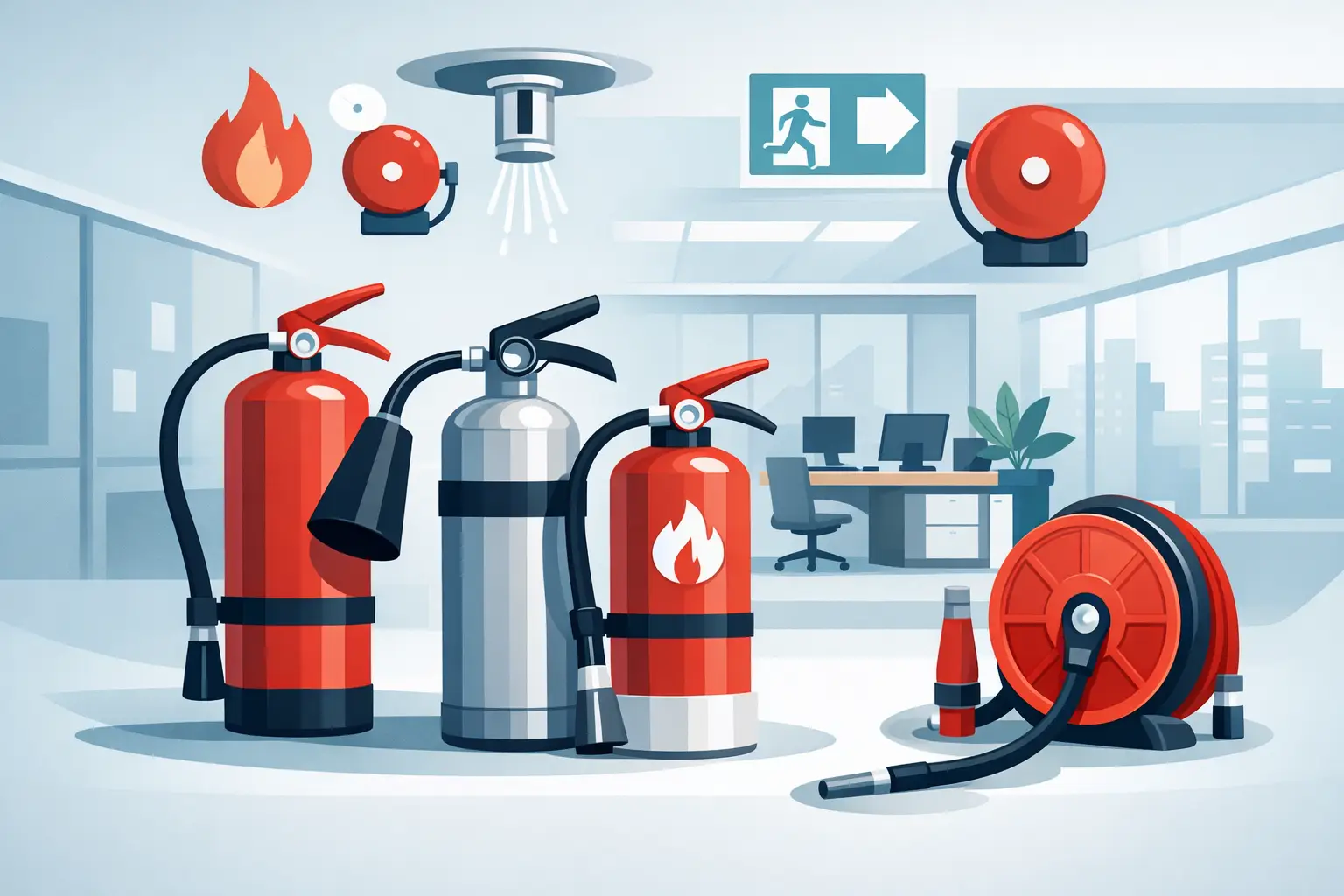
A small fire in an office rarely stays small for long. A bin fire beside a desk, an overheated appliance in a kitchen area, or an electrical fault in a comms room can disrupt operations within minutes. Choosing the best extinguishers for office buildings is not simply a purchasing decision. It is part of meeting your legal duties, protecting staff and visitors, and keeping your premises ready to respond when seconds matter.
For most office duty holders, the real challenge is not finding an extinguisher. It is selecting the right types, in the right quantities, for the actual risks on site. Too little cover creates obvious danger. Too much of the wrong equipment can be just as problematic, particularly where staff may hesitate or use the wrong extinguisher on the wrong fire.
What makes the best extinguishers for office buildings?
The best extinguishers for office buildings are the ones matched to the fire risks present, correctly sited, commissioned, and maintained in line with BS 5306. In a typical office, that usually means a combination rather than a single extinguisher type.
Offices are often seen as low-risk environments, but that can be misleading. They contain paper, furniture, soft furnishings, electrical equipment, kitchenettes, server cupboards and communal areas with varying ignition sources. A one-size-fits-all approach rarely gives the right level of protection.
In practical terms, most office buildings need cover for Class A fires involving combustible materials such as paper, wood and textiles. They also need appropriate provision for electrical risks, even though electricity itself is not a fire class. If there is a tea point or kitchen, there may also be a need to consider cooking oils and fats. The right answer depends on the layout and use of the building, not just the floor area.
The extinguisher types most offices should consider
Water extinguishers
Water extinguishers are often a strong choice for general office areas because they are effective on Class A fires. That makes them suitable for combustible materials commonly found in offices, including paper records, cardboard packaging, wooden furniture and fabric seating.
They are straightforward to identify and use, which matters in an emergency. However, they should not be used on live electrical equipment. In a modern office with printers, monitors, chargers and IT equipment almost everywhere, that limitation needs to be considered carefully when deciding where water units should be placed.
Water mist extinguishers
Water mist extinguishers can be a useful option in some office settings because they are versatile and leave less collateral damage than traditional water units. They can be suitable for several common workplace fire risks and are often valued where reducing clean-up and interruption is a priority.
That said, suitability depends on the specific unit and its ratings. Not every mist extinguisher is the same, and assumptions can create compliance problems. If you are considering them for a multi-room office, they need to be assessed properly rather than chosen for convenience.
Foam extinguishers
Foam extinguishers are often selected where Class A fires are a concern and there is also a possibility of flammable liquid fires. In a standard office this may be less common, but some premises have maintenance stores, cleaning products or small quantities of solvents that change the risk profile.
Foam can be effective, but it is not automatically the best default for every office floor. In many purely administrative spaces, water may be simpler and more appropriate. Foam choices should be driven by identified hazards, not by habit.
CO2 extinguishers
CO2 extinguishers are commonly provided in offices to address fires involving electrical equipment. They are particularly relevant near server rooms, photocopier areas, plant rooms and workstations with significant electrical load.
Their main advantage is that they do not leave residue, which helps limit damage to electronics and reduces downtime after discharge. The trade-off is that they are less effective on Class A fires and offer no cooling effect, so there is a risk of re-ignition. They also require confident handling, as the discharge horn becomes extremely cold during use. For that reason, CO2 is usually best used as part of a broader extinguisher strategy rather than in isolation.
Wet chemical extinguishers
Wet chemical extinguishers are mainly intended for cooking oil and fat fires. In many office buildings they are not needed at all. But if your premises includes a staff canteen, commercial-style kitchen, or any catering operation using deep fat fryers, they become highly relevant.
This is a good example of why extinguisher selection depends on the building’s actual use. A serviced office with a kettle and microwave has very different requirements from an office with a staffed kitchen producing hot food daily.
Matching extinguishers to office risks
A typical office floor with open-plan desks, meeting rooms and paper storage will usually require Class A cover, often supported by CO2 for electrical equipment. That is the baseline many businesses recognise.
Where buildings become more complex, the extinguisher plan needs to follow. Archive rooms, workshops attached to office premises, comms rooms, kitchenettes, reception areas and shared tenant spaces may all need different consideration. The best extinguishers for office buildings are therefore not defined by brand or price first. They are defined by suitability.
This is also where duty holders can get caught out. Buying extinguishers online and placing them where they seem sensible may leave gaps in coverage or create conflicts with recognised siting guidance. Equipment should support your fire risk assessment, not sit outside it.
Why siting matters as much as extinguisher type
Even the correct extinguisher is of limited value if it cannot be reached quickly. Extinguishers should be positioned where people can access them without moving towards the fire, and where they are visible enough to be identified under pressure.
In office buildings, that often means placing units on escape routes, near exits, at storey entrances and close to identified hazards. Travel distance matters. So does consistency across the building, especially where multiple floors or tenants are involved.
Poor siting creates practical and legal problems. An extinguisher tucked behind a coat stand or stored in a locked cupboard may as well not be there. During inspection, these issues are easy to spot. During a real incident, they can have serious consequences.
Compliance is not just about having extinguishers on the wall
Under UK fire safety law, duty holders must provide appropriate firefighting equipment where necessary. In offices, that expectation is closely linked to the findings of the fire risk assessment and the standards for selection, installation, inspection and maintenance.
BS 5306 is central here. It informs the provision and ongoing care of portable fire extinguishers, including commissioning and annual servicing. A missing service label, a discharged unit, incorrect pressure, physical damage or poor placement can all undermine compliance and emergency readiness.
This matters beyond enforcement. If an extinguisher fails in use, or if equipment was clearly unsuitable for the risks present, the consequences may affect not only life safety but also business continuity and insurer scrutiny after a fire.
Maintenance decides whether your extinguishers are actually ready
Many businesses focus on what to buy and give less attention to what happens afterwards. That is a mistake. Extinguishers are not fit-and-forget items. They need routine checks on site and formal servicing by a competent provider.
In office environments, units can be knocked, obstructed, tampered with or quietly discharged. Changes in layout can also leave them in the wrong place. Refurbishments, desk moves and altered room use should all trigger a review of extinguisher provision.
This is where a specialist maintenance relationship adds value. A proper service does more than tick a compliance box. It helps confirm that the equipment still matches the building as it is being used today. For businesses across Glasgow and the wider Scottish market, that practical approach is often the difference between nominal compliance and genuine readiness.
Common mistakes when choosing office extinguishers
One common mistake is over-relying on CO2 because electrical equipment is everywhere. Another is placing water extinguishers without thinking through nearby electrical hazards or staff confidence in using them. A third is assuming a small kitchen area does not need separate consideration.
There is also a tendency to standardise every floor in exactly the same way. That sounds efficient, but it can overlook local risks. A records room, a kitchen and a comms cupboard should not always be treated as interchangeable spaces.
Price-led buying can cause problems too. Lower-cost units may still have a place if properly specified and maintained, but buying on price alone often leads to poor siting, inconsistent stock, missing commissioning and weak servicing records.
So what is the best setup for most office buildings?
For many office buildings, a sensible arrangement includes water-based extinguishers for general Class A risks and CO2 extinguishers for electrical equipment. If there is a commercial kitchen or deep fat frying, wet chemical provision should be considered. Beyond that, the right setup depends on your fire risk assessment, layout, occupancy and any specialist hazards.
The safest approach is to treat extinguisher provision as part of the building’s wider fire protection strategy rather than an isolated purchase. Selection, siting, commissioning and maintenance all need to work together.
If you are responsible for an office building, the right question is not simply which extinguisher is best. It is whether your current provision is appropriate, compliant and ready to use if a fire starts this afternoon. That is the standard worth working to.
Leave a Reply