

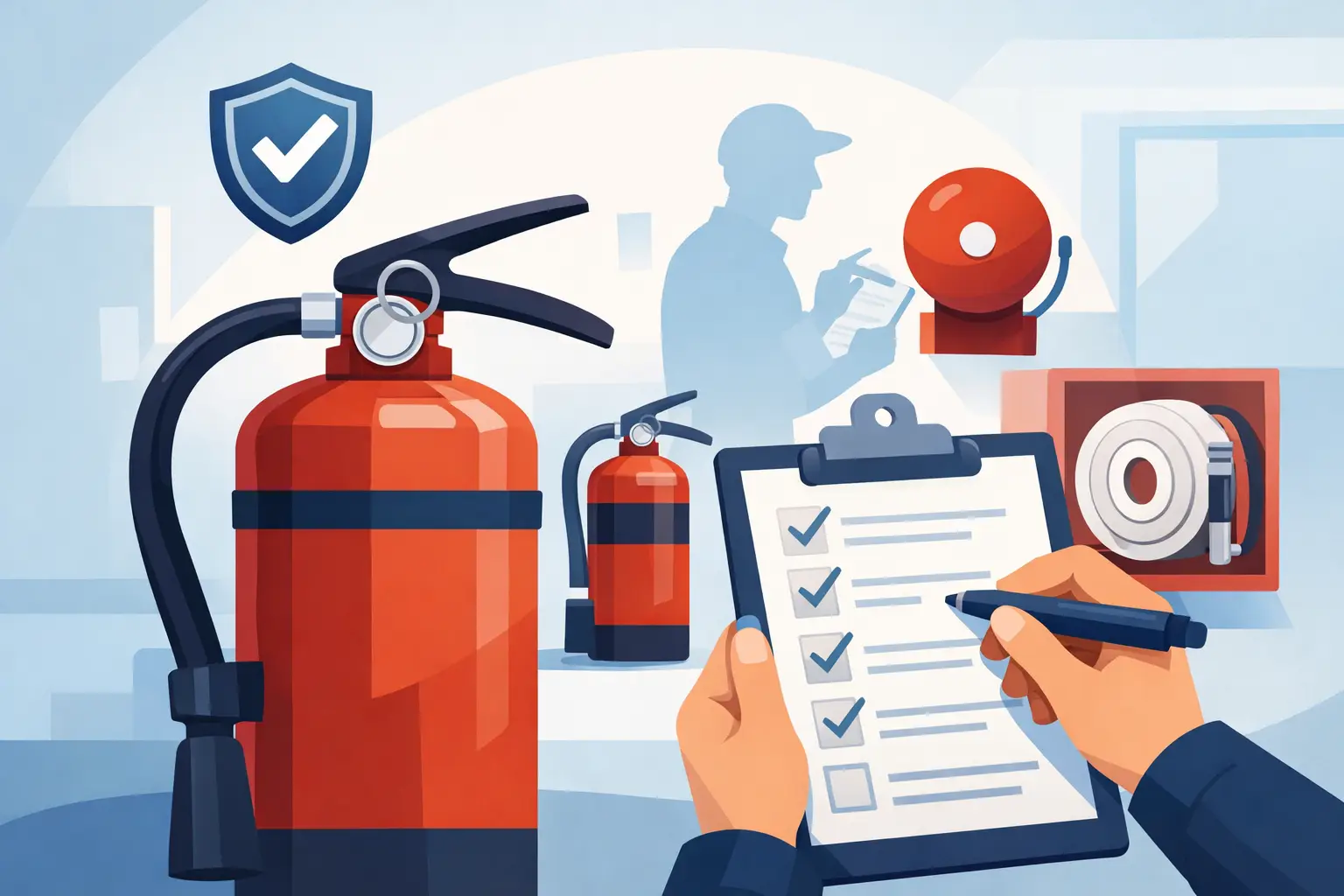
A fire extinguisher can sit on the wall for years without drawing much attention – right up until the moment someone needs it. When that happens, there is no room for missing pins, low pressure, damaged hoses or outdated service records. An annual extinguisher inspection checklist gives duty holders a clear way to confirm that each unit is compliant, in the right place and ready to perform in an emergency.
For workplaces in Glasgow and across Scotland, this is not simply good housekeeping. Fire extinguishers form part of your wider fire safety arrangements, and their maintenance needs to meet recognised standards such as BS 5306. If an extinguisher is faulty, inaccessible or unsuitable for the risk it is meant to cover, the problem may only become obvious after a fire starts. By then, the cost is measured in injury, disruption and damage.
What an annual extinguisher inspection should achieve
An annual inspection is not a quick glance to see whether the extinguisher is still hanging in place. It is a formal maintenance check designed to confirm that the unit is serviceable, correctly sited and appropriate for the fire risks present in the building.
That distinction matters. Many businesses carry out basic monthly visual checks in-house, which is sensible and often recommended. Those routine checks help identify obvious issues such as obstruction, tampering or accidental damage. The annual inspection goes further. It provides a deeper review of condition, pressure, labelling, fittings and service history, and it should be completed by a competent person.
For a business owner, landlord or facilities manager, the practical aim is straightforward. You need confidence that extinguishers will work when needed and that your records show reasonable steps have been taken to keep them maintained.
Annual extinguisher inspection checklist for workplaces
A useful annual extinguisher inspection checklist should cover more than the extinguisher body itself. It should look at the unit, its location, its identification and its servicing status as part of one compliance-led process.
1. Confirm the extinguisher is in the correct location
The inspection should begin by checking that the extinguisher is where it is meant to be, mounted or positioned correctly, and easy to access. If furniture, stock, display units or equipment block it, response time is lost immediately. In a real incident, seconds matter.
The type and location should also still match the fire risk. Offices, kitchens, workshops, plant rooms and mixed-use premises do not all require the same extinguisher provision. If the layout or use of the building has changed since the last service, the original siting may no longer be appropriate.
2. Check the identification signage and operating instructions
Each extinguisher should be clearly identifiable, with the correct sign in place and legible instructions on the body of the unit. In an emergency, staff should not need to guess what the extinguisher is for or how it operates.
If labels are worn, peeling or unreadable, the extinguisher may still be physically present but not fully fit for purpose. This is especially relevant where different extinguisher media are installed close together, such as CO2 and foam units serving different risks.
3. Inspect the body for damage, corrosion or leakage
The cylinder should be examined for dents, gouges, rust, chemical residue or any sign that the extinguisher has been compromised. Surface marks are not always serious, but corrosion around the base, neck or fittings can be a warning sign.
Leakage, swelling or impact damage should never be ignored. A damaged extinguisher may fail to discharge properly, or it may become unsafe to keep in service. The right response depends on the type of damage and the age of the unit, which is why competent assessment is essential.
4. Check the pressure indicator where fitted
Many stored-pressure extinguishers have a gauge that shows whether the internal pressure sits within the serviceable range. If the needle is outside the correct zone, the extinguisher may not discharge as intended.
This is one of the simplest checks on the list, but it should not be treated as proof that everything is fine. A normal gauge reading does not rule out other faults such as internal deterioration, blocked components or mechanical damage.
5. Examine the hose, horn and fittings
Hoses, nozzles and discharge horns should be intact, secure and free from cracks, blockages or splits. CO2 extinguishers in particular require careful attention to the horn and fitting assembly, as these parts are critical to safe operation.
Loose, damaged or missing components can make an extinguisher ineffective even if the cylinder itself appears sound. If the hose has perished or the horn has been damaged, replacement or further action may be required before the unit can remain in service.
6. Inspect the tamper seal and safety pin
The safety pin should be in place and the tamper indicator intact. If the seal is missing, it does not always mean the extinguisher has been discharged, but it does suggest that it may have been interfered with or partially used.
That creates uncertainty, and uncertainty is a problem in fire safety. If there is any doubt about whether a unit has been operated, it should be assessed properly rather than left on the wall on the assumption that it is still ready.
7. Review service labels and maintenance records
A compliant inspection is not complete without checking the service label and confirming when the extinguisher was last maintained. The record should show the date of service and provide a clear maintenance trail.
This paperwork matters for more than administration. If there is a fire, insurers, enforcing authorities and internal stakeholders may all want evidence that extinguishers were being maintained appropriately. Missing or inconsistent records can raise difficult questions very quickly.
8. Confirm the extinguisher is still within its service life
Some extinguishers require extended servicing or discharge testing at set intervals, depending on type and age. Others may be approaching the end of their usable life and need replacement rather than another routine service.
This is where a checklist needs judgement, not just box-ticking. Keeping an old unit in place because it looks acceptable can be a false economy. Replacement is sometimes the safer and more compliant option.
Why annual checks are not enough on their own
An annual extinguisher inspection checklist is essential, but it should sit alongside regular in-house visual checks. Between annual visits, extinguishers can be knocked, moved, discharged, blocked by stock or exposed to weather and contaminants.
A warehouse, commercial kitchen or busy communal building may face more wear than a small office. That means frequency of informal checks can depend on the environment. High-traffic or higher-risk premises usually need closer attention. The legal duty does not disappear simply because the last annual service was completed six months ago.
Common issues found during annual inspections
In practice, the same faults appear again and again. Extinguishers are often found behind doors or furniture, with faded labels, missing pins, damaged bases or pressure readings outside the normal range. In some sites, the bigger problem is suitability rather than condition. The extinguisher may be in working order but not right for the actual fire risk in that area.
Another frequent issue is change without review. A room that was once general storage becomes an electrical equipment area. A canteen adds cooking appliances. A workshop starts storing flammable liquids. If extinguisher provision has not kept pace with those changes, the site may no longer be adequately protected.
Who should carry out the annual inspection?
For workplace compliance, the annual inspection should be completed by a competent extinguisher service technician. Staff can and should report visible problems, but formal maintenance requires the right training, knowledge and record-keeping.
That is particularly important where defects are not obvious or where decisions are needed on extended servicing, replacement or siting changes. A poor-quality inspection may create false reassurance, which is one of the most dangerous outcomes in fire safety management.
For businesses that want a clear maintenance process without uncertainty, EXSERVICE supports employers and duty holders with annual extinguisher maintenance that focuses on compliance, operational readiness and documented servicing records.
Making the checklist part of wider fire safety management
The best annual extinguisher inspection checklist is the one that becomes part of routine site management rather than a once-a-year scramble. It should tie into your fire risk assessment, staff awareness, equipment register and maintenance records.
That approach protects more than compliance. It reduces the chance of equipment failure, supports insurer expectations and helps limit disruption if a fire occurs. It also makes life easier for the person responsible for the building, because issues are spotted early instead of being discovered during an audit or after an incident.
If you are responsible for workplace fire safety, treat extinguisher inspections as a live operational duty rather than a paper exercise. A well-maintained extinguisher may never be needed, but if the day comes, it needs to work without hesitation.
Leave a Reply