

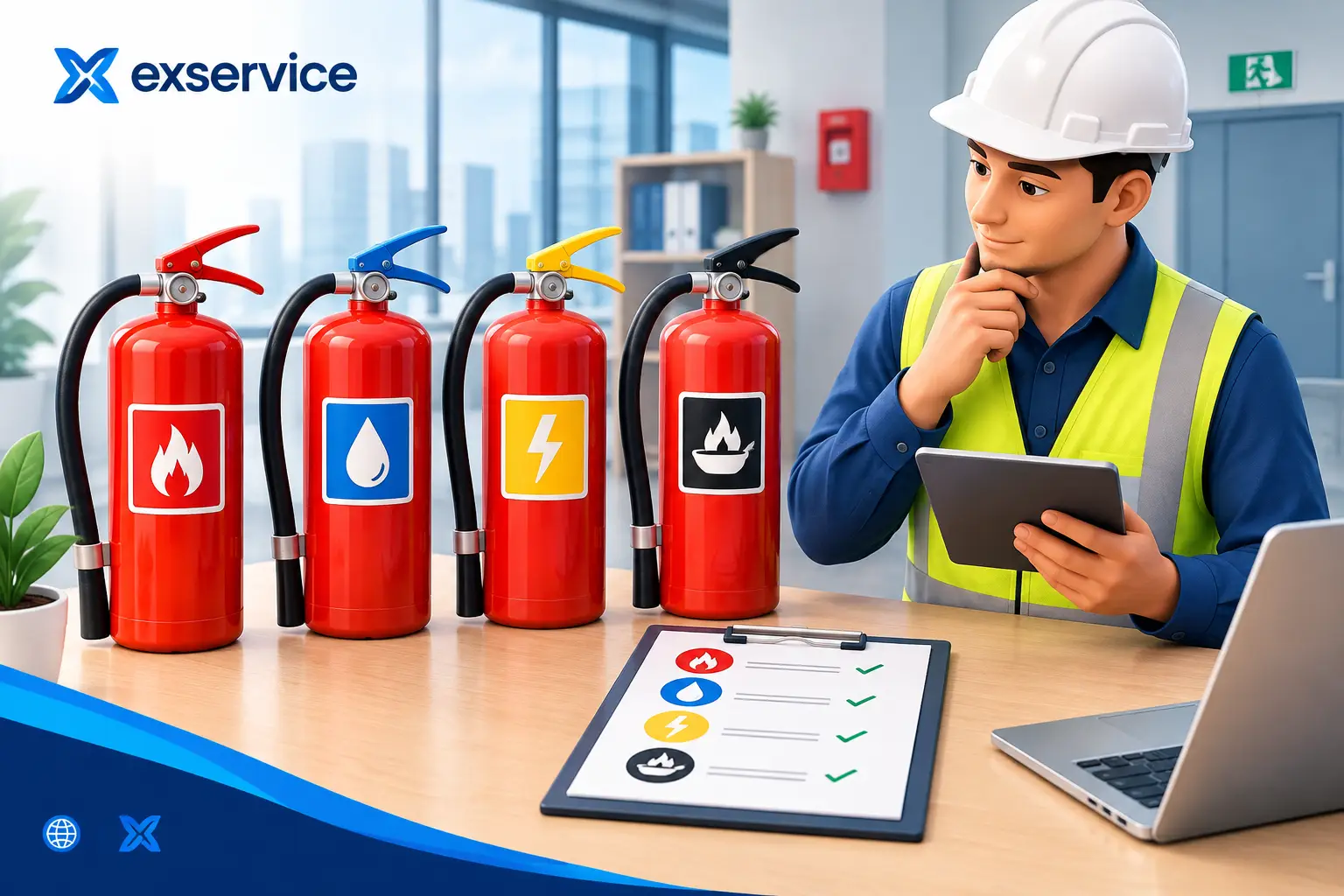
A fire extinguisher can look reassuring on a wall while being entirely wrong for the fire risk in front of it. A small office with mainly paper and furniture needs different cover from a vehicle workshop, commercial kitchen or premises storing flammable liquids. To select workplace extinguisher ratings properly, duty holders need to look beyond the extinguisher’s colour band and capacity. The rating, fire class, extinguishing medium and location must all match the hazards identified in the fire risk assessment.
Getting this right protects people first, but it also protects business continuity. The wrong extinguisher can allow a manageable fire to grow, create additional danger for staff, or leave a business unable to demonstrate that suitable equipment was provided and maintained.
What extinguisher ratings actually mean
Fire extinguisher ratings show the size and type of fire that an extinguisher has been tested to tackle. They are not simply a measure of the cylinder’s weight or litres of contents. A 6-litre extinguisher and a 9-litre extinguisher may have different ratings, depending on the agent inside and the test performance achieved.
For ordinary combustible materials such as wood, paper, textiles and many plastics, look for a Class A rating. This is usually shown as a number followed by A, such as 13A or 21A. The higher the number, the larger the test fire the extinguisher has been proven to extinguish. In many workplaces, Class A cover forms the foundation of the provision because these are the materials found in offices, shops, communal areas and general storage spaces.
Class B ratings apply to flammable liquids, including petrol, solvents, paints and certain oils. These are displayed as a number followed by B, such as 55B, 89B or 144B. A workshop, maintenance area or stockroom handling solvents may require suitable Class B provision in addition to general Class A cover.
The rating matters, but it is only one part of the decision. An extinguisher with a high rating is not automatically the best choice if it is too heavy for likely users, unsuitable for the hazard, or placed where people cannot reach it safely.
Start with the fire risk assessment
The correct extinguisher provision should follow the premises’ fire risk assessment, not a generic shopping list. In Scotland, responsible persons must take appropriate fire safety measures for their premises. Suitable firefighting equipment is one of those measures, alongside escape routes, alarm arrangements, staff information and emergency procedures.
A practical assessment considers what could burn, how a fire might start, who is at risk and whether trained staff could safely tackle an early-stage fire. It should identify hazards such as combustible stock, electrical equipment, cooking oils, charging areas, plant rooms and flammable substances.
For example, a small office may need mainly Class A coverage, with an extinguisher suitable around electrical equipment where appropriate. A joinery workshop may need more substantial Class A provision because of timber, dust and packaging, while also requiring separate consideration for machinery, electrical panels and flammable finishes. A short-term let or communal area has different risks again, particularly where residents or visitors may not be trained to use equipment.
This is why extinguisher selection is never just about buying the biggest cylinder. More equipment is not necessarily safer if it confuses users, blocks escape routes or is poorly matched to the risk.
Match the extinguisher to the fire class
Different extinguishing agents are designed for different hazards. The following are common workplace considerations:
- Water and water-based extinguishers are generally effective for Class A fires involving paper, wood and textiles. They are commonly suitable in offices, retail premises and similar low-risk areas, but they must not be used on live electrical equipment or burning flammable liquids unless specifically certified for that use.
- Foam extinguishers can provide Class A and Class B performance, making them useful where ordinary combustibles and flammable liquids are both present. Their suitability depends on the exact product, the liquid hazard and the environment.
- Carbon dioxide (CO2) extinguishers are commonly provided for electrical equipment and certain Class B risks. They leave no residue, which can make them suitable near servers, switchgear and office equipment. However, CO2 has limited cooling effect, so fires involving solid materials can reignite if the source is not controlled.
- Wet chemical extinguishers are designed for cooking oil and fat fires, known as Class F fires. Commercial kitchens require specific consideration because using water on burning cooking oil can cause a violent fire spread.
- Powder extinguishers can achieve high fire ratings and may suit some industrial or external applications. Inside occupied workplaces, they are often less suitable because the powder reduces visibility, contaminates equipment and can create respiratory irritation. Their use should be justified by the risk assessment.
Electrical equipment is often misunderstood. Electricity is not itself a fire class. The question is whether the extinguisher is safe and effective to use around energised equipment. Once isolated, the underlying fuel may be a Class A or Class B fire and should be dealt with accordingly.
How to select workplace extinguisher ratings under BS 5306
BS 5306 provides the recognised framework for selecting, installing, commissioning and maintaining portable fire extinguishers. It helps ensure that equipment is not chosen in isolation, but as part of a considered fire safety arrangement.
For Class A risks, a common starting point is to calculate the floor area and assess the minimum required fire rating. In general terms, BS 5306-8 uses a benchmark of 13A of Class A rating for every 200 square metres of floor area, with a minimum provision of two Class A-rated extinguishers on each floor. However, this is a baseline, not a substitute for professional judgement.
A premises with a higher fire loading, long travel distances, multiple separated rooms or significant combustible storage may need more than the minimum. Conversely, a small area with unusual hazards may need specialist extinguishers rather than simply additional water-based units.
Class B provision is assessed according to the quantity and nature of flammable liquid present. The appropriate rating needs to reflect the credible size of a spill fire, where the liquid is stored or used, and whether staff can safely intervene. A single small container used occasionally creates a different requirement from a workshop with regular solvent handling or a plant area with fuel supplies.
Extinguishers should also be positioned so that users do not have to travel excessive distances to reach them. Equipment must be visible, accessible and located on escape routes or at points where it can be collected without moving towards the fire. An extinguisher hidden in a locked cupboard or behind stored stock offers little practical protection.
Do not overlook the people expected to use them
Even a correctly rated extinguisher has limits. Staff should only tackle a fire if it is small, they have been trained, they have a clear escape route behind them and doing so does not put them at risk. The priority is always to raise the alarm, get people out and call the fire and rescue service.
This matters particularly in premises with lone workers, members of the public, sleeping accommodation or people unfamiliar with the building. In those settings, the safest approach may place greater emphasis on early warning, evacuation and containment rather than expecting occupants to fight a fire.
Training should cover the types of extinguisher on site, the hazards they are intended for and the circumstances in which staff must not attempt to use them. It should be reinforced when workplace layouts, processes or staff responsibilities change.
Commissioning, servicing and records are part of compliance
Selection is only the beginning. Extinguishers must be commissioned when installed, maintained at suitable intervals and checked routinely for damage, obstruction, missing signage or loss of pressure. A unit can be correctly rated on paper but fail when needed if it has not been serviced or has reached the end of its working life.
Documented servicing records are valuable evidence for fire safety management, inspections and insurer queries. They also help duty holders identify units that need replacement before a fault becomes an emergency problem. Annual maintenance by a competent technician is a central part of keeping provision aligned with BS 5306 expectations.
For businesses in Glasgow and across the central belt, EXSERVICE can assess existing provision, supply suitable equipment and maintain clear servicing records. This can be particularly useful where premises have grown over time and extinguishers have been added without a clear review of their ratings or suitability.
The right rating is not a label to tick off once. It is a practical decision based on the fire risks in your building, the people using it and the equipment that must work without hesitation when every second matters.
Leave a Reply