

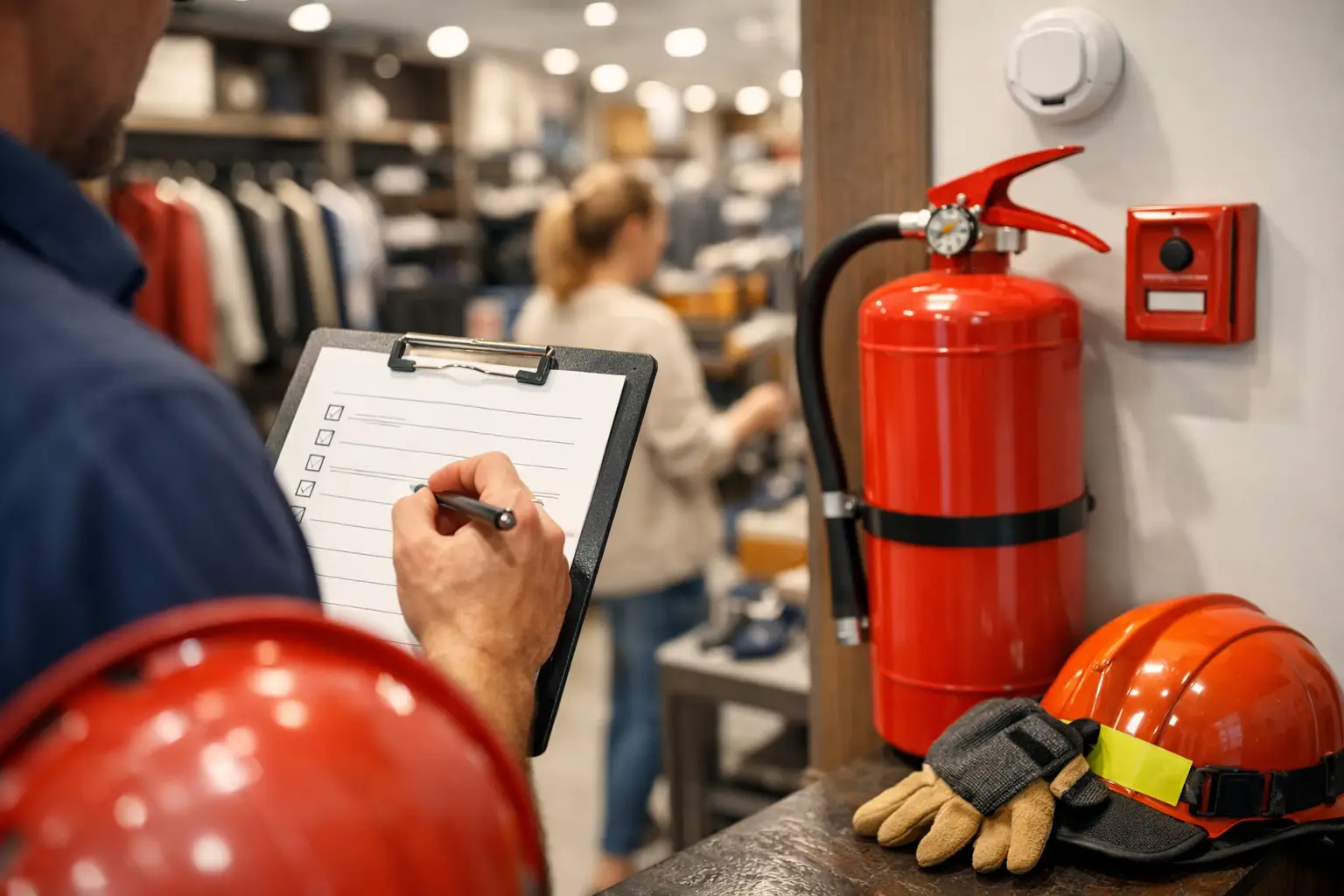
A faulty till cable tucked behind a counter, cardboard stored by the rear exit, and a staff member propping open a fire door during a delivery – that is exactly how a routine day in a shop can turn into a serious risk. A retail fire risk assessment example is useful because it turns legal duty into something practical. It shows what a competent assessment looks at, what findings might be recorded, and what action a duty holder should take.
For shops, boutiques, convenience stores, showrooms and other customer-facing premises, fire risk is rarely about one dramatic hazard. More often, it comes from ordinary retail conditions – electrical equipment in constant use, display stock, packaging waste, seasonal pressure, and members of the public who do not know the layout of the building. The assessment needs to reflect the real premises, the way the business operates, and the people using it.
What a retail fire risk assessment example should cover
A suitable assessment is not a box-ticking exercise. It should identify fire hazards, people at risk, existing fire precautions, and any further action required to reduce risk to an acceptable level. In Scotland, duty holders must be able to show they have considered their premises properly and acted on the findings.
In a retail setting, that usually means looking at ignition sources such as lighting, electrical installations, portable heaters, faulty appliances and, where relevant, hot works from contractors. It also means identifying fuel sources such as clothing, paper bags, stock packaging, shelving, waste materials and display contents. Oxygen is generally present as part of the normal environment, but ventilation systems or stored oxidising products can affect how a fire develops.
The assessment should also account for the people who may be exposed. This includes staff, customers, cleaners, contractors, delivery drivers and anyone who may need extra assistance to evacuate, such as elderly customers or people with mobility impairments. A small shop with one exit presents different issues from a large retail unit with a stockroom, staff area and multiple escape routes.
Retail fire risk assessment example for a typical shop
Consider a ground-floor retail unit on a busy high street. The premises sell clothing and accessories, with a sales area open to the public, a small stockroom at the rear, one staff kitchenette, one WC, and a final exit leading to the street at the front plus a staff exit at the rear. There are six members of staff, with two to four usually on site at one time.
The construction is standard commercial shopfront at ground level within a larger mixed-use building. The shop has mains lighting, emergency lighting, a manual fire alarm call point arrangement with sounders, portable fire extinguishers, and fire exit signage. Electrical stock systems, a till point, display lighting and a small number of portable chargers are used daily.
In this retail fire risk assessment example, the main ignition hazards identified are overloaded sockets behind the till, poor cable management around display lighting, and a domestic kettle used in the staff area with no clear checks in place. The stockroom also contains a battery charging point for handheld devices, which increases the need for good housekeeping and visual inspection of equipment.
The main fuel hazards are clothing stock, cardboard boxes, plastic wrapping, waste packaging awaiting disposal, and combustible display materials. In many shops, the stock itself is the dominant fire load. That matters because even if the chance of ignition is moderate rather than high, the consequences of fire spread can be severe.
People at risk include staff working in the rear stockroom, lone workers opening or closing the premises, customers unfamiliar with the exits, and any person needing assistance during an evacuation. If the shop is busiest at weekends or during seasonal trading, the assessment should reflect that. Fire safety arrangements that work during quiet hours may be less effective when the shop floor is crowded.
Example findings and what they mean
The front exit is clearly visible from most of the sales floor, which is a positive feature. The rear exit, however, is partially restricted by temporary stock storage during deliveries. That does not always mean the exit is fully blocked, but it is still a concern. Escape routes must remain usable at all times, not only after staff have finished unpacking.
The fire door between the stockroom and sales area is in place, but staff have a habit of wedging it open for convenience. This is a common retail issue. A fire door only protects the route and slows fire spread when it is closed properly. If it is being held open without a suitable automatic release linked to the alarm, the control measure is failing in practice.
Portable extinguishers are present, including water and CO2 units, but one extinguisher near the rear exit is partly hidden by stored boxes. This reduces accessibility. An extinguisher that cannot be reached quickly is of limited value in the early stages of a fire.
Emergency lighting is fitted, but monthly function checks are not being documented. That creates a compliance gap. If a power failure occurs during an incident and the emergency lighting does not operate as expected, the business may struggle to show it took reasonable steps to maintain the system.
The fire alarm can be heard on the shop floor, but audibility in the stockroom is weaker when the door is shut. That may require testing and possibly improvement. It depends on the actual sound levels and layout, but any area where staff could miss the alarm needs attention.
Staff have received basic induction training, yet there is no clear record of refresher instruction, no nominated sweep procedure, and no clear arrangement for assisting a customer who may not evacuate quickly. Training is often where otherwise decent fire precautions fall down. Equipment can be present and still be ineffective if staff are unsure what to do.
Recommended actions from the example assessment
The first priority would be housekeeping and route management. Stock and packaging should be kept clear of the rear exit and escape path at all times, with deliveries managed so that temporary storage does not compromise evacuation. This is simple to correct, but only if someone is clearly responsible for enforcing it.
The second priority would be electrical safety. The overloaded socket arrangement behind the till should be reviewed, unnecessary adaptors removed, and equipment use checked against safe capacity. Cables should be secured and kept away from combustible display materials. In retail premises, poor cable management is often treated as untidy rather than dangerous, but it can be both.
The fire door issue needs immediate control. Staff should be instructed not to wedge the door open, and management should monitor compliance. If the door genuinely needs to stay open for operational reasons, a proper fire door retainer linked to the alarm may be appropriate, but that depends on the building layout and system design.
Extinguishers should be correctly sited, visible and maintained in line with the relevant standards. The right extinguisher in the wrong location is not a reliable control measure. Regular servicing and clear access matter just as much as type and size.
Testing and record keeping should also be tightened. That includes alarm tests, emergency lighting checks, staff fire drills where appropriate, and servicing documentation. For many businesses, records are what prove the fire safety arrangements are active rather than assumed.
Why examples help, but cannot replace a real assessment
A retail fire risk assessment example is useful for understanding the process, but it should never be copied across to another premises. Two shops selling similar products can have very different risk profiles. One may be a small single-unit shop with a simple front exit, while another may sit within a larger building with shared escape routes, higher occupancy and more complex responsibilities.
The age and condition of the premises also matter. Older properties may have compartmentation issues, hidden voids or service penetrations that affect fire spread. Newer premises may have better fire protection features, but they still need competent review and proper maintenance.
There is also a judgement element. Some issues are straightforward, such as blocked exits or missing signage. Others depend on the wider picture. A stockroom with a moderate fire load may be acceptable if separation, detection and housekeeping are all good. The same stockroom becomes a serious concern if the fire door is compromised and waste is allowed to build up.
Common mistakes in retail fire assessments
One common mistake is treating the shop floor as the only meaningful area. In reality, stockrooms, staff rooms and service corridors often present the greater fire risk. Another is assuming that because extinguishers are on the wall, the premises are adequately protected. Fire safety is about the full arrangement – prevention, warning, escape, maintenance and staff response.
It is also common to underestimate how quickly retail conditions change. Seasonal stock, promotional displays, Christmas trading, sale rails and temporary layouts can all affect escape routes and fire loading. An assessment should reflect normal trading conditions, but it also needs review when the way the premises is used changes significantly.
For duty holders who want a clear, defensible standard, a specialist assessor can identify the practical gaps that are easy to miss internally. That is particularly valuable where there are shared buildings, mixed use premises, or ongoing questions about extinguisher siting, maintenance records and legal compliance.
A good assessment does more than satisfy paperwork. It helps protect staff, customers, stock, premises and trading continuity. If your retail unit had to be evacuated this afternoon, the question is simple – would your current arrangements work as intended, or only look acceptable on paper?
Leave a Reply