

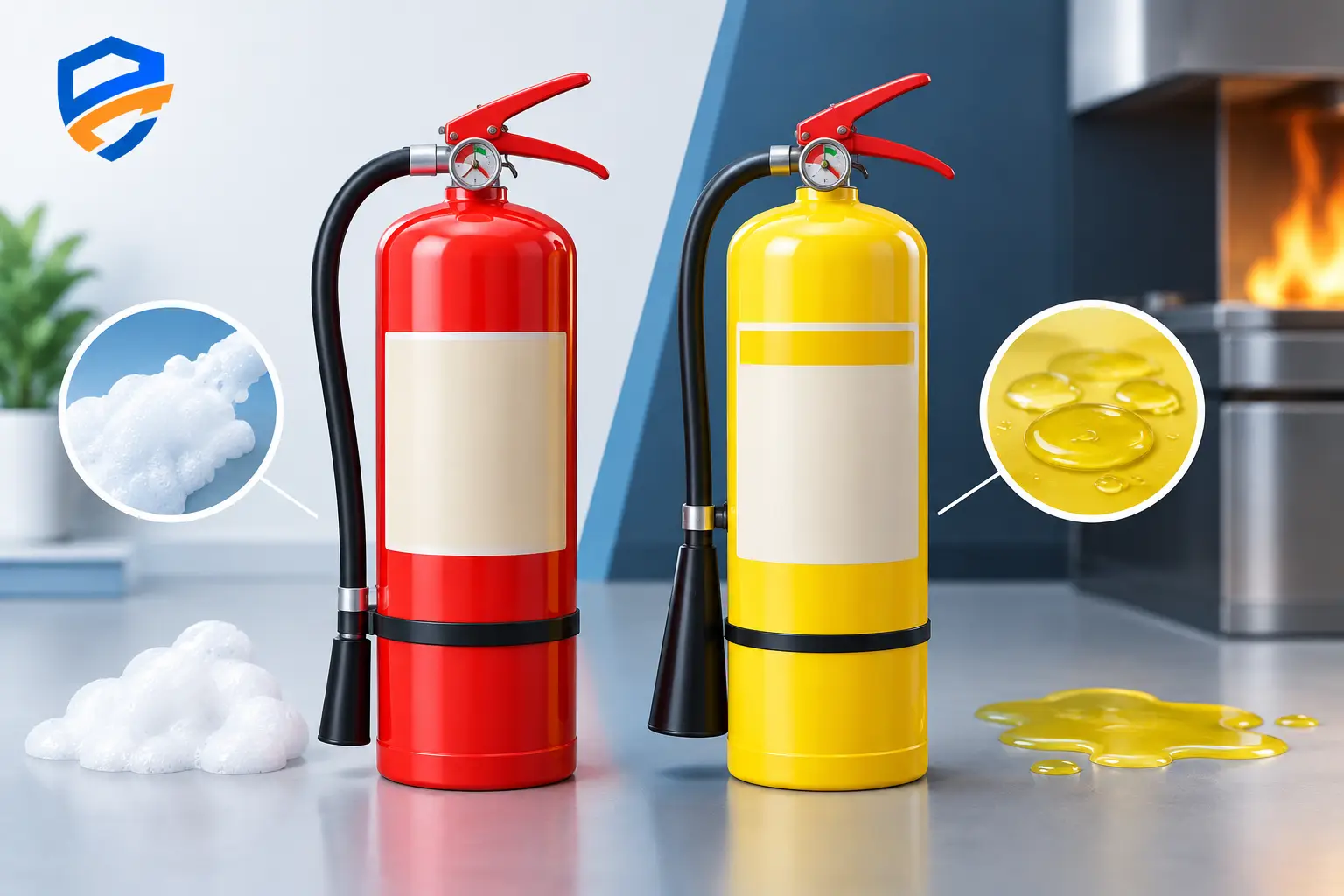
A fire in a staff kitchen is not the same emergency as a fire involving packaging, furniture or flammable liquids in a workshop. Choosing the wrong extinguisher can put people at greater risk and allow a manageable incident to escalate. Foam versus wet chemical extinguishers is therefore not a question of which type is better overall. It is a question of which type is suitable for the specific fire risks identified in your premises.
For duty holders, the decision should follow the fire risk assessment, the activities carried out on site and the equipment already provided. Extinguishers must be correctly selected, positioned, maintained and clearly available for use. A unit that is unsuitable for the risk, or placed too far from it, may offer little practical protection when seconds matter.
What foam extinguishers are designed to tackle
Foam extinguishers are commonly provided for Class A and Class B fire risks. Class A covers combustible solid materials such as paper, wood, textiles and furnishings. Class B covers flammable liquids, including some fuels, paints, solvents and oils used in commercial processes.
When used on a liquid fire, foam forms a blanket over the surface. This suppresses flammable vapours and helps prevent oxygen reaching the fuel. It also has a cooling effect. That makes foam a useful choice where a premises has a mixed risk from ordinary combustibles and contained flammable liquids.
Typical examples include offices with paper and furnishings, retail premises, workshops, small warehouses and maintenance areas. A foam extinguisher may be appropriate where there are modest quantities of flammable liquids, but its suitability always depends on how those liquids are stored, handled and used. A high-risk industrial process may require a more specialised fire suppression arrangement.
In the UK, foam extinguishers are usually identified by a cream colour band. They should not be selected simply because they appear to cover more fire classes than another extinguisher. The label, fire rating and site-specific risk assessment matter more than the colour band alone.
Important limits of foam extinguishers
Foam is not the right first-response extinguisher for every fire. It must not be used on cooking oil or fat fires. Applying an unsuitable extinguisher to a burning deep-fat fryer can spread the burning oil and cause severe injury.
Nor should a standard foam extinguisher be treated as a safe option for live electrical equipment. Some extinguishers may be tested for use at a stated distance from low-voltage electrical equipment, but that does not make them an electrical-fire extinguisher. Where electrical equipment presents a foreseeable risk, the extinguisher provision should be based on the equipment and the environment, often alongside carbon dioxide or other appropriate measures.
Environmental considerations are also relevant. Some foam concentrates have historically contained fluorinated substances, and requirements around these products are changing. When replacing end-of-life foam units, businesses should seek competent advice on the most suitable compliant alternative rather than assuming like-for-like replacement is always the best route.
What wet chemical extinguishers are designed to tackle
Wet chemical extinguishers are purpose-designed for Class F fires involving cooking oils and fats. They are the essential specialist extinguisher where commercial cooking creates a foreseeable risk from deep-fat fryers, griddles, woks or similar appliances using hot oil.
The extinguisher discharges a fine chemical mist that cools the oil and reacts with it to create a soapy layer over the surface. This process, known as saponification, helps seal the fuel from oxygen and reduces the likelihood of reignition. The long lance fitted to many wet chemical units allows the operator to apply the agent carefully from a safer distance.
This is why a wet chemical extinguisher belongs in a properly assessed commercial kitchen, not simply anywhere food is prepared. A staff tea point with a microwave and kettle does not normally present the same Class F risk as a restaurant fryer line. Equally, a café, pub, takeaway, hotel kitchen or workplace canteen may need wet chemical provision even if the cooking area is relatively compact.
Wet chemical extinguishers are usually identified by a yellow colour band. They may carry a Class A rating too, but this does not mean they should replace the general-purpose extinguishers needed throughout a building. Their primary function is controlling cooking oil and fat fires at the point where that risk exists.
Wet chemical extinguishers need the right kitchen controls
An extinguisher is only one part of kitchen fire safety. Extract systems, cooking appliances, cleaning procedures, staff training, emergency shut-offs and evacuation arrangements all affect the outcome of a fire. In larger or higher-risk kitchens, a fixed suppression system may be necessary in addition to portable extinguishers.
The wet chemical unit must be accessible without requiring someone to reach through flames or stand directly beside the fryer. It should be sited near the kitchen exit or on the escape route, subject to the layout and findings of the fire risk assessment. Staff must know that they should only attempt firefighting if it is safe to do so, they have been trained and they have a clear escape route behind them.
Foam versus wet chemical extinguishers: the practical difference
The key distinction is the fuel involved. Foam is generally selected for ordinary combustibles and flammable liquids. Wet chemical is selected for cooking oils and fats. Neither is a substitute for the other where both risk types exist.
A restaurant, for example, may need wet chemical extinguishers in the kitchen, while requiring other extinguisher types in customer areas, stores, offices and plant rooms. A vehicle workshop may need foam or an alternative suitable extinguisher for combustible materials and flammable-liquid risks, but would have no reason to install wet chemical units unless commercial cooking equipment is also present.
For landlords and short-term let operators, the same principle applies. A standard domestic-style kitchen does not automatically require a wet chemical extinguisher. However, the risk assessment must consider the property’s layout, occupants, cooking arrangements, management controls and the potential for misuse. Fire safety measures in rental accommodation should never be copied from a commercial kitchen without a clear risk-based reason.
It is also worth remembering that portable extinguishers are intended for small, early-stage fires. They do not remove the need for alarm systems, escape routes, staff instruction or suitable housekeeping. If fire or smoke is already spreading, evacuation and calling the fire and rescue service take priority.
Selection and maintenance are compliance issues
Under Scottish fire safety legislation, duty holders must take reasonable measures to reduce fire risk and protect relevant persons. The fire risk assessment provides the foundation for deciding whether extinguishers are needed, what type is appropriate and where they should be installed.
For workplaces, extinguisher selection and siting should follow the principles of BS 5306-8. Ongoing maintenance should be carried out in line with BS 5306-3, with documented servicing records retained. These records demonstrate that equipment has been inspected and remains ready for use. They can also be important when responding to an insurer, investigating an incident or demonstrating that fire safety duties have been managed properly.
Annual servicing is not a box-ticking exercise. A competent technician checks for damage, corrosion, pressure loss, missing components, failed tamper seals, expired units and changes to the risks in the premises. Extinguishers can be present on a wall yet still be unsuitable, inaccessible or no longer serviceable.
Changes in how a building is used should also trigger a review. Adding a fryer, converting a store room into a workshop, introducing flammable cleaning products or changing the kitchen layout can alter the extinguisher provision required. EXSERVICE helps Glasgow and central Scotland businesses assess these practical changes, maintain records and keep firefighting equipment ready to use.
The right choice starts with the risk, not the extinguisher
Do not choose foam because it seems more versatile, and do not fit wet chemical simply because there is a kitchen on site. Identify the materials that could burn, the people who may be affected, the likely fire location and whether trained staff could safely intervene. Then provide suitable extinguishers at the right points, supported by regular servicing and clear staff procedures.
A correctly selected extinguisher can protect people, limit damage and reduce costly disruption. The responsible next step is to check that your current provision still reflects the real risks in your premises.
Leave a Reply