

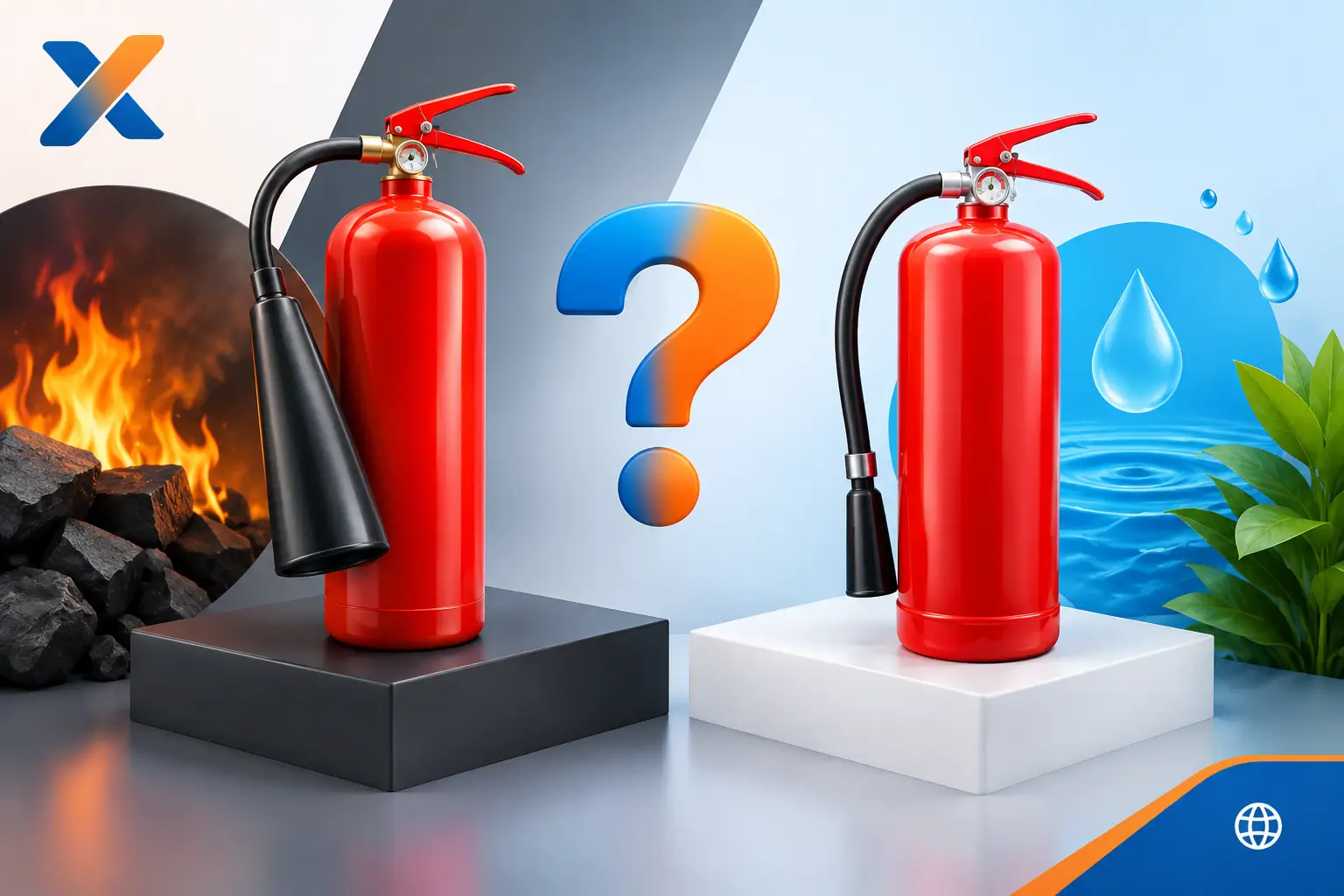
A CO2 or water extinguisher is not a like-for-like choice. Each is designed for a different type of fire, and placing the wrong one at the point of risk can put staff, visitors and premises at greater danger. For business owners and duty holders, the decision should follow a suitable fire risk assessment rather than convenience, price or the colour of the extinguisher label.
The right provision supports a fast, safe first response to a small fire. It also helps demonstrate that appropriate firefighting equipment has been selected, positioned, commissioned and maintained as part of the fire safety arrangements for the premises.
CO2 or water extinguisher: the essential difference
Water extinguishers are intended primarily for Class A fires involving solid combustible materials. This includes wood, paper, cardboard, textiles and many furnishings. They work by cooling the burning material below its ignition temperature. In offices, shops, communal areas, storage rooms and many rental properties, these are common fuel sources, which is why water units often form part of a general extinguisher provision.
CO2 extinguishers are intended for Class B fires involving flammable liquids, such as petrol, solvents and some paints. They are also widely provided near live electrical equipment, including server cabinets, control panels and office machinery. CO2 works by displacing oxygen around the fire and does not leave a powder or foam residue behind.
That clean discharge is useful where residue could damage equipment or create an extended clean-up problem. It does not mean that CO2 is automatically the better extinguisher for every electrical risk. The fire itself, the surrounding materials, the room layout and the likelihood of re-ignition all matter.
When a water extinguisher is the right choice
A water extinguisher is usually the practical choice where the foreseeable fire load is mainly paper, packaging, timber, fabric or similar ordinary combustibles. A small office with desks, files and soft furnishings, for example, often needs effective Class A coverage. The same applies to retail stockrooms and workshop areas where combustible materials are present but flammable liquids are not the principal risk.
Water is highly effective at cooling deep-seated Class A fires. A fire in a waste bin, stack of cardboard or wooden furniture can continue smouldering after an initial discharge, so the cooling effect is valuable. In many cases, a water unit can provide a stronger response to this kind of fire than CO2.
However, ordinary water extinguishers must not be used on live electrical equipment. Water can conduct electricity, creating a serious shock hazard. They are also unsuitable for flammable liquid fires and cooking oil or fat fires. A kitchen with commercial fryers requires specific wet chemical provision, not water or CO2 as a substitute.
Some water-based extinguishers use additives or mist technology and may carry additional fire ratings or electrical-use information. The label, rating and manufacturer instructions must always be checked. Duty holders should not assume that every extinguisher with a red label has identical capabilities.
Where CO2 is most appropriate
CO2 extinguishers are commonly placed near electrical distribution boards, server rooms, photocopiers, office equipment and machinery with live electrical components. They can be used where it is unsafe or impractical to apply water to energised equipment, provided the user can approach safely and has a clear escape route.
They are also suitable for certain flammable liquid risks. A garage, workshop or maintenance area may have small quantities of solvents, fuels or paints that make CO2 appropriate as part of the overall extinguisher selection. The fire risk assessment should establish the nature and volume of those liquids, how they are stored and whether another extinguisher type is needed alongside CO2.
There are important limitations. CO2 has little cooling effect, so a fire can re-ignite if the fuel source remains hot. It is less effective outdoors or in draughty locations because the gas disperses quickly. The discharge horn also becomes extremely cold during use, so it must be held by the insulated handle or horn grip.
In small or poorly ventilated spaces, CO2 can create an asphyxiation risk if discharged in significant quantities. This does not make the extinguisher unsuitable in every enclosed room, but it does mean that siting and staff instruction need careful consideration. A person should never fight a fire if doing so compromises their escape or safety.
Electrical equipment does not always mean CO2 only
A common mistake is to label a room as an “electrical fire risk” and install only CO2 extinguishers. Most workplaces contain electrical equipment, but the surrounding combustible materials still matter. A fire beginning in a printer may spread to paper, furniture or wall finishes. Once electricity is isolated, the remaining fire may be a Class A fire that needs cooling.
This is why many premises require more than one extinguisher type. A properly assessed office may have CO2 near electrical equipment and water-based provision for the general Class A fire load. The correct combination depends on the building, its use, occupants, escape routes and specific hazards.
Avoid treating an extinguisher as a universal tool. CO2 must not be used for cooking oil and fat fires, and it is not the first choice for fires involving combustible metals. Water is unsafe on live electrical equipment and flammable liquids. Selecting equipment by fire classification is fundamental to protecting people rather than creating a more dangerous incident.
Selection should start with the fire risk assessment
For premises in Scotland, the responsible person or duty holder must take reasonable fire safety measures appropriate to the risks in the building. Suitable portable firefighting equipment is part of that duty, but an extinguisher on a wall is not proof that the arrangement is adequate.
A fire risk assessment should consider the likely ignition sources, combustible and flammable materials, work activities, building layout, occupancy and evacuation arrangements. It should also consider whether occupants are expected to use extinguishers at all. The primary action in most workplace fires is to raise the alarm, evacuate and call the fire and rescue service. Extinguishers are for tackling only a very small, early-stage fire where it is safe to do so.
Selection and siting should align with the relevant recommendations of BS 5306. This includes ensuring units are appropriate for the hazard, visible or clearly signed, accessible, protected from damage and located where people can reach them without moving towards a fire. An extinguisher hidden behind stock or placed inside a locked room cannot provide an effective first response.
Maintenance is part of readiness
Even the correct CO2 or water extinguisher can fail the business if it is overdue for service, has lost pressure, is damaged or has been moved from its designated location. Equipment should be commissioned when installed, checked visually at suitable intervals and serviced by a competent person in line with the applicable British Standard and manufacturer guidance.
Records matter. Servicing labels, maintenance certificates and documented inspections help demonstrate that equipment has been managed responsibly. They also give site managers a clear record of what has been checked, what requires replacement and whether the extinguisher provision still reflects the way the premises is being used.
Changes to the workplace should trigger a review. A storage room converted into a workshop, a new server rack, the introduction of cleaning chemicals or a change in tenancy can all alter the fire risk. End-of-life extinguishers need replacement, not a last-minute decision after an inspection is due.
Give staff clear instructions
Staff should know the location of extinguishers, the type of fires they are intended for and when not to use them. Practical fire safety training should reinforce a simple rule: never attempt to fight a fire unless it is small, there is a safe exit behind you and you are confident the extinguisher is suitable.
There should be no expectation that staff will put themselves at risk to protect stock, equipment or the building. A prompt evacuation protects lives and supports business continuity far more effectively than an untrained attempt to tackle a growing fire.
For workplaces, short-term lets and commercial premises across Glasgow and the central belt, EXSERVICE can assess existing provision, service equipment and identify where extinguisher types or locations no longer match the risk. The most useful extinguisher is not simply the one nearest the door. It is the one selected for the hazard, maintained properly and ready for a safe first response when it is genuinely needed.
Leave a Reply