

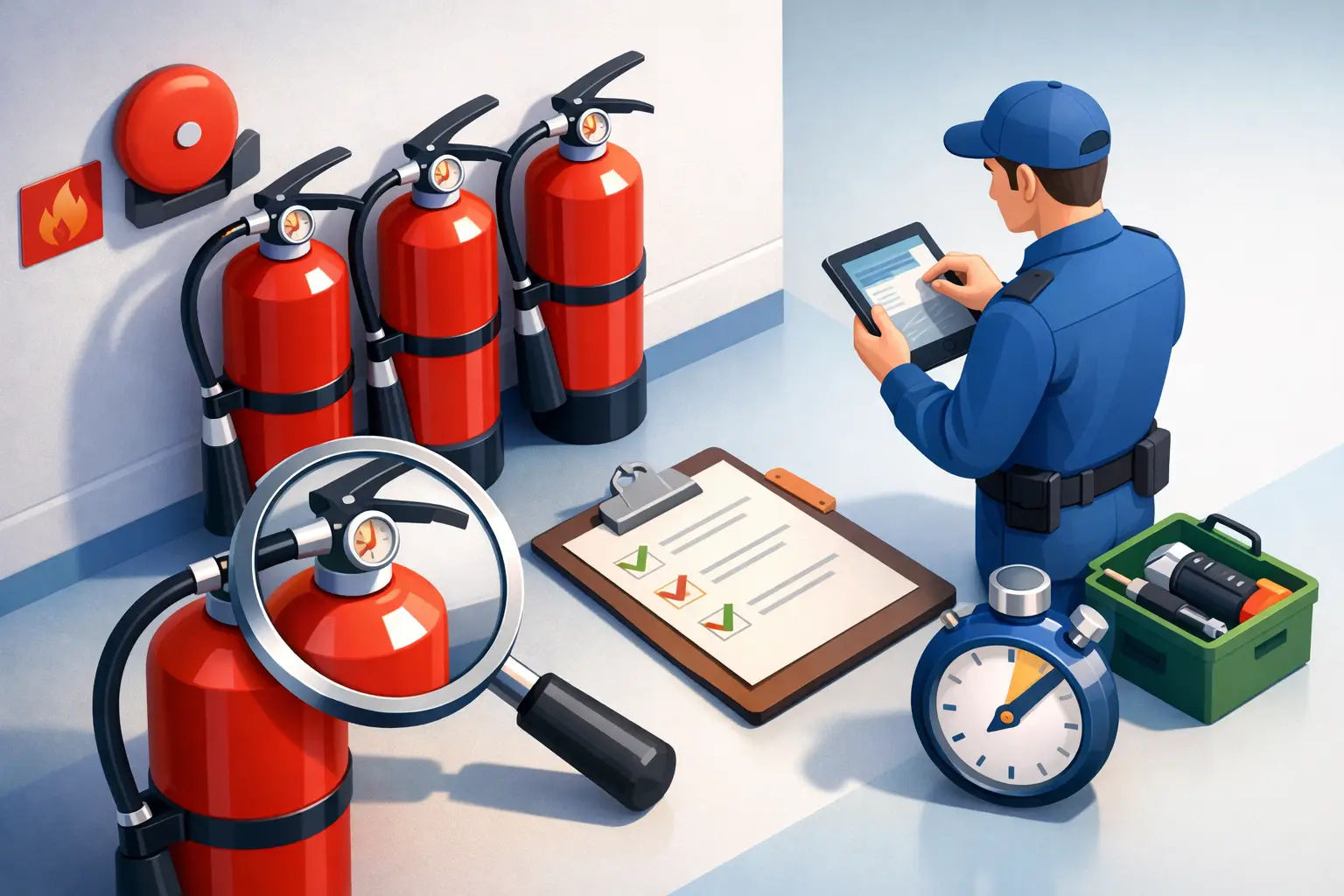
A fire extinguisher can look perfectly serviceable while being unsuitable for use: moved from its designated point, partly discharged, obstructed by stock, or overdue professional maintenance. Knowing how to record extinguisher checks gives duty holders a clear record that equipment has been reviewed, defects have been identified, and action has been taken before an emergency exposes a gap.
For workplaces, rental premises with shared areas, and commercial sites, the record is more than paperwork. It supports the fire risk assessment, demonstrates responsible management, and helps ensure extinguishers remain available when people need them most.
Why extinguisher check records matter
In Scotland, fire safety duties require those responsible for relevant premises to take reasonable measures to safeguard people from fire. The precise duties depend on the premises and its use, but the principle is consistent: fire safety measures must be maintained and managed, not simply installed and forgotten.
A documented check provides evidence of that management. If an extinguisher is missing, damaged or inaccessible, the record should show when the issue was found, who was told, and when it was resolved. This is valuable during a fire risk assessment review, an insurer query, an internal audit or an investigation after an incident.
Records also prevent small problems becoming operational failures. A simple monthly inspection may reveal that a contractor has placed materials in front of an extinguisher, a tamper seal has been broken, or a unit has been removed without replacement. These issues are often easy to correct, provided someone is looking and recording the outcome.
Routine visual checks do not replace servicing by a competent person. Professional maintenance under the relevant BS 5306 standards remains a separate requirement within a sound fire safety programme. The routine record helps bridge the period between visits and gives the service technician useful information about recurring issues or equipment misuse.
Decide who carries out the checks
The responsible person should appoint a suitable member of staff to complete routine extinguisher checks. In a small office, this may be the office manager. On a larger site, it could be a facilities manager, caretaker, health and safety co-ordinator or trained site supervisor.
The appointed person does not need to dismantle extinguishers or carry out technical servicing. Their role is to make a straightforward visual inspection, follow the site’s fire safety procedure, and report defects promptly. They should know where every extinguisher is meant to be located, what obvious signs of damage look like, and who has authority to arrange repairs or replacement.
Consistency matters more than creating an overcomplicated process. Assign a named person, nominate cover for absence, and set a regular inspection date. Monthly checks are widely used in workplaces, although the right frequency should reflect the fire risk assessment, the premises, the likelihood of interference and manufacturer guidance. A busy warehouse or publicly accessible site may need closer attention than a small, secure office.
How to record extinguisher checks step by step
Use a logbook, paper checklist or digital inspection system that is easy for staff to complete and easy to retrieve. A record that stays on a clipboard in the plant room but is never reviewed has limited value. The best system is one that prompts action and gives management visibility of unresolved defects.
Start every entry with the date, the premises or area inspected, and the name and signature of the person carrying out the check. If the premises has several floors, buildings or units, identify the precise location. “Ground floor” is often too vague. “Ground floor, east exit beside reception” makes it clear which extinguisher was checked.
Each extinguisher should have an identifier that matches its location on the fire safety plan, asset register or servicing documentation. This might be a numbered label or barcode. Individual identification is particularly helpful where there are multiple units of the same type in one area.
For each item, record whether it passed the visual check or whether a defect was found. A pass should mean the extinguisher was present, visible, accessible and appeared ready for use. If it did not pass, describe the defect clearly rather than writing only “fail”. For example: “CO2 extinguisher E14 blocked by boxed stock” or “foam extinguisher E07 has broken tamper seal and requires inspection”.
Finally, record the corrective action. State who was notified, the date the issue was reported, and the date it was resolved. If an extinguisher has been removed for replacement or servicing, record the temporary control put in place where appropriate. Leaving a blank space beside a failed item is not a defensible management process.
What to look for during a routine check
A visual inspection should be practical and proportionate. The person completing it should confirm that the extinguisher is in its designated position, clearly visible and not blocked by furniture, equipment, deliveries or stored materials. Fire points should remain accessible at all times, including during refurbishment, cleaning and stock movements.
They should also look for visible damage, corrosion, leakage, missing components or signs that the extinguisher has been discharged. Check that the tamper seal and safety pin are intact where fitted, that signage remains visible, and that any pressure indicator is in the acceptable operating range. Not every extinguisher has a gauge, so staff should not assume a missing gauge is a defect.
The service label should be present and legible. If it indicates that maintenance is due, or the label is missing or unclear, arrange for a competent fire extinguisher technician to review it. Staff should not attempt to refill, recharge, open or repair an extinguisher themselves.
Where extinguisher cabinets, stands, brackets or fire blankets are provided, include them in the check. A unit that falls from a damaged wall bracket or cannot be removed from a cabinet quickly is not effectively available for emergency use.
Use a record format that can be audited
A good extinguisher check record should allow another person to understand exactly what happened without relying on memory. Whether paper or digital, include the following fields:
- inspection date and time;
- inspector’s name and signature or digital confirmation;
- building, floor and exact extinguisher location;
- extinguisher identification number and type;
- condition result, such as satisfactory, defect found or not present;
- a clear description of any issue;
- action taken, person notified and target completion date; and
- closure date and confirmation that the defect has been resolved.
Keep these records with other fire safety documentation, including the fire risk assessment, emergency plan, staff training records and service certificates. Retention periods should reflect your organisation’s document-control policy, insurer requirements and the need to demonstrate ongoing management. Many businesses retain records for several years so that trends and repeated defects can be identified.
Treat defects as actions, not observations
The main weakness in many fire safety logs is that they record a problem without proving it was dealt with. A missing extinguisher is not merely an administrative issue. It may leave a specific risk area without the equipment selected through the fire risk assessment.
Set clear response arrangements. Obstructions can often be removed immediately. A damaged, discharged, leaking or suspect extinguisher should be reported without delay and assessed by a competent provider. If a unit is taken out of service, ensure the responsible person understands whether a suitable replacement is required before the area is left unprotected.
For repeated issues, look beyond the individual fault. If extinguishers are regularly blocked by stock, the solution may involve improving storage controls, floor markings, staff briefings or supervision. If units are repeatedly tampered with in public areas, cabinet selection or location may need to be reviewed.
Paper versus digital records
A paper logbook can work well for a small, stable premises where one person conducts checks and records are stored securely. It is inexpensive, familiar and does not depend on software access. Its limitations are that it can be misplaced, handwriting may be unclear, and overdue actions are easier to overlook.
Digital records are often more practical for multi-site businesses, landlords with several common areas, or facilities teams responsible for a large number of extinguishers. They can attach photographs, issue reminders, assign actions and create an audit trail. However, a digital system is only useful if staff are trained to use it and managers review the exceptions.
The right choice depends on the scale of the premises and how fire safety is managed. The standard to aim for is not a particular format. It is a complete, accurate record that leads to timely corrective action.
Keep routine checks aligned with professional servicing
Routine checks give management confidence between scheduled visits, but they are not a substitute for competent inspection and maintenance. Extinguishers require appropriate commissioning, periodic servicing and, where applicable, extended service, overhaul or replacement in line with the equipment type, manufacturer instructions and British Standards.
Keep the routine log alongside the servicing certificate and equipment register. When a technician attends, provide details of any leaks, broken seals, accidental discharges, changes to building layout or recurring access problems. This allows the servicing programme to address the real conditions on site rather than treating each extinguisher as an isolated item.
For Glasgow businesses and property managers, a specialist provider such as EXSERVICE can help establish a practical checking process alongside servicing and fire risk assessment duties. The goal is straightforward: maintain compliant equipment, protect people, and avoid discovering a preventable failure when seconds matter.
A well-kept record should give the responsible person confidence to answer a simple question at any time: are our extinguishers present, maintained, accessible and ready to use? If the answer is not clear from the records, the checking process needs attention before an emergency does.
Leave a Reply