

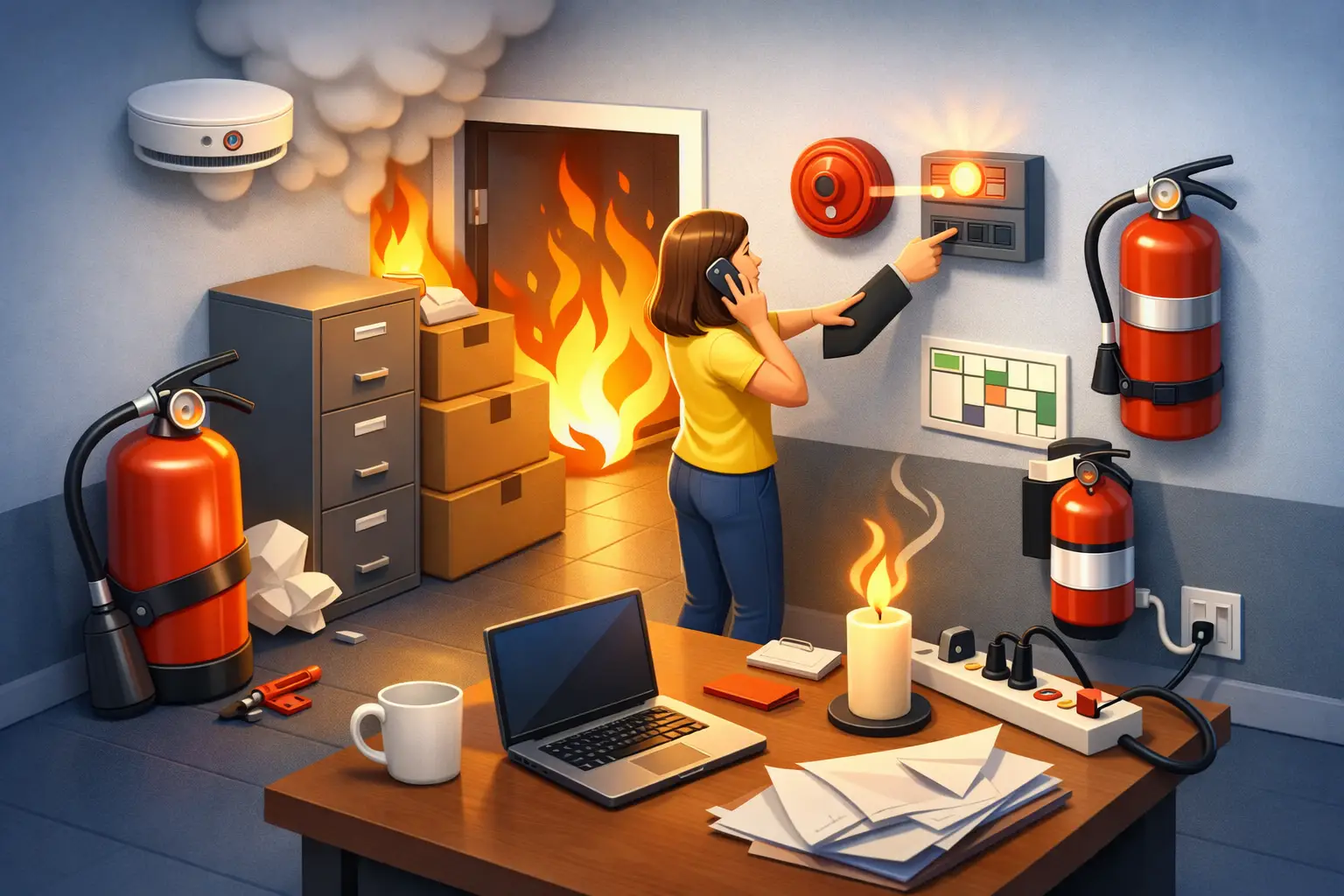
A fire extinguisher hidden behind stored stock, a fire door wedged open for convenience, or a service label that is years out of date can turn a manageable incident into a serious business loss. The top fire safety compliance mistakes are rarely caused by a deliberate disregard for safety. More often, they happen because responsibility is unclear, checks become informal, or equipment is assumed to be ready when it has not been properly inspected.
For duty holders, landlords and workplace managers, fire safety is not a box-ticking exercise. It is a continuing responsibility to protect people, premises and the ability to trade. The right arrangements should reflect the building, its occupants and the work carried out there.
Top fire safety compliance mistakes to address first
Treating the fire risk assessment as a one-off document
A fire risk assessment should be a working record of the hazards in your premises, the people who could be affected, and the controls needed to keep them safe. Filing it away after it has been completed is one of the most common failures.
Premises change. A new tenant moves in, stock levels increase, a room is repurposed, contractors begin working on site, or staffing patterns change. Any of these can alter escape routes, ignition risks and the suitability of existing controls. The assessment should be reviewed regularly and whenever there is a material change, following a fire, or where shortcomings have been identified.
In Scotland, the duty to take fire safety measures applies to relevant premises, and the responsible person must make sure those measures remain appropriate. A dated assessment with no evidence of review offers limited reassurance after an incident.
Assuming extinguishers are compliant because they are present
An extinguisher on a wall is not automatically a compliant or usable extinguisher. It must be appropriate for the foreseeable fire risks, correctly sited, clearly visible or signed, accessible, and maintained. The number of units matters less than whether the selection and location allow people to respond safely in the earliest stage of a fire.
For example, a kitchen, workshop, server room and general office may need different types of provision. Using the wrong medium can make a fire worse, particularly where cooking oils, electrical equipment or flammable liquids are involved. Extinguishers should be selected through the fire risk assessment rather than bought as a generic package.
Maintenance also matters. Under BS 5306, extinguishers require routine user checks and competent servicing at appropriate intervals. A missing pin, damaged hose, low-pressure gauge, obstructed cabinet or expired unit can prevent effective use when seconds count. Keep service labels and records in order, but do not mistake paperwork for a physical inspection.
Leaving fire doors open or poorly maintained
Fire doors are designed to hold back smoke and fire long enough for people to escape and for firefighters to intervene. A wedged-open door removes that protection immediately. So does a damaged door, missing smoke seal, faulty self-closing device or excessive gap around the frame.
This is often a behavioural problem as much as a maintenance problem. Staff may wedge doors open to improve airflow or make deliveries easier without understanding the consequence. Where access or ventilation is a genuine operational issue, the answer is not to bypass the fire door. Consider a suitable, compliant hold-open arrangement that releases when the fire alarm operates, alongside professional advice.
Routine checks should confirm that fire doors close fully into the frame, are not obstructed and have no obvious damage. Higher-risk or heavily used doors may need more frequent attention than a quiet internal office door.
Allowing escape routes to become storage areas
Corridors, stairwells and final exits often become convenient places for parcels, cleaning equipment, displays and surplus furniture. The items may seem harmless during a normal working day, but they can slow evacuation, create a trip hazard in smoke, or add fuel to a developing fire.
Escape routes should remain clear, adequately lit and easy to follow at all times. Final exit doors must be capable of being opened quickly by people escaping, without searching for a key or relying on a colleague. This should be tested in practice, including when the building is occupied and during periods with reduced staffing.
Pay particular attention to shared commercial buildings. One occupier’s stored goods can compromise another occupier’s means of escape, so responsibilities for common areas need to be agreed and monitored rather than assumed.
Providing training once and never revisiting it
A fire action notice on the wall is useful, but it does not prove people know what to do. New starters, temporary staff, cleaners, contractors and shift workers all need clear information relevant to the building. They should know how to raise the alarm, where to leave, where to assemble and who has specific evacuation responsibilities.
Training should be proportionate. Not every employee needs to operate an extinguisher, and nobody should be expected to fight a fire if doing so would put them at risk. However, nominated staff may need practical instruction so they understand extinguisher limitations, safe use and when evacuation is the only correct response.
Fire drills expose issues that written procedures miss: an assembly point blocked by vehicle movements, a manager who is absent, visitors who have not been briefed, or an alarm that cannot be heard in a noisy area. Record the outcome and act on the findings rather than treating the drill as an annual formality.
Failing to test alarms, emergency lighting and other systems
Fire safety depends on a chain of measures working together. If the alarm is not heard, emergency lighting does not operate, or a smoke control system has faults, an otherwise sound evacuation plan can fail.
Weekly alarm tests, routine visual checks and planned servicing give early warning of defects. The exact regime depends on the system, premises and risk assessment, but it should be documented and carried out consistently. Test different call points in rotation where appropriate, and ensure staff understand that a test is taking place.
A fault should not simply sit in a logbook. Assess the risk immediately, arrange repair and put temporary measures in place where necessary. That may include increased checks, a fire watch or changes to how the premises are used. The right response depends on the nature of the fault and the people at risk.
Confusing records with compliance
Records are essential. They show that inspections, servicing, testing, training and reviews have taken place. They can also support conversations with insurers, enforcing authorities and landlords. But records cannot compensate for unsafe conditions on site.
A useful fire safety logbook reflects reality. If an extinguisher has been removed for servicing, the record should show how suitable cover was maintained. If a fire door defect was found, it should show when it was reported, what interim controls were used and when repair was completed. Gaps, copied entries and unsigned checks weaken confidence in the whole system.
Overlooking responsibility in rented or shared premises
In leased buildings, it is easy for tenants, managing agents and landlords to assume someone else is dealing with fire safety. The lease may allocate maintenance tasks, but legal duties can still apply to more than one person depending on control of the premises and common areas.
Clarify who is responsible for the alarm, emergency lighting, extinguishers, fire doors, communal escape routes and the fire risk assessment. Put the arrangement in writing and share relevant inspection findings. If you manage your own unit but rely on a common stairwell or shared entrance, its condition is directly relevant to your evacuation arrangements.
Turn compliance into a routine, not a reaction
The most reliable workplaces make fire safety part of normal site management. A named person carries out regular visual checks, defects are reported promptly, servicing dates are planned ahead, and managers review changes before they create new risks. This does not need to create unnecessary administration. It needs clear ownership and evidence that controls are being maintained.
For many Glasgow businesses, an external specialist can provide the technical support and servicing discipline that an internal team cannot always sustain. EXSERVICE helps duty holders assess risks, maintain suitable extinguishers and keep the records needed to demonstrate responsible management.
The practical test is simple: if a fire started this afternoon, would people know how to get out, would the alarm be heard, and would the available equipment be ready to use? Reviewing that question regularly is one of the most effective ways to protect your people and your business.
Leave a Reply