

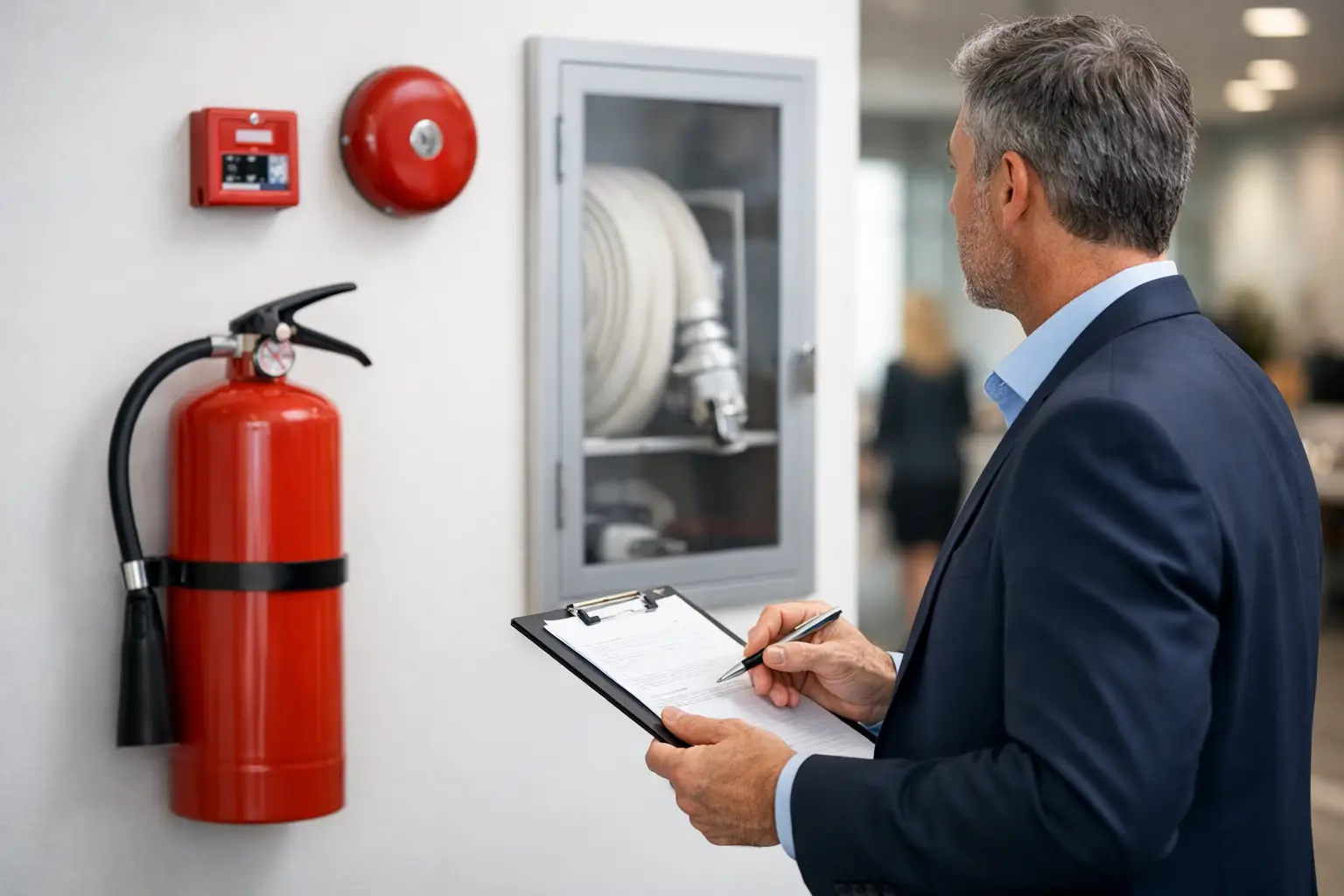
A fire extinguisher fixed to the wall is only reassuring if it is the right type, in the right place, and ready to work. That is where this BS 5306 business owner guide matters. For duty holders across Scotland, the standard is not paperwork for its own sake – it shapes whether staff can respond quickly to a small fire, whether your premises meet expected safety standards, and whether avoidable compliance gaps are left sitting unnoticed.
BS 5306 is the British Standard that covers fire extinguishing installations and equipment on premises. For most business owners, the practical focus is simple: choosing suitable extinguishers, positioning them properly, maintaining them at the right intervals, and keeping records that show they are being looked after. If you are responsible for an office, warehouse, shop, salon, workshop, rented commercial unit or managed property, this standard sits very close to your legal duties under fire safety law.
What BS 5306 means in practice
BS 5306 is often spoken about as if it were one single rulebook, but for businesses the day-to-day issues usually come down to extinguisher provision and maintenance. It supports decisions about how many extinguishers you need, what types are appropriate for your fire risks, where they should be sited, and how they should be inspected and serviced over time.
That matters because extinguisher cover is not one-size-fits-all. A small office with mainly paper, furniture and electrical equipment will not have the same risk profile as a commercial kitchen, vehicle workshop or light industrial unit. Water extinguishers may suit Class A risks in one area, while CO2 may be necessary near electrical equipment and wet chemical units may be critical in kitchens. The standard helps turn that risk picture into something practical and defensible.
It also creates consistency. If an insurer, enforcing authority or responsible person needs to review what has been provided, BS 5306 gives a recognised benchmark. That does not remove the need for judgement – every site has its own layout, occupancy and hazards – but it stops fire safety from becoming guesswork.
The BS 5306 business owner guide to your responsibilities
If you control business premises, you are not expected to become a fire extinguisher engineer. You are expected to ensure suitable equipment is provided and maintained. That means taking responsibility for the outcome, even if a specialist company carries out the technical work.
In practice, your duties usually include making sure extinguishers are appropriate for the risks identified in your fire risk assessment, visible and accessible, and subject to regular inspection and annual maintenance by a competent person. You should also make sure damaged, discharged or end-of-life units are replaced promptly. A missing service label, an obstructed extinguisher cabinet or a unit hidden behind stock can all turn a compliant-looking setup into a real problem.
There is also a people element that gets overlooked. Extinguishers are there for first-aid firefighting, not for heroics. Staff need to know what equipment is available, when it may be used, and when evacuation is the safer decision. Good provision without clear procedures can still leave you exposed.
Choosing the right extinguishers for the risks on site
This is where many businesses get caught out. They may inherit equipment from a previous occupier, add units over time without a clear plan, or rely on a supplier who has not properly assessed the premises. The result can be poor coverage, unsuitable extinguisher types, or duplication in one area while another is left underprotected.
A sensible approach starts with the fire risk assessment. What could burn? How quickly could a fire spread? Are there electrical risks, cooking oils, flammable liquids or vulnerable escape routes? Once those questions are answered, extinguisher selection becomes more precise.
There are trade-offs. More extinguishers do not always mean better protection if they create confusion or include the wrong media for the hazard. Equally, the cheapest option can become the most expensive if it leads to failed inspections, replacement costs or ineffective response in an emergency. The right setup is the one that matches the premises, is easy to locate, and can be maintained properly throughout its service life.
Siting and visibility matter more than many owners expect
An extinguisher is no use if nobody can reach it quickly. BS 5306 places strong emphasis on siting because response time is critical in the early stages of a fire. Units should normally be located on escape routes, near exits, at fire points, and close to identified hazards where that is appropriate. They should also be mounted and signed so they are easy to see.
This sounds straightforward, but workplaces change. Stock gets moved, furniture is rearranged, partitions are added, and refurbishments alter travel routes. Over time, an extinguisher that was once well placed can become hidden behind a photocopier, boxed in by deliveries or left too far from the area it is supposed to protect.
That is why visual checks matter between formal service visits. Staff do not need technical training to spot obvious issues. They can see whether an extinguisher is present, accessible, undamaged and still in the correct location. Catching those problems early is part of keeping protection live rather than assuming it is fine because the wall bracket is still there.
Servicing under BS 5306 is not optional housekeeping
A common mistake is to think annual servicing is an administrative requirement with little operational value. In reality, maintenance is what confirms an extinguisher is likely to function when needed. Pressure loss, accidental damage, corrosion, tampering and age-related wear are not always obvious during a quick walk-round.
Professional servicing checks whether each unit remains in serviceable condition and suitable for continued use. Records are then updated to show what was inspected, what action was taken, and whether any replacements were needed. Those records matter. They demonstrate that equipment has not simply been installed and forgotten.
There is an insurance point here too. If a fire occurs and extinguishers were overdue for maintenance, missing or not fit for purpose, that can create difficult questions afterwards. While every claim turns on its own facts, poor fire safety management is not a position any business wants to defend.
Some units will also reach the point where replacement is the better option. Refilling, extended servicing or replacement decisions depend on the extinguisher type, age and condition. This is another area where competent advice matters, because delaying replacement can leave you with equipment that looks acceptable but no longer offers dependable protection.
Where business owners tend to go wrong
The most frequent issues are not usually dramatic. They are small failures of oversight that build up over time. Equipment gets inherited without review. Annual maintenance dates slip. Extinguishers are moved during works and never returned. Service records are incomplete. A site adds new hazards but keeps the old extinguisher layout.
Another problem is treating all premises the same. A multi-let building, a retail unit and a light industrial site may all need extinguishers, but their risks, access arrangements and response expectations are different. Compliance has to reflect how the premises are actually used.
This is where a specialist provider adds value beyond simply supplying cylinders. A competent company can assess the setting, identify gaps, carry out servicing correctly and keep your documentation in order. For businesses that want clarity rather than uncertainty, that ongoing support removes a lot of risk from the process.
BS 5306 business owner guide for ongoing compliance
The most effective way to stay compliant is to treat extinguisher management as part of normal site control, not as a once-a-year task. Your fire risk assessment should inform what is on site. Your maintenance schedule should keep equipment serviceable. Your staff should know the basics of reporting problems. And your records should be easy to produce if they are ever requested.
It also helps to review provision when something changes. A fit-out, tenancy change, workshop expansion or kitchen installation can all alter extinguisher needs. Waiting until the next annual visit may be too late if the layout or hazards have already shifted.
For Scottish businesses, especially those managing multiple rooms, public access areas, storage spaces or mixed-use premises, consistency is the safeguard. That means suitable extinguishers, correct siting, documented servicing and a clear understanding of who is responsible for what. EXSERVICE supports businesses with that practical, compliance-led approach so equipment is not only present, but ready to use.
Fire safety standards are easiest to live with when they are built into everyday management. If your extinguishers are correctly chosen, properly maintained and checked before problems develop, you are not just meeting a standard – you are protecting people, premises and the continuity of the business that depends on both.
Leave a Reply