

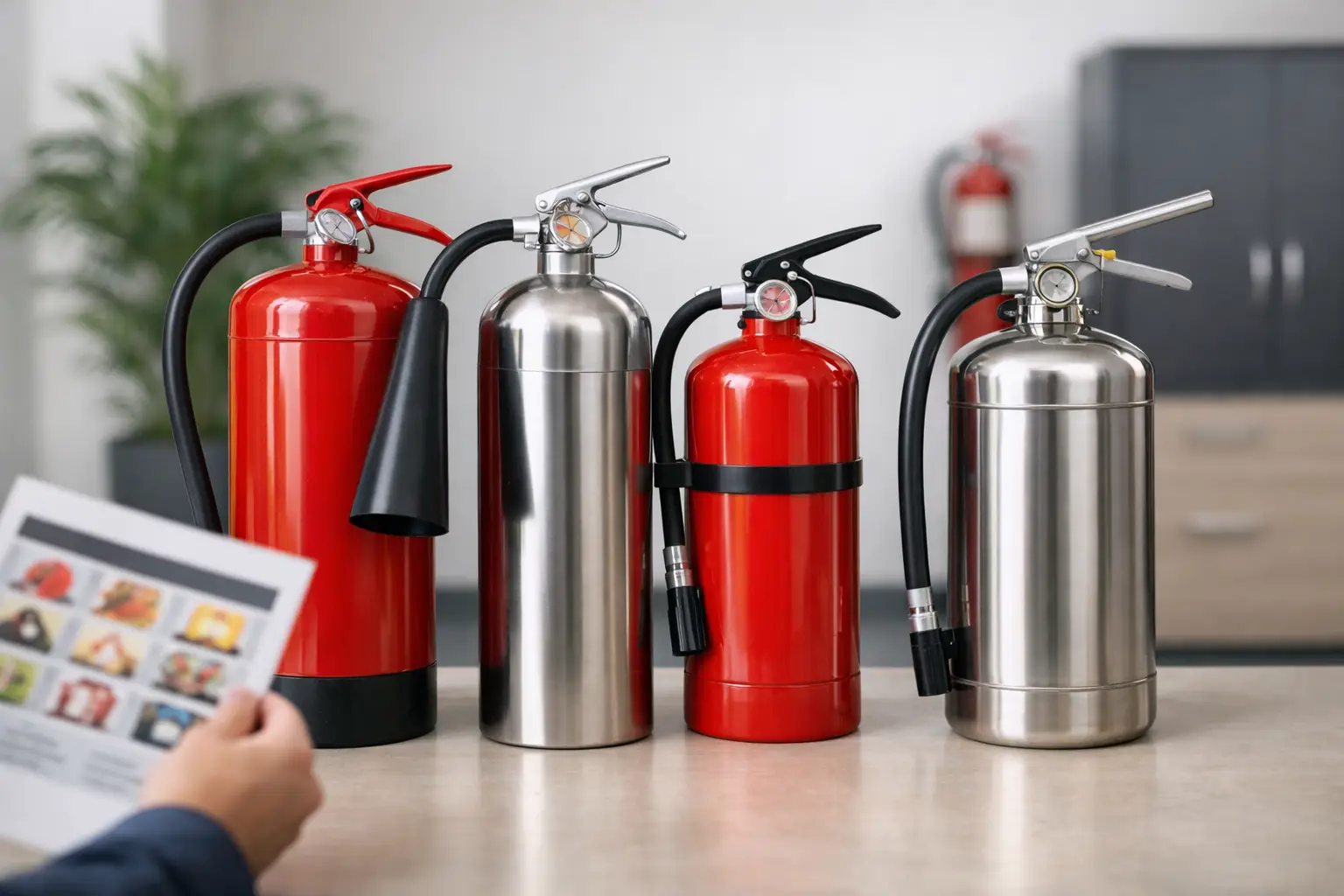
A fire starts in a staff kitchen, workshop or plant room, and the extinguisher on the wall is only useful if it is the right one for that risk. That is why knowing how to choose extinguisher types matters. It is not just about buying equipment to fill a bracket. It is about protecting people, limiting damage, supporting business continuity and meeting your duties as a responsible person.
For many duty holders, the confusion starts with the number of extinguisher options available. Water, foam, CO2, powder and wet chemical all have different uses, limitations and siting requirements. Choosing correctly depends on the fire risks present, the layout of the premises, who will use the equipment and what standard of compliance you need to maintain.
How to choose extinguisher types for your premises
The starting point is always the fire risk, not the product. In practical terms, that means looking at what could burn, where it could ignite and what would happen if a fire developed before the fire and rescue service arrived.
In an office, the main concern may be paper, furniture and electrical equipment. In a commercial kitchen, cooking oils and fats are a clear priority. In a workshop, flammable liquids or machinery may change the picture entirely. The right extinguisher provision is based on those real conditions rather than a one-size-fits-all approach.
You also need to think about the people expected to use the extinguisher. A unit that is technically suitable but likely to create poor visibility, breathing irritation or collateral damage may not be the best choice for an enclosed workplace. This is one reason why extinguisher selection should be tied to a proper fire risk assessment and to BS 5306 guidance on selection and siting.
Match the extinguisher to the class of fire
The clearest way to understand extinguisher choice is to work from the fire class involved.
Class A fires
Class A covers solid combustibles such as paper, wood, textiles and many packaging materials. These are common in offices, schools, retail premises and shared areas in rental accommodation. Water extinguishers are often suitable here, and foam may also be used in some environments where mixed risks are present.
Class B fires
Class B fires involve flammable liquids such as petrol, paint, solvents or certain cleaning chemicals. These risks appear in workshops, stores, industrial settings and some maintenance areas. Foam is commonly used for this type of fire. In some cases, dry powder can also be effective, but powder is often less suitable indoors because it creates a cloud that reduces visibility and leaves residue.
Electrical risks
Strictly speaking, electricity is not a fire class in the same way, but live electrical equipment changes extinguisher choice significantly. Offices, server rooms, plant rooms and commercial premises with electrical installations usually require CO2 extinguishers near electrical hazards. CO2 does not leave residue, which makes it appropriate where electrical equipment is involved, but it has limited cooling effect, so re-ignition can be a concern if the underlying material remains hot.
Class F fires
Class F fires involve cooking oils and fats. If your premises contain deep fat fryers or commercial catering equipment, wet chemical extinguishers are normally required. Using the wrong extinguisher on these fires can be dangerous. A standard water or foam unit is not a substitute where a kitchen oil fire risk exists.
Special risks
Some sites have metal fires, vehicle risks, external storage or mixed industrial hazards. These situations need more specific assessment. This is where generic advice often falls short. A premises with unusual processes or higher hazard activities should not rely on basic assumptions about extinguisher cover.
Understand what each extinguisher type is for
Water extinguishers are generally used for Class A materials and remain a standard choice in many workplaces. They are straightforward and effective for ordinary combustibles, but they are not suitable for flammable liquids or live electrical equipment.
Foam extinguishers are often selected where Class A and Class B risks overlap. They can be a practical option in mixed-use premises, though the exact suitability depends on the product rating and the site conditions.
CO2 extinguishers are mainly intended for electrical risks. They are commonly placed near distribution boards, server equipment and office electronics. They are not ideal as the main extinguisher for general combustible materials because they do not soak or cool surfaces in the way water-based units do.
Dry powder extinguishers can cover several fire types, including flammable liquid and electrical-related fires, and they are sometimes used externally or in specific industrial settings. However, indoors they can create serious visibility issues, contaminate equipment and complicate evacuation. For many commercial indoor environments, they are no longer the preferred option unless there is a specific need.
Wet chemical extinguishers are designed for cooking oil and fat fires and are standard in commercial kitchens. If frying equipment is present, this type is usually essential rather than optional.
How to choose extinguisher types without overproviding or underproviding
One of the most common mistakes is assuming that more extinguishers automatically means better protection. Overproviding can create confusion, unnecessary maintenance costs and poor placement. Underproviding is more serious, as it can leave parts of the building without suitable first-aid firefighting capability.
The balance comes from correct siting, suitable ratings and proper coverage for the hazards identified. Travel distance matters. Visibility matters. Mounting position matters. So does the need for staff to reach the extinguisher quickly without moving towards a fire that is already developing.
This is why extinguisher provision should never be separated from the wider fire safety strategy for the building. The number and type of units should support your escape routes, compartmentation, alarm arrangements and staff procedures.
Compliance is not just about having extinguishers on site
A common misunderstanding is that once extinguishers are installed, the job is done. In reality, compliance also depends on correct commissioning, routine inspection, annual servicing and replacement when units reach end of life or fail maintenance standards.
For businesses and landlords, that matters for more than legal formality. If extinguishers are incorrectly selected, poorly maintained or unsuitable for the hazard, they may fail when needed or expose occupiers to greater risk. That can affect life safety, property damage, business interruption and insurer expectations.
BS 5306 provides the framework for selection, siting and maintenance, and it exists for a reason. Extinguishers are emergency equipment. They need to be suitable, accessible and ready to use at all times.
When premises need a more tailored approach
Some environments are straightforward. A small office with standard electrical equipment and ordinary combustibles may need a simple combination of water-based cover and CO2 for electrical risks. Other premises require more careful judgement.
A mixed commercial building may contain offices, kitchens, cleaners’ cupboards, stockrooms and workshop areas under one roof. A rental property with shared spaces may have different risks from a retail unit or light industrial site. If the building layout is complex, the occupancy changes frequently or hazardous materials are stored on site, extinguisher choice should be reviewed against the actual use of each area.
This is particularly relevant if the premises have evolved over time. Many buildings carry extinguisher layouts based on old tenants, outdated room use or equipment that is no longer present. Reviewing what is on the wall against current operations is often where gaps are uncovered.
How to choose extinguisher types with staff safety in mind
An extinguisher is only part of the response. Staff should understand when it is appropriate to use one and when to leave immediately. That means your selection should reflect the likely user, not just the fire class.
In enclosed workplaces, a type that impairs vision or causes panic may not support a safe initial response. In kitchens, staff need the right extinguisher within easy reach of the hazard area. In offices, people need clear identification and simple, familiar equipment. The best extinguisher arrangement is one that fits the risk and supports a safe decision under pressure.
For businesses across Glasgow and the wider Scottish market, this usually comes back to one principle. Do not guess. Extinguisher types should be chosen through competent assessment, then supplied, sited and maintained to match the building and its actual fire risks.
If you are unsure whether your current provision still suits the premises, that uncertainty is itself a reason to review it. The right equipment does more than satisfy a checklist. It gives your people a safer first response, helps protect the premises and keeps your fire safety responsibilities under control. A well-chosen extinguisher is quiet reassurance on the wall until the day it matters.
Leave a Reply