

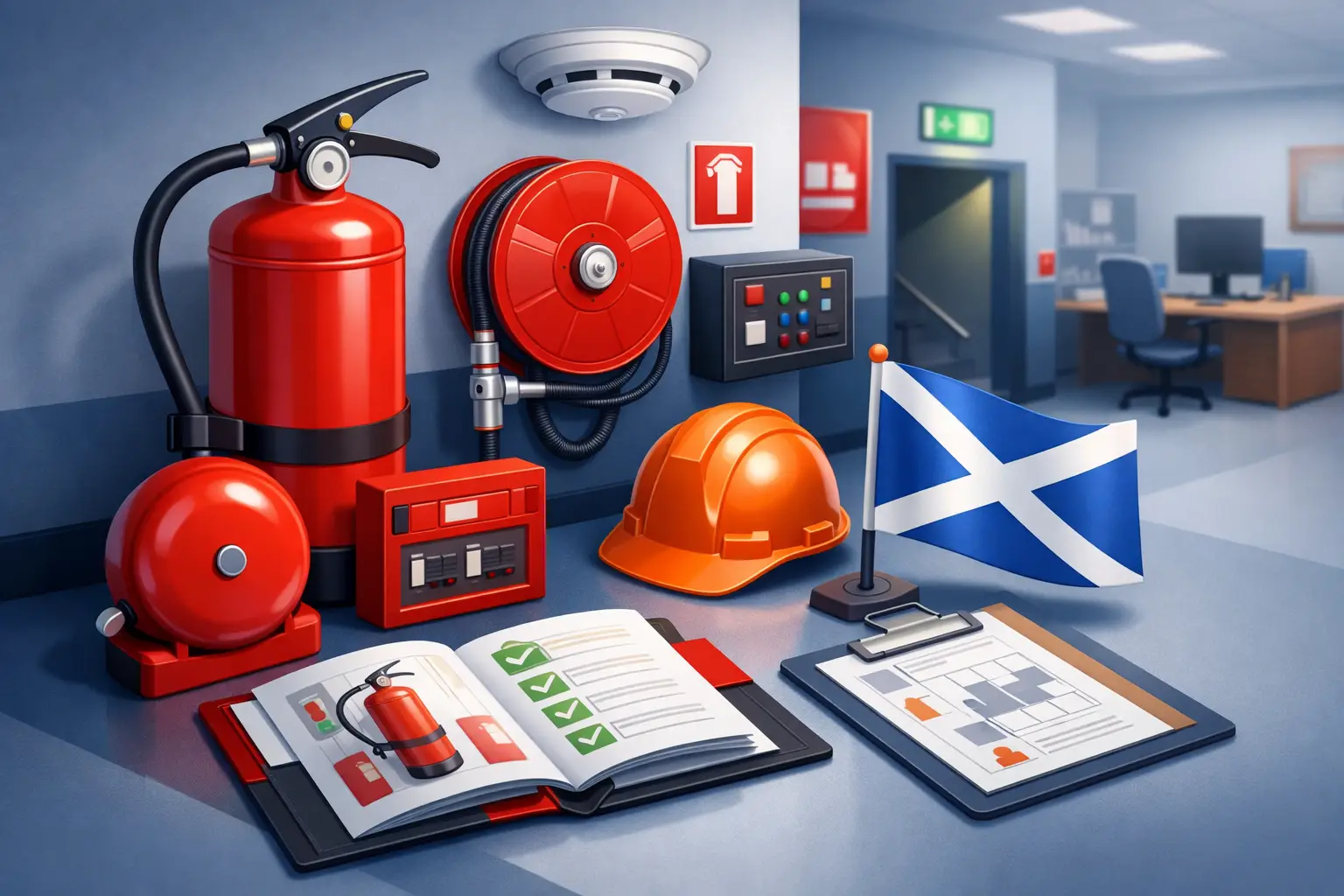
A fire extinguisher can look perfectly acceptable on a wall while being unsuitable for the risk, out of service, or impossible to access when seconds matter. This BS 5306 compliance guide explains what duty holders need to do to keep portable extinguishers correctly selected, maintained and ready for use across Scottish workplaces.
For a business owner, landlord or facilities manager, compliance is not simply a servicing sticker. It is the evidence that your fire-fighting equipment supports your fire risk assessment, can be used safely in an early-stage fire, and has been properly managed throughout the year.
What BS 5306 means for your business
BS 5306 is the British Standard covering fire extinguishing installations and equipment on premises. For most workplaces, the key parts are BS 5306-8, which deals with the selection and positioning of portable fire extinguishers, and BS 5306-3, which covers their commissioning and maintenance.
The Standard is not a replacement for your legal fire safety duties. In Scotland, those duties sit principally under the Fire (Scotland) Act 2005 and the Fire Safety (Scotland) Regulations 2006. However, following the relevant parts of BS 5306 is widely recognised as a practical way to demonstrate that extinguishers have been selected, installed and maintained to an appropriate standard.
Your fire risk assessment should drive every decision. A small office with general electrical equipment has different risks from a commercial kitchen, workshop, warehouse or premises storing flammable liquids. Buying extinguishers without considering the actual hazards can create a false sense of security and leave gaps in your fire precautions.
Start with the fire risk assessment
Before checking extinguisher types or service dates, establish what the premises needs. The responsible person should ensure the fire risk assessment identifies likely ignition sources, combustible materials, people at risk, escape routes and the fire precautions already in place.
This determines the extinguishing media required. Water-based extinguishers may be suitable for ordinary combustible materials such as paper, wood and textiles. Carbon dioxide units are commonly provided near electrical equipment, while wet chemical extinguishers are designed for commercial cooking oil and fat fires. Foam and powder have their own applications and limitations.
A multi-purpose extinguisher is not automatically the right answer. Powder, for example, can be effective in certain environments but may reduce visibility, impair breathing and cause substantial clean-up damage indoors. In many occupied indoor workplaces, it may be inappropriate unless the risk assessment clearly justifies it.
The assessment should also establish the required fire rating and number of extinguishers. This is based on the fire risk and floor area, rather than an assumption that one extinguisher near the exit will cover the whole building.
Selecting and siting extinguishers correctly
Extinguishers need to be visible, accessible and positioned where people can reach them without moving towards the fire. They are commonly located on escape routes, near exits and close to specific high-risk areas, but not so close that heat or smoke could cut off access.
Correct siting involves more than fixing a unit to a wall. Consider whether the extinguisher is obscured by furniture, stock or open doors; whether staff and visitors can see the sign; and whether it can be reached by someone with restricted mobility. In busy premises, equipment that is regularly knocked, moved or hidden needs particular attention.
BS 5306-8 also addresses signage, mounting heights and the provision of appropriate units for particular hazards. A competent provider can assess these details on site and identify whether an existing layout still reflects how the premises is used.
Changes in operations should always trigger a review. A new kitchen appliance, battery charging area, storage arrangement, tenancy or refurbishment can alter the fire risk materially. The extinguisher provision that was suitable two years ago may no longer be suitable now.
The maintenance cycle under BS 5306-3
A compliant maintenance programme is planned, documented and carried out by competent people. It is not a one-off annual visit followed by eleven months of inattention.
Monthly visual checks
A nominated member of staff should carry out a simple visual inspection at approximately monthly intervals. They do not need to dismantle equipment or perform technical tests. Their role is to spot obvious issues early and report them.
Check that each extinguisher is in its designated position, clearly visible and unobstructed. Look for damage, corrosion, missing pins or tamper seals, loss of pressure where a gauge is fitted, discharge residue, and labels that cannot be read. Confirm that the service label is current and the unit has not passed its replacement or extended service date.
Record the check in a fire safety logbook or other controlled record. If a unit is missing, damaged, discharged or suspected to be faulty, arrange replacement or servicing immediately. Do not wait for the next annual visit.
Annual basic service
Portable extinguishers require a basic service at intervals not exceeding 12 months. This should be completed by a competent service technician using the correct procedures, tools and replacement parts.
The technician will inspect the extinguisher, assess its condition and operation, verify its contents and pressure as appropriate, check components, and confirm that it remains suitable for use. The service record should identify the units inspected, work completed, defects found and any equipment replaced or condemned.
An annual service is also a useful opportunity to compare the current site layout with the fire risk assessment. If a unit has repeatedly been moved behind stock or a new hazard has appeared, the problem is operational as well as technical.
Extended service and replacement dates
Some extinguisher types need an extended service, often known as a discharge test, at longer intervals. This involves more intrusive maintenance than a basic annual service and may require the extinguisher to be refilled or replaced. The relevant interval depends on the extinguisher type and manufacturer guidance.
Water, foam and wet chemical units commonly have extended service requirements at five-year intervals. Carbon dioxide extinguishers require periodic overhaul, often at ten-year intervals. These are general maintenance patterns, not a reason to ignore the manufacturer instructions or site-specific service requirements.
There is a practical choice at these points. An extinguisher may be extended-serviced if it remains economical and suitable, or it may be replaced with a new unit. Replacement can be the better option where equipment is old, corroded, obsolete, repeatedly damaged or no longer appropriate for the premises.
Keep records that stand up to scrutiny
If there is a fire, an insurance query or a visit from an enforcing authority, verbal assurances are not enough. You should be able to show a clear record of what equipment is installed, where it is located, when it was serviced and what corrective action was taken.
Your records should normally include:
- the current fire risk assessment and any review dates;
- an extinguisher asset list or site plan showing locations and types;
- annual service certificates and reports of remedial work;
- monthly visual inspection records; and
- staff fire safety training records, including extinguisher awareness where provided.
Keep these documents together and make sure responsibility is clear when staff change roles. For multi-let commercial property, landlords and tenants should also understand who is responsible for equipment in shared areas and within individual units. Assumptions create gaps.
Train people, but do not expect them to fight every fire
Extinguishers are provided for use on small, developing fires where it is safe to do so. They do not turn employees into firefighters, and no member of staff should be expected to tackle a fire if their escape route is compromised, smoke is building, or they have not been trained.
Staff should know how to raise the alarm, leave by the appropriate route and report to the assembly point. Selected staff may receive practical extinguisher training, but the message must remain clear: life safety comes first. The right decision is often to evacuate immediately and call the fire and rescue service.
Training should reflect the equipment installed. There is little value in teaching generic extinguisher theory if staff cannot identify the units at their own workplace or do not understand the risks of using the wrong media on cooking oil or electrical equipment.
When professional support is needed
A competent fire extinguisher provider should do more than attach a service label. They should identify unsuitable equipment, explain defects plainly, provide the right replacement options and leave you with accurate documentation.
For businesses in Glasgow and the surrounding area, EXSERVICE can support the full cycle: fire risk assessment, extinguisher supply, correct siting, commissioning, annual servicing and replacement of end-of-life units. This creates a single, accountable approach to keeping equipment ready to use.
Do not wait for an inspection, a landlord query or a near miss to discover that your extinguisher provision has fallen behind. Set a named person, maintain a simple inspection routine, and act promptly whenever the premises or its risks change. That is how fire safety remains practical rather than paperwork on a shelf.
Leave a Reply