

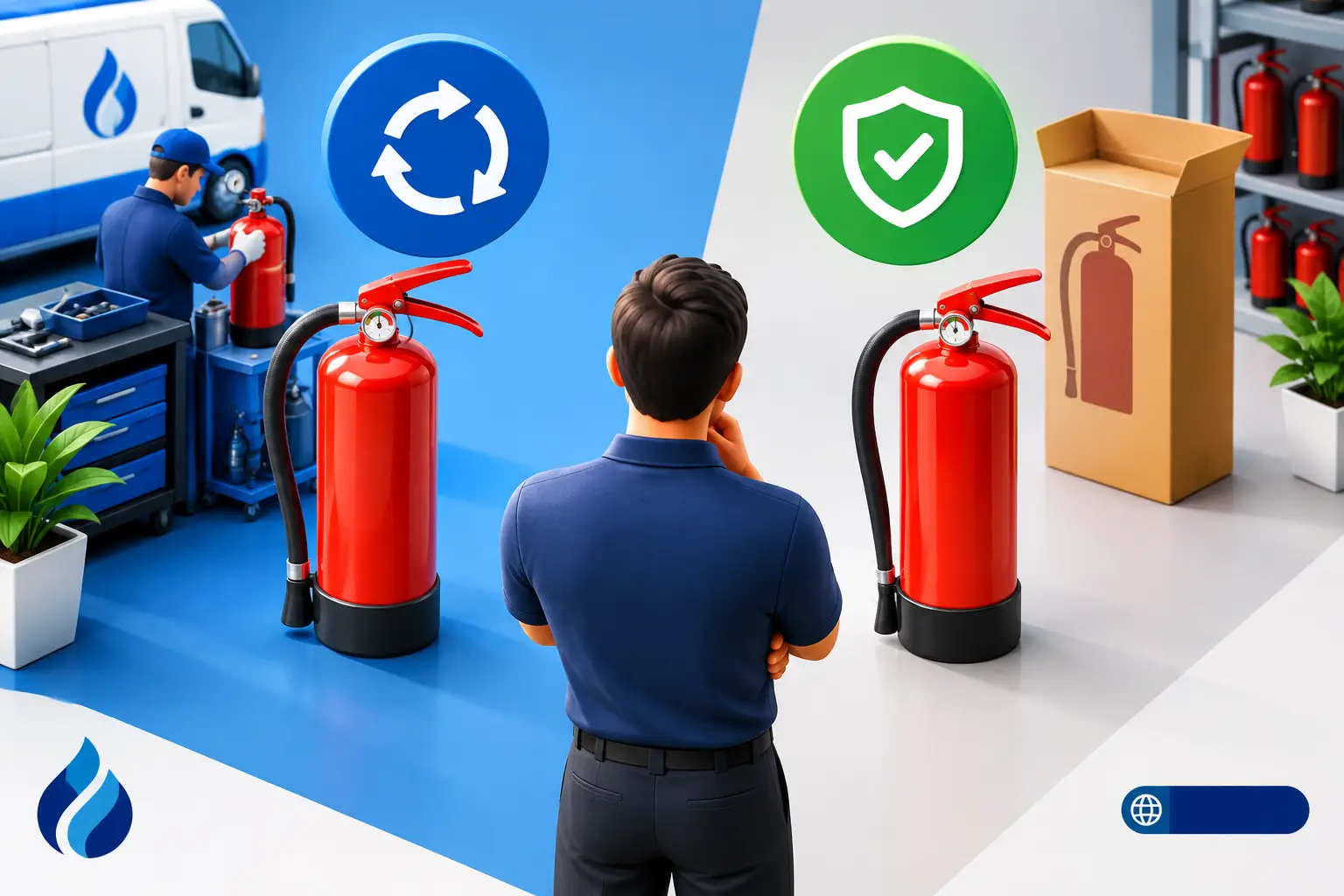
A discharged extinguisher by a staff kitchen door is not a minor housekeeping issue. It is a gap in your fire protection that could leave people without the right equipment during the first moments of a fire. Knowing whether to refill or replace extinguishers is therefore a practical compliance decision, not simply a question of buying the cheaper option.
For landlords, facilities managers and business owners, the right answer depends on the extinguisher type, its condition, service history and the risks within the premises. A competent assessment prevents wasted spend, supports your fire safety duties and, most importantly, keeps suitable equipment ready to use.
When an extinguisher can be refilled
In fire safety terms, refilling is usually called recharging. If an extinguisher has been used, even briefly, it must be removed from service and dealt with promptly. A pressure gauge sitting in the green zone does not prove the unit is ready for another emergency. Its contents may have been discharged, its seal may be broken or its operating mechanism may have been affected.
Many modern extinguishers can be recharged, provided the cylinder, valve, hose, horn and safety devices remain in sound condition. A competent technician will inspect the unit, carry out the required maintenance work and recharge it with the correct extinguishing medium. The extinguisher must then be returned to its proper location with an updated service label and record.
Recharging may be appropriate where the extinguisher is relatively new, has a clear maintenance history and passes its inspection. This can be a sensible option after a small incident or accidental discharge, particularly where a matching unit is readily serviceable.
That said, recharging is not an automatic right for every extinguisher. Some units are designed or supplied in a way that makes replacement more appropriate. The availability of parts, the manufacturer’s instructions and the condition of the cylinder all matter.
When to replace extinguishers instead
Replacement is necessary when an extinguisher cannot safely or economically be returned to service. Visible corrosion, dents, damaged threads, a cracked hose, a faulty valve or signs of leakage are all reasons for concern. Equipment stored in damp workshops, external areas, communal stairwells or harsh industrial environments can deteriorate faster than equipment in a clean office.
Age also matters, but it should not be used as the only test. Extinguishers have defined maintenance intervals, and some require more extensive work at set points in their service life. For example, water, foam and powder units commonly require an extended service after five years, while carbon dioxide extinguishers require periodic overhaul and pressure testing at longer intervals. If a unit fails this work, replacement is the safe route.
It may also be more cost-effective to replace an extinguisher when the cost of a major service, recharge, transport and replacement parts approaches the price of a compliant new unit. This is particularly relevant for smaller extinguishers, older models and units with uncertain histories.
A replacement may also be needed because the fire risk has changed. A retail unit that installs a commercial kitchen, a workshop that introduces welding, or a short-term let that changes its layout may no longer be adequately protected by the existing extinguisher provision. The replacement should be selected for the actual hazards present, rather than simply matching the colour of the old unit.
Refill or replace extinguishers: the checks that matter
The decision should be based on a documented inspection, not assumption. Under BS 5306-3, portable fire extinguishers should receive regular checks by the responsible person and maintenance by a competent person. In Scotland, duty holders must also ensure that fire safety measures are maintained and suitable for the premises.
A competent service visit considers more than whether an extinguisher looks presentable. The technician will check its location, accessibility, signage, tamper seal, pressure indicator where fitted, external condition and service status. They will also establish whether the extinguisher remains suitable for the class of fire it may be used against.
The following issues commonly point towards replacement rather than a recharge:
- the cylinder is corroded, dented, damaged or past a required test without a satisfactory result;
- the unit has missing, obsolete or damaged components that cannot be reliably replaced;
- the extinguisher has no credible servicing history or identification;
- the extinguisher type no longer suits the risks in the building; or
- a new compliant extinguisher is the safer and more economical option.
A unit that has simply been discharged is different from one that has reached the end of its safe service life. Treating both situations in the same way can create unnecessary cost or, worse, leave defective equipment on site.
Why servicing records protect your business
A fire extinguisher is only one part of your wider fire safety arrangements, but it is a visible and scrutinised part. Following a fire, an insurer, enforcing authority or investigating party may ask whether equipment was provided, maintained and available for use. Missing service labels, incomplete records and overdue maintenance can make it harder to demonstrate that reasonable steps were taken.
Good records show what was inspected, what action was required, whether equipment was recharged or replaced, and when the next service is due. They also help a responsible person spot recurring problems, such as extinguishers being moved, damaged or discharged without being reported.
For multi-site businesses, rental accommodation portfolios and premises with frequent staff changes, a planned maintenance schedule removes much of this uncertainty. It ensures discharged units are not forgotten in a cupboard and that end-of-life replacements are identified before an annual visit becomes an urgent compliance problem.
Do not overlook the temporary gap
When an extinguisher is removed for recharge or repair, the premises may be left without adequate cover. This is especially significant near electrical equipment, cooking areas, plant rooms, escape routes and higher-risk work activities. The responsible person should arrange a suitable temporary replacement where necessary.
Do not move another extinguisher from elsewhere in the building without checking the effect on that area. Firefighting equipment is positioned according to the layout, travel distances and identified risks in the fire risk assessment. Creating one gap to solve another is not a reliable solution.
Staff should also know that a used extinguisher must be reported immediately, even if the fire was small or the discharge was accidental. Prompt reporting allows the unit to be quarantined, replaced or recharged before it is mistakenly relied upon.
Choosing the right support
The best approach is to have extinguishers assessed by a competent fire safety provider that can service, recharge and replace equipment where required. This avoids a one-size-fits-all recommendation and keeps the decision tied to the premises, the equipment condition and relevant maintenance standards.
For businesses across Glasgow and the central belt, EXSERVICE can inspect existing provision, maintain suitable units and identify when replacement is the safer course. The aim is not to replace equipment unnecessarily. It is to ensure every extinguisher on site is correctly located, properly maintained and ready to perform if a fire starts.
A service label may look like a small detail, but it represents a much bigger responsibility: someone has checked that the equipment people may depend on in an emergency is still fit for purpose.
Leave a Reply