

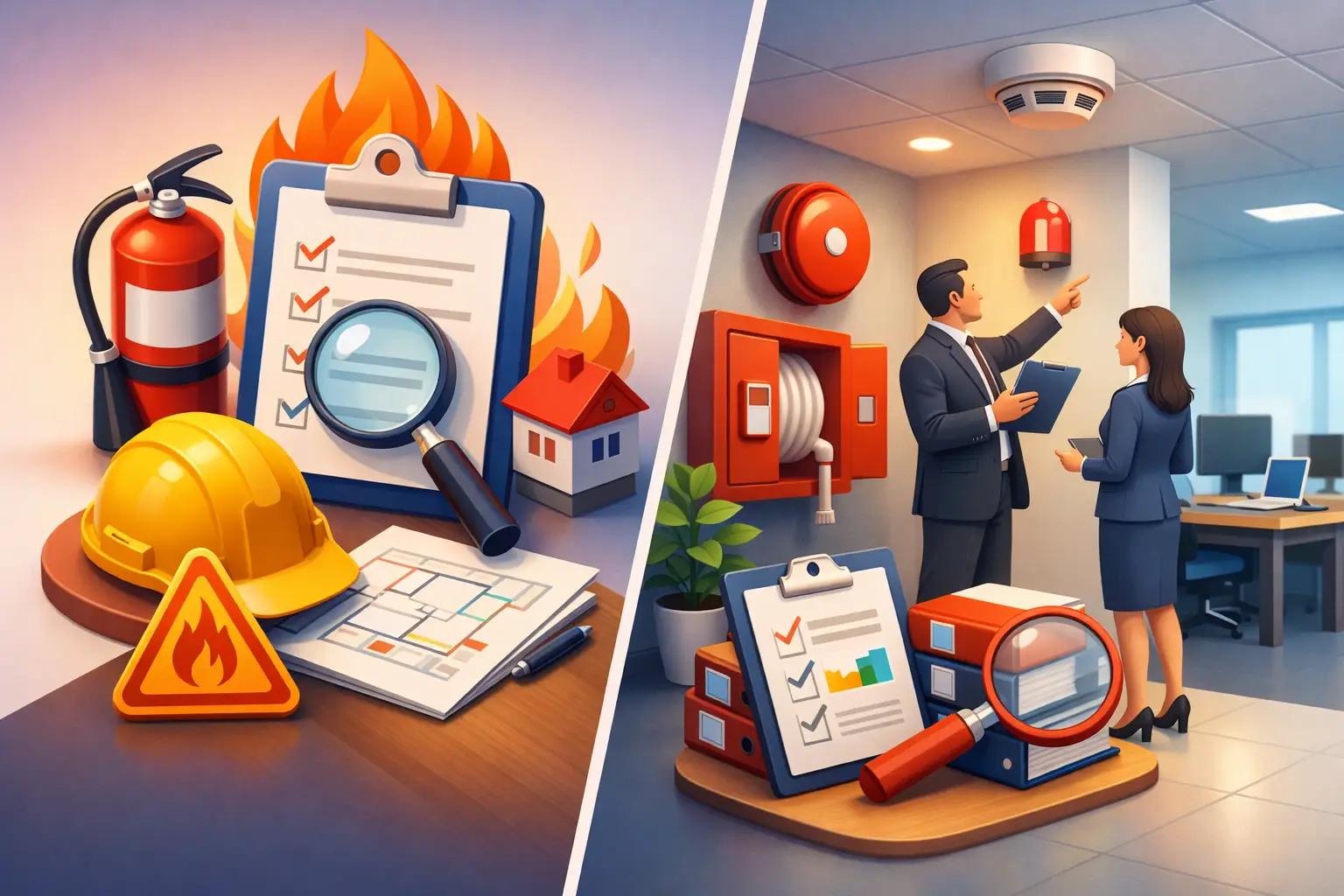
A fire risk assessment vs audit is not a choice between two versions of the same task. One identifies the fire hazards and controls required in your premises. The other tests whether your fire safety arrangements are actually being followed, maintained and recorded. For employers, landlords and facilities managers, understanding the difference helps prevent gaps that can put people, property, insurance cover and business continuity at risk.
In practice, a business may need both. A suitable fire risk assessment sets the direction. A fire safety audit provides assurance that the systems, equipment and routines put in place are working as intended.
What is a fire risk assessment?
A fire risk assessment is a systematic examination of a building, how it is used and the people within it. Its purpose is to identify anything that could cause a fire, determine who may be at risk, assess existing precautions and specify any action needed to reduce risk to an acceptable level.
For commercial premises in Scotland, fire safety duties arise principally under the Fire (Scotland) Act 2005 and supporting regulations. The duty holder must take reasonable fire safety measures and carry out a suitable assessment of fire risks. The assessment should be kept under review and recorded where required, particularly where five or more employees are employed or where the premises are subject to licensing or other relevant conditions.
A competent assessment looks beyond the obvious presence of extinguishers and fire alarms. It considers the whole fire safety picture, including ignition sources, combustible materials, escape routes, emergency lighting, fire doors, signage, staff training, evacuation arrangements and the needs of vulnerable people.
The assessment asks: what could go wrong?
A proper assessment considers realistic scenarios. In an office, this might include overloaded extension leads, a kitchenette appliance left on, poorly stored cardboard or a blocked escape route. In a workshop, it may include hot works, flammable liquids, charging equipment and more complex processes. In rental accommodation, it may focus on shared escape routes, electrical risks, cooking facilities and the condition of fire-resisting doors.
The outcome should be practical. If an extinguisher is missing, unsuitable for the hazard or positioned where staff cannot reach it safely, that should lead to a clear action. If a fire door does not close properly, it needs repair. If staff would not know how to raise the alarm or leave the building, training and procedures need attention.
A fire risk assessment is not a certificate that a premises is permanently compliant. Buildings change. So do occupancy levels, layouts, stock, equipment, contractors and work activities. It should be reviewed when there is a significant change, after a fire or near miss, when concerns arise, or at sensible planned intervals. Many businesses use an annual review as a reliable compliance discipline, but the right frequency depends on the level of risk and change within the premises.
What is a fire safety audit?
A fire safety audit is a structured check of whether fire safety measures are being implemented and managed in practice. Rather than starting with hazards alone, it examines evidence: inspection records, maintenance certificates, training logs, evacuation drills, equipment condition, corrective actions and whether responsibilities are being carried out.
An audit may be conducted internally by a competent manager or externally by a specialist. Its scope can be narrow, such as checking fire extinguisher servicing records across several sites, or broad, covering the full fire safety management system.
Where an assessment may identify that extinguishers are required at particular locations, an audit may ask whether those extinguishers are present, correctly sited, unobstructed, labelled, within service date and suitable for the risks now present. It will also check whether monthly visual inspections and scheduled maintenance have been documented.
The audit asks: are we doing what we said we would do?
This distinction matters because a well-written assessment cannot protect a business if its actions are left open. An audit can reveal that a required repair was never completed, that a fire door check has not been recorded, or that an extinguisher has reached end of life without replacement.
It can also expose inconsistency between sites. A company with a strong head-office policy may find that individual branches have different evacuation notices, incomplete training records or equipment servicing that has been missed after a change of tenancy. These are management failures, not necessarily failures in the original assessment, but they can still have serious consequences during an emergency or enforcement visit.
Fire risk assessment vs audit: the practical differences
The easiest way to distinguish them is by purpose. A fire risk assessment determines the precautions needed to control fire risk. A fire safety audit checks whether those precautions, and the management systems supporting them, are in place and effective.
They also produce different outputs. An assessment normally results in a documented set of findings, a risk-based action plan and a review date or trigger. An audit produces evidence of compliance or non-compliance, identifies recurring weaknesses and assigns corrective actions. Both documents should be clear enough for the responsible person or duty holder to act on.
Timing differs too. A risk assessment is needed before or when a premises is occupied and must be reviewed as circumstances change. Audits are often scheduled periodically to check performance over time. Higher-risk premises, multi-site businesses and organisations with frequent staff turnover may benefit from more regular auditing.
Neither process should become a paperwork exercise. Records matter because they demonstrate control and help managers track outstanding work, but the real test is whether people can escape safely and whether equipment will work when it is needed.
Why fire extinguisher records often feature in audits
Portable fire extinguishers are a familiar part of workplace fire safety, yet they are commonly overlooked between service visits. They must be appropriate to the hazards, accessible, visible where necessary and maintained to the relevant standards, including BS 5306.
An audit may identify practical issues that have developed since the original assessment. A refurbishment may have moved an extinguisher behind a cabinet. A water extinguisher may now be positioned close to electrical equipment. A unit may have been discharged, damaged or removed without replacement. Signage may be missing, or staff may have no understanding of when it is safe to use an extinguisher and when evacuation is the only sensible response.
Regular servicing and documented inspections provide evidence that equipment has been checked by a competent person. They also reduce the risk of discovering a fault only when an emergency occurs. For businesses, this supports life safety, protects assets and helps demonstrate responsible management to insurers, landlords, clients and enforcing authorities.
When do you need an assessment, an audit or both?
If you are taking responsibility for a new premises, changing the layout, introducing new equipment or work processes, or have not reviewed fire risks for some time, begin with the fire risk assessment. It establishes what your premises needs.
If you already have an assessment but are unsure whether its actions have been completed, whether servicing records are current or whether local teams are following procedures, an audit is the sensible next step. It gives management a clearer view of performance and accountability.
Both are particularly valuable after organisational change. A new tenant, expansion, refurbishment, change in storage arrangements, increased occupancy or altered opening hours can all affect fire safety. The assessment should consider the changed risk, while the audit confirms that the practical controls have caught up.
For smaller businesses, the same competent provider may be able to support assessment, extinguisher maintenance and follow-up actions. This can make compliance easier to manage, provided each element remains properly documented and the findings are addressed rather than simply filed away.
Common mistakes that create avoidable exposure
One mistake is assuming an annual service of fire extinguishers is a full fire risk assessment. Servicing is essential, but it does not assess escape routes, fire doors, alarm arrangements or changes to the building.
Another is commissioning an assessment and treating the report as the end of the process. Priority actions need owners, deadlines and confirmation when completed. A repeated audit finding is a warning that responsibility is unclear or that the control is not workable in day-to-day operations.
Businesses can also rely on generic templates that do not reflect their actual premises. A meaningful assessment must reflect the people, hazards, layout and activities on site. A meaningful audit must test real conditions, not just whether a form has been signed.
Turn findings into fire safety action
The value of both processes lies in what happens next. Keep assessment findings available, assign actions to named people, retain maintenance and inspection records, and revisit issues until they are genuinely resolved. Where a change affects fire precautions, update the assessment rather than waiting for the next planned review.
For Glasgow businesses and property managers, dependable fire safety management is built through regular attention, not a last-minute response to an inspection. A current assessment tells you what protection is required. A disciplined audit shows whether that protection is still ready to do its job when it matters most.
Leave a Reply