

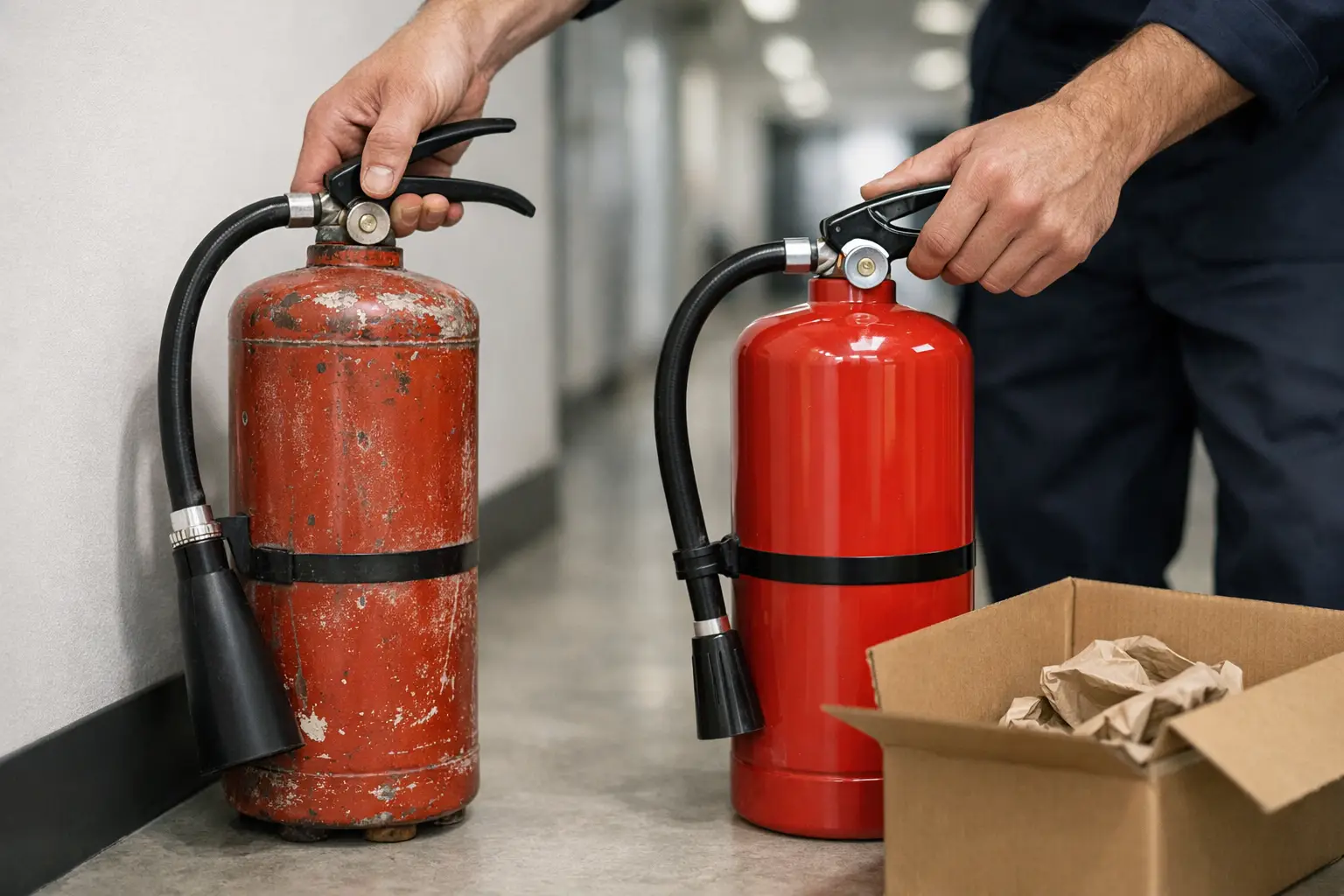
An extinguisher with an out-of-date service label can create a false sense of security. It may still be mounted on the wall, clearly signed and apparently undamaged, but that does not prove it will operate effectively when a member of staff needs it. Knowing how to replace expired extinguishers is therefore not simply an administrative task. It is part of protecting people, premises, insurance arrangements and business continuity.
For duty holders, the right response is rarely to buy a like-for-like cylinder and remove the old one. A replacement should be selected against the current fire risk assessment, installed in the correct location, commissioned properly and recorded as part of the site’s fire safety arrangements.
Do fire extinguishers actually expire?
Fire extinguishers do not all have one universal expiry date. The date stamped on the cylinder or shown on a service label may refer to manufacture, installation, a previous service, an extended service, or the point at which a unit reaches its expected working life. These dates mean different things.
Under the usual BS 5306-3 servicing approach, portable extinguishers require a basic service every year by a competent person. Water, foam and powder extinguishers normally require an extended service at five-year intervals. Carbon dioxide extinguishers normally require overhaul and pressure testing at ten-year intervals. A competent engineer may condemn a unit sooner if it is damaged, corroded, leaking, has the wrong pressure, cannot be serviced economically or no longer meets the needs of the premises.
Some modern maintenance-free or long-life extinguishers follow a manufacturer-specific maintenance regime. Their condition and replacement dates must be checked against the manufacturer’s instructions, not assumed from the timetable used for serviceable units.
The practical point is clear: do not judge an extinguisher by appearance alone. If its service interval is overdue, its replacement date has passed, or an engineer has marked it as condemned, it should not remain in service as your available firefighting provision.
When replacement is the right option
An extended service does not automatically mean a new extinguisher is needed. A suitable refillable extinguisher may be safely overhauled and returned to service where its cylinder, valve and components pass the required checks. This can be a cost-effective option for some sites.
Replacement is usually the safer and more sensible route when the extinguisher has reached end of life, failed inspection, suffered impact damage, shows corrosion, has a damaged hose or horn, has lost pressure, or has been discharged. It is also appropriate where an older model no longer provides the right fire rating or extinguishing medium for the risk.
For example, a premises that has introduced electric vehicle charging, commercial cooking equipment, lithium-ion battery storage or new flammable liquids may need more than a direct swap. The existing extinguisher provision may no longer reflect the actual hazards on site. Replacing an old unit is a useful opportunity to confirm that the type, quantity and siting remain suitable.
How to replace expired extinguishers correctly
Start with the fire risk assessment
Before ordering replacement units, review the fire risk assessment and the extinguisher schedule. This identifies the likely fire risks, the people at risk, escape routes and the equipment required to support safe evacuation.
Extinguishers are intended for trained people to tackle a small fire only where it is safe to do so and where there is a clear escape route. They are not a substitute for fire prevention, alarm systems, evacuation procedures or staff training.
The assessment should confirm whether the premises need water, foam, carbon dioxide, powder, wet chemical or specialist extinguishers. Each medium has limitations. Water-based units must not be used on live electrical equipment or flammable liquid fires. Carbon dioxide is commonly suitable for electrical risks but has limited cooling effect, meaning re-ignition can be a concern. Powder can be effective across several fire classes but may reduce visibility, contaminate equipment and affect breathing in enclosed spaces. Wet chemical extinguishers are designed for commercial cooking oil and fat fires.
The correct choice depends on the risk, not what happened to be installed previously.
Remove the old unit from service immediately
If an extinguisher is overdue for a required service, has been condemned or is clearly damaged, arrange for it to be removed from operational use. Do not leave it in position with the expectation that staff will remember not to use it in an emergency.
If immediate removal would leave the premises without adequate cover, provide a suitable temporary replacement as quickly as possible. This is particularly important at escape routes, fire points, plant rooms, kitchens and areas with higher fire loading.
Never place an old extinguisher in general waste, a skip or a scrap-metal collection. It remains a pressurised vessel and may contain extinguishing agents that require controlled handling. Foam extinguishers can also raise environmental concerns, especially older products containing persistent fluorinated substances. A competent fire safety provider can arrange compliant collection, disposal or recycling.
Select an equivalent or improved replacement
The replacement should meet the required fire rating and be appropriate for the environment. A small office, a workshop, a communal area in rental accommodation and a commercial kitchen will not necessarily need the same equipment.
Check practical details as well as fire type. The unit must be manageable for the people expected to use it, visible, accessible and protected from avoidable damage. In cold, damp or externally exposed areas, the extinguisher and its cabinet may need additional protection. In public-facing locations, tamper protection may be appropriate, provided it does not prevent rapid access in an emergency.
Where a business has altered its layout, moved machinery or changed occupancy, fire points may need to be moved. An extinguisher hidden behind stock, locked inside an office or positioned beyond a developing fire is of limited value.
Have the new extinguisher commissioned and sited
A new extinguisher should be commissioned before it is put into service. This is more than hanging it on a wall. Commissioning includes checking that the unit is undamaged and correctly charged, recording its details, fitting the appropriate service label and confirming the installation location.
It should be mounted on a suitable bracket, stand or cabinet at the correct height and accompanied by clear identification signage. Fire points should be positioned where people can reach them without moving towards the fire, commonly on escape routes or near exits. Exact siting should follow the fire risk assessment and recognised installation guidance.
A competent technician will also check that the extinguisher is not obstructed and that the surrounding signage remains visible. These details matter during an evacuation, when seconds are limited and conditions may be poor.
Update the records and maintenance plan
Once replacement is complete, update the fire safety logbook or servicing records. Record the extinguisher type, capacity, fire rating, serial number, location, commissioning date and next service due date. Retain records for removed units too, including the reason for condemnation and disposal route where available.
Accurate records demonstrate that equipment is being managed rather than merely purchased. They also help a responsible person, insurer, enforcing authority or incoming facilities manager understand the history of the site’s fire precautions.
In Scotland, duty holders must take appropriate fire safety measures under the Fire (Scotland) Act 2005 and associated fire safety regulations. BS 5306 provides recognised good practice for selecting, installing and maintaining portable extinguishers. Following a planned servicing regime helps show that your equipment has been maintained in a ready-to-use condition.
Avoid these common replacement mistakes
The most common error is replacing on price alone. A cheaper extinguisher may not have the required rating, may be unsuitable for the hazard or may create avoidable servicing complications later. The cost of the wrong unit is small compared with the consequences of ineffective first response, fire damage or disruption to trading.
Another mistake is treating a replacement as a one-off purchase. Every extinguisher needs routine visual checks by the responsible person and periodic maintenance by a competent technician. Staff should know where extinguishers are, what they are for and when not to use them. Training should reinforce that life safety and evacuation always come first.
Finally, do not rely on colour or an old site plan. Equipment types, signage conventions and risks change. A current assessment and an up-to-date extinguisher register provide a more dependable basis for decisions.
Arrange replacement before compliance becomes a problem
For businesses with several units, multiple floors or more complex risks, planned replacement is far easier than reacting after a failed annual service. A competent provider can identify end-of-life units in advance, advise whether extended service or replacement is appropriate, dispose of old equipment responsibly and commission the new units with a complete service record.
EXSERVICE supports workplaces across Glasgow and the surrounding area with extinguisher supply, siting, commissioning, servicing and end-of-life replacement aligned with BS 5306 good practice. The aim is straightforward: equipment that is suitable for the risk, available when needed and properly documented.
A service label should never be the first sign that an extinguisher needs attention. Keep a clear maintenance schedule, act on engineer recommendations and treat every replacement as a chance to strengthen the fire protection your people rely on.
Leave a Reply