

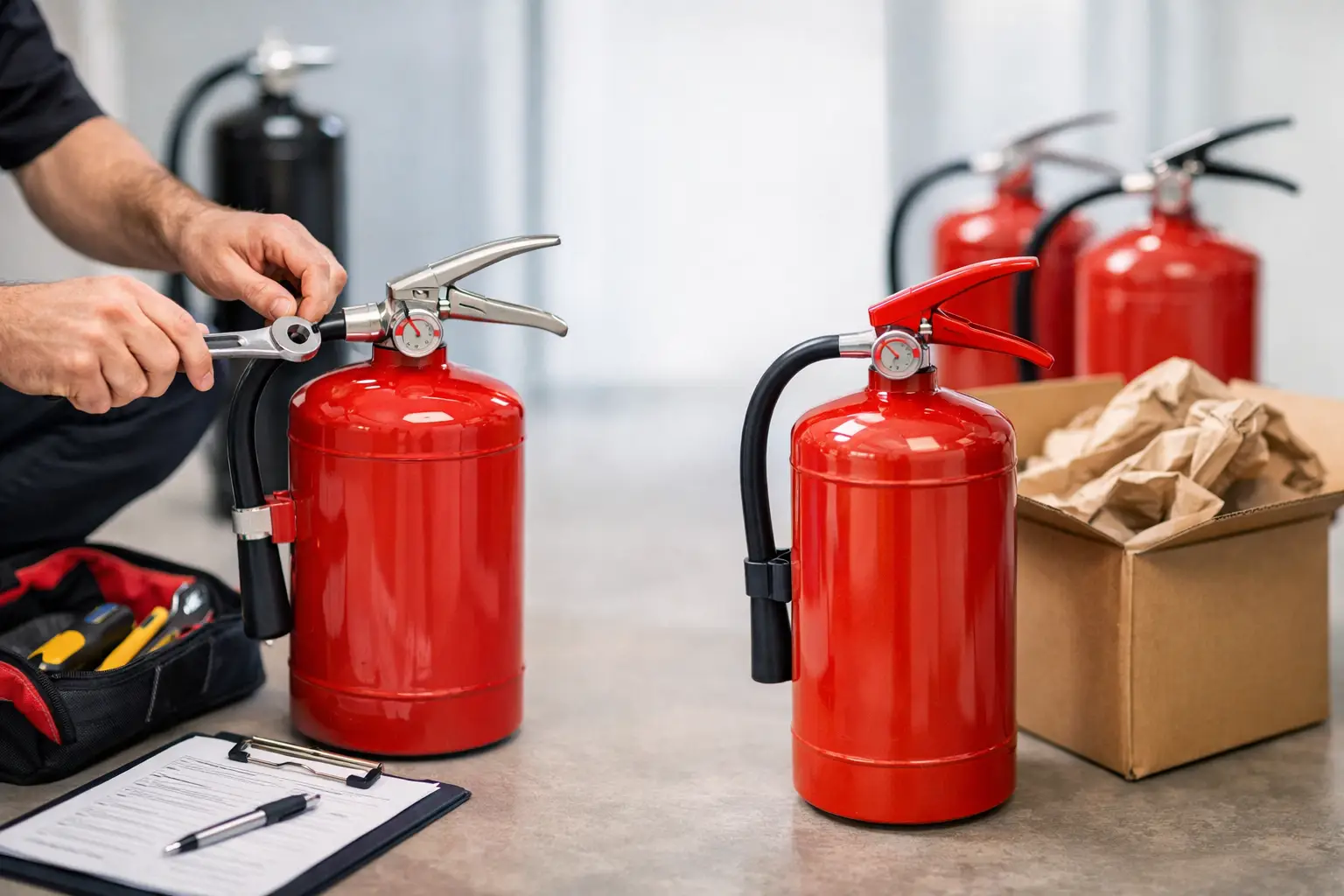
A fire extinguisher that looks fine on the wall can still be unfit for use. That is where the service vs replace extinguishers question becomes more than a budgeting decision. For duty holders, it is about whether equipment will operate correctly in the first few seconds of a fire, whether records will stand up to scrutiny, and whether your business is meeting its responsibilities under BS 5306.
In most workplaces, the right answer is not to replace extinguishers as soon as they age, and it is not to keep servicing them indefinitely either. It depends on the extinguisher type, its condition, its age, and whether maintenance can still confirm it is safe and reliable. A proper inspection removes guesswork and gives you a defensible decision.
Service vs replace extinguishers – what is the real difference?
Servicing is the scheduled maintenance process that checks whether an extinguisher remains in serviceable condition. That usually includes inspection of pressure, seals, hose, horn, body condition, labelling, bracket position and any signs of damage, corrosion or tampering. It also confirms that the extinguisher is still suitable for its location and risk profile.
Replacement is different. It means the extinguisher has reached a point where continued use is not appropriate. That may be because it has reached the end of its service life, failed an inspection, suffered damage, become corroded, discharged, or no longer meets the needs of the premises.
For a business owner or facilities manager, the distinction matters. Servicing helps preserve compliance and readiness. Replacement is what protects you when servicing can no longer do that with confidence.
When servicing is the right choice
In many cases, annual servicing is exactly what is needed. A well-maintained extinguisher that is within its expected life span, free from significant damage, correctly pressurised and properly located should not be replaced simply because it has been in place for a few years.
This is especially true where extinguishers have been professionally commissioned, receive regular maintenance, and have not been exposed to harsh environmental conditions. Offices, retail units and many commercial premises can keep extinguishers in service for years, provided the units continue to meet the relevant maintenance standard and pass inspection.
That said, annual servicing is not just a quick visual check. A compliant service should identify developing issues before they become failures. Slow pressure loss, damaged hoses, compromised pins, worn labels and early signs of corrosion can all affect performance. If these are picked up early, the extinguisher may remain serviceable or be replaced before it creates a gap in protection.
For businesses managing multiple units across a site, servicing also provides a current record of condition. That matters not only for life safety, but also for inspections, audits and insurer expectations.
When replace extinguishers is the safer decision
Some extinguishers should be replaced without hesitation. If a unit is badly dented, visibly corroded, leaking, has missing parts, shows unreliable pressure readings, or has been discharged, replacement is usually the sensible course.
Age can also become decisive. Different extinguisher types have different maintenance pathways and expected service lives. Certain units may require extended servicing or discharge testing at defined points. Others may reach a stage where replacement is more practical and safer than further maintenance. Water, foam, powder and CO2 extinguishers do not all follow exactly the same pattern, which is why a blanket rule often causes confusion.
There is also the issue of suitability. A unit may still function mechanically but no longer be the right extinguisher for the area it protects. Changes to layout, equipment, fire load or occupancy can make replacement necessary even when the extinguisher itself is not defective. A workshop, kitchen, plant room and open-plan office all present different risks.
Where there is doubt, the cost of delay is rarely worth it. An extinguisher is emergency equipment, not a decorative compliance item. If there is a credible question over its performance, replacement is often the prudent decision.
The age question businesses often get wrong
One of the most common misunderstandings is that every extinguisher must be replaced after one standard number of years. That is not how competent maintenance works.
What matters is the extinguisher type, the manufacturer guidance, the results of servicing, and whether required extended maintenance has been carried out. Some units remain fit for service well beyond the point where others need replacing. Some fail much earlier because of environmental exposure, misuse or poor siting.
Premises near coastal air, damp service yards, warehouses with temperature extremes, or buildings where extinguishers are regularly knocked by trolleys and equipment may see faster deterioration. In those environments, replacement cycles can shorten. In cleaner indoor spaces with good maintenance, service life may be longer.
This is why fixed assumptions can be risky. Duty holders need a maintenance decision based on evidence, not habit.
Compliance, insurance and liability
The service vs replace extinguishers decision is not just operational. It has compliance and liability consequences.
Under BS 5306, extinguishers in workplaces should be correctly selected, installed, commissioned and maintained. If equipment is retained in service despite obvious deterioration or overdue maintenance, that can leave a business exposed. If a fire occurs and an extinguisher fails, questions will follow about inspection history, servicing records and whether replacement should have happened sooner.
Insurance concerns are also relevant. Insurers expect reasonable precautions to be in place. Firefighting equipment that is out of date, poorly maintained or clearly defective can complicate a claim, particularly if the condition of the equipment contributed to greater damage or disruption.
For landlords and duty holders, there is also the reputational issue. If staff, tenants or visitors cannot rely on visible safety equipment, trust disappears quickly. Good maintenance records and timely replacement are part of showing that fire safety is being managed properly.
Cost matters – but short-term savings can be expensive
It is understandable to look at replacement costs and ask whether another year of servicing is possible. Sometimes that is entirely reasonable. Sometimes it is false economy.
Repeatedly servicing ageing or marginal equipment can become less cost-effective than replacing it, especially where multiple issues are emerging across a site. The cheaper option on paper may lead to more engineer time, more remedial visits and a greater risk of non-compliance.
Replacement can also bring practical benefits. Newer units may be lighter, easier to operate, clearer in their signage and better matched to current risks. If a site has changed use over time, replacing extinguishers as part of a wider review can improve coverage and simplify future maintenance.
For many businesses, the right approach is not aggressive replacement or minimal servicing. It is a planned maintenance strategy that replaces units when evidence supports it, rather than waiting for avoidable failure.
How a competent provider decides whether to service or replace
A reliable fire extinguisher provider should not push replacement by default, and should not leave poor equipment on the wall just to avoid cost. The decision needs to be technically justified.
That means looking at the extinguisher body, components, pressure condition, date information, maintenance history, siting and operational risk. It also means checking whether the extinguisher still aligns with the current fire risk assessment for the premises.
In practice, that gives duty holders a clear basis for action. If the unit is serviceable, it stays in service with the right documentation. If it is not, it should be replaced promptly and correctly commissioned. For businesses in Glasgow and the wider Scottish market, that clarity matters because it turns a vague compliance concern into a straightforward maintenance decision.
What businesses should do now
If you are unsure whether your extinguishers need servicing or replacement, the worst option is to leave the question unresolved until the next inspection becomes urgent. Check when each unit was last serviced, whether any have visible wear or damage, and whether your premises or fire risks have changed.
If records are incomplete, units appear mismatched to the environment, or extinguishers are approaching later stages of their service life, arrange a professional assessment. A specialist provider such as EXSERVICE can review condition, confirm compliance position and identify which units remain suitable for service and which should be replaced.
The goal is not to spend more than necessary. It is to make sure the extinguishers on your walls are there for a reason, ready to operate, and capable of protecting people and property when seconds matter.
Good fire safety management is rarely about dramatic decisions. More often, it is about dealing with small questions properly before they become serious problems.
Leave a Reply