

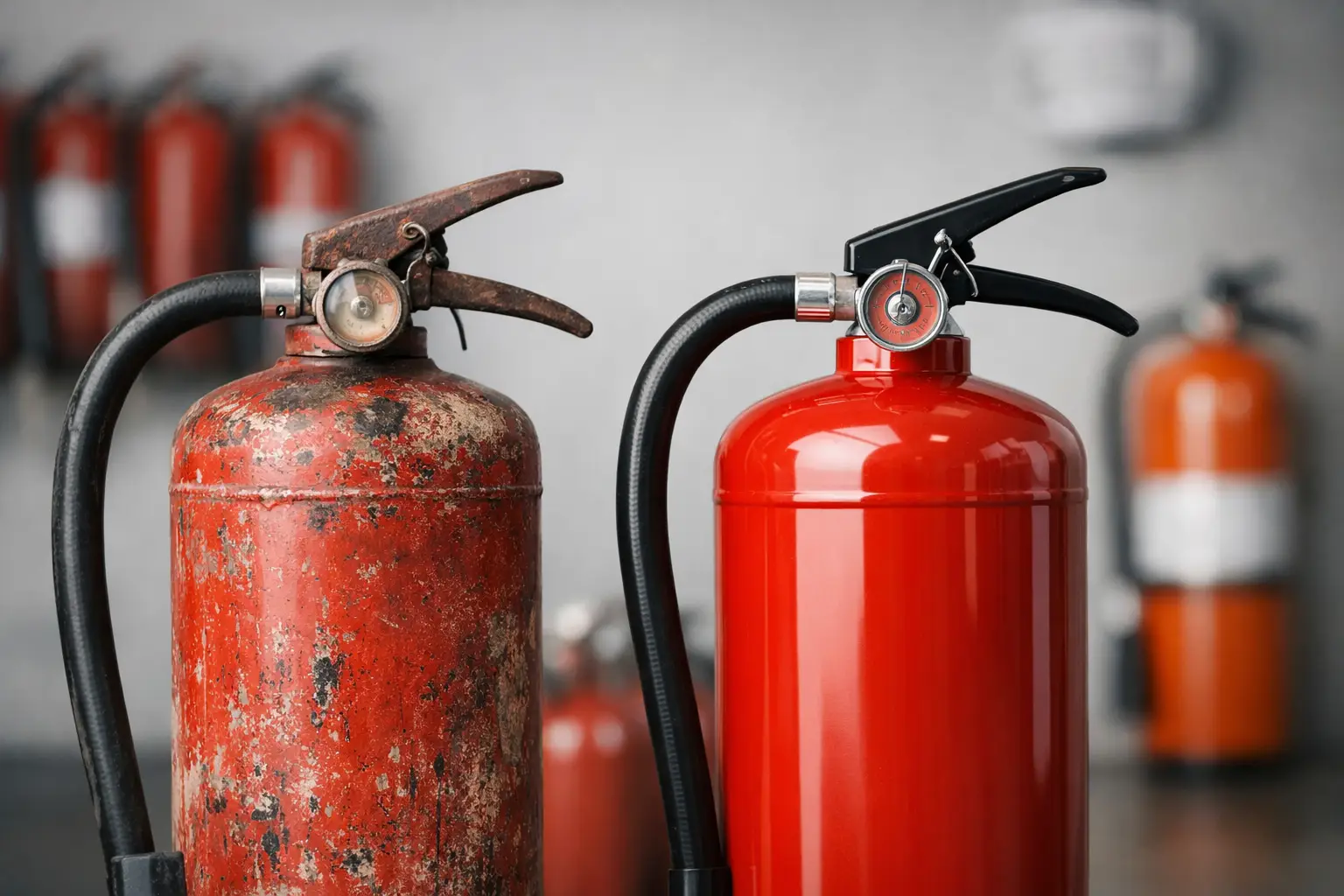
A fire extinguisher can sit quietly on a wall for years and still become a liability long before anyone notices. For duty holders, the real question is not simply whether an extinguisher is present, but when should extinguishers be replaced so they remain safe, compliant and ready to use in an emergency.
For workplaces, rental properties and commercial premises, replacement is not based on guesswork. It depends on the extinguisher type, its age, its condition, its service history and whether it still meets the standards expected under BS 5306. An old unit that looks acceptable from a distance may already be past its reliable working life.
When should extinguishers be replaced in the workplace?
In most cases, fire extinguishers should be replaced when they reach the end of their service life, fail inspection, show signs of damage or corrosion, have been discharged, or are no longer suitable for the risks on site. There is no single rule that covers every unit, which is why regular professional servicing matters.
A common point of confusion is the difference between servicing and replacement. Annual maintenance helps confirm that an extinguisher is still fit for purpose, but servicing does not mean it can remain in use indefinitely. Every extinguisher has a practical lifespan, and once reliability is in doubt, replacement is the responsible option.
For many stored pressure extinguishers, a working life of around 10 years is often treated as the point where replacement becomes the sensible and compliant route. Some may need replacing sooner if they are in harsher environments such as workshops, kitchens, plant rooms or exposed external areas. Others may remain physically intact but still fail on technical grounds.
Age matters, but condition matters more
Businesses often ask whether there is a fixed expiry date stamped on every extinguisher. In practice, the answer is more nuanced. Manufacturing dates and service labels give a clear indication of age, but the decision to replace should always consider condition as well.
An extinguisher may need replacing if the body is dented, the hose is split, the head cap assembly is damaged, the pin or tamper seal is missing, or corrosion is visible around the base, neck or weld points. These are not cosmetic issues. They can affect pressure retention, operation and user safety.
This is especially relevant in premises where extinguishers are moved, knocked, exposed to cleaning chemicals or stored in damp conditions. A unit in a busy warehouse or shared commercial kitchen usually ages differently from one mounted in a clean office corridor. That is why a calendar date on its own is never the full story.
Signs an extinguisher should be replaced
Some signs are immediate red flags. If the pressure gauge sits outside the correct range, if the label is unreadable, if parts are missing, or if the extinguisher has been used even briefly, it may need replacement or refill depending on type and condition.
Water, foam, powder and CO2 extinguishers each have their own maintenance considerations. CO2 units, for example, require periodic overhaul and pressure testing because of the nature of the cylinder. If a unit cannot pass those checks economically or safely, replacement is usually the right decision.
Older extinguishers can also become non-compliant if markings are unclear or if they no longer align with current siting and fire risk requirements. Even if the cylinder still functions mechanically, it may no longer be the right equipment for the area it protects.
Replacement after discharge or failed servicing
Any extinguisher that has been discharged should be dealt with promptly. Even partial use can leave the unit unfit for reliable operation. In some cases, it may be recharged or refurbished if the design allows and the condition is sound. In other cases, replacement is the only appropriate action.
The same applies after a failed service inspection. If an engineer identifies damage, pressure loss, blocked components or evidence that the extinguisher cannot be relied upon, leaving it in place is not a safe shortcut. It can also create a false sense of security for staff who assume the equipment is ready to use.
For duty holders, this is where compliance and practical risk meet. A failed extinguisher is not just a maintenance issue. It can affect emergency response, fire safety records and insurer confidence after an incident.
How BS 5306 affects when extinguishers should be replaced
BS 5306 sets out the standards for commissioning, siting, inspection and maintenance of fire extinguishers in the UK. For businesses, it provides the framework for what good practice looks like and helps demonstrate that equipment is being managed properly.
Under that framework, annual servicing by a competent person is central. Extended service intervals also apply to certain extinguisher types. Water, foam, powder and wet chemical extinguishers typically require a more thorough extended service at set intervals, while CO2 extinguishers require pressure testing at longer intervals. If a unit fails those requirements, replacement may be more appropriate than further maintenance.
This matters because compliance is not only about having extinguishers on site. It is about having the right extinguishers, in the right condition, properly maintained and available for immediate use. If a unit is clearly beyond its useful life, retaining it can undermine that position.
The risk of waiting too long
Delaying replacement often starts as a cost-saving decision. In reality, it can become the more expensive option. Ageing extinguishers are more likely to fail inspection, more likely to need repeated attention and more likely to let a business down when immediate action is needed.
There is also the wider operational risk. If an extinguisher does not work during the early stage of a fire, what might have been a small, controllable incident can escalate into major damage, interruption to trade and potential injury. For landlords and employers, the legal and financial consequences can be serious.
Insurers may also expect servicing and replacement decisions to reflect recognised standards. Poorly maintained or obviously obsolete equipment can raise difficult questions after a claim. From a business continuity point of view, timely replacement is usually far cheaper than dealing with avoidable fire loss.
When replacement is the better option than continued servicing
Not every ageing extinguisher needs to be replaced immediately, but there comes a point where continued servicing stops being sensible. If a unit is near the end of its expected life, has visible wear, or requires work that is disproportionate to its value, replacement is often the more dependable option.
This is particularly true across multi-site businesses or premises with several extinguishers of mixed age. Standardising units through planned replacement can make servicing records clearer, improve consistency and reduce the risk of overlooked defects. It also helps ensure staff are using equipment that is current, correctly labelled and suited to the site fire risk assessment.
For businesses in Glasgow and the wider Scottish market, this is often best managed as part of a wider maintenance plan rather than as a last-minute reaction to failed equipment. Planned replacement gives better control over cost, compliance and readiness.
What duty holders should check now
If you are responsible for fire safety, start with the basics. Check the service label, the manufacturing date where visible, the pressure indicator, the physical condition of the body and fittings, and whether the extinguisher still matches the hazards in that area.
If anything looks uncertain, do not rely on assumptions. A competent extinguisher engineer can confirm whether the unit remains serviceable, requires extended servicing, should be recharged, or has reached the point where replacement is necessary. That decision should be based on evidence, not convenience.
A good provider will also consider the wider picture. If your layout has changed, if your fire risk assessment has been updated, or if the use of the premises has altered, replacement may involve more than swapping old units for new ones. It may mean changing types, sizes or locations so protection remains appropriate.
One of the most common problems in commercial premises is equipment that has simply been left in place because no one has reviewed it properly for years. That is avoidable. Regular inspections and clear servicing records remove uncertainty and make replacement decisions easier to justify.
Fire extinguishers are there for the first critical moments of an emergency. If there is any doubt about whether a unit is still safe, compliant and ready to perform, that doubt should be dealt with before it becomes a problem.
Leave a Reply