

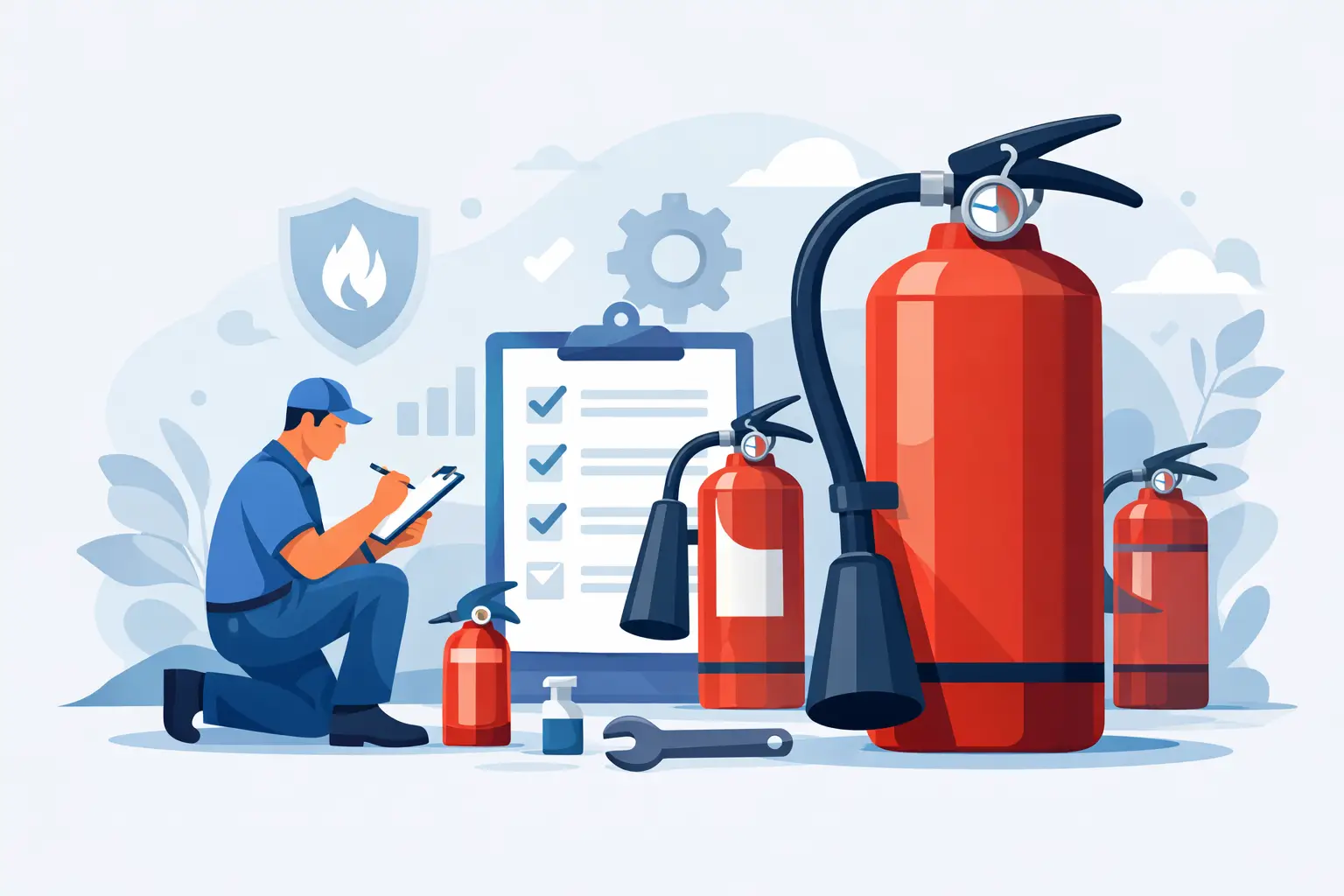
A fire extinguisher can be brand new, in the right location and apparently ready for use, yet still fail a workplace if it has not been properly commissioned. That is why understanding how to commission fire extinguishers matters for every duty holder, landlord and facilities manager responsible for commercial premises.
Commissioning is not the same as simply unpacking an extinguisher and fixing it to a wall. It is the formal process of checking that the unit is suitable, undamaged, correctly installed, pressurised where applicable, and ready for service in line with British Standard requirements. In practice, it is the point where a supplied extinguisher becomes part of a compliant fire protection system.
What commissioning a fire extinguisher actually means
When businesses ask how to commission fire extinguishers, they are often really asking two things. First, what has to be checked before an extinguisher can be relied upon? Second, who is allowed to do it?
Under BS 5306, commissioning involves a competent person carrying out the initial inspection and preparation of the extinguisher once it has been installed or placed into service. This includes confirming the extinguisher is the correct type for the identified fire risk, that it has not been damaged in storage or transport, and that all operating instructions and safety markings are clear and legible.
It also means confirming practical details that are easy to overlook but critical in an emergency. The extinguisher must be correctly positioned, accessible, visible, and mounted at the right height or placed on a suitable stand. If signage is required to identify the location or the type of extinguisher provided, that should be in place as well.
Why commissioning matters for compliance and safety
A workplace extinguisher is there to support life safety and limit early fire spread. If it is the wrong medium, incorrectly sited, or not checked before handover, it may be ineffective or even dangerous to use.
This is where commissioning goes beyond a box-ticking exercise. A water extinguisher near electrical risks, a CO2 unit hidden behind stock, or a discharged pressure gauge missed at installation can all create serious problems. The point of commissioning is to make sure the equipment matches the risk and is genuinely ready to perform.
There is also the compliance issue. Businesses are expected to provide appropriate firefighting equipment and maintain it in efficient working order. Insurers and fire risk assessors will expect to see that extinguishers have been properly put into service and are being maintained thereafter. Missing or incomplete commissioning details can raise questions that no responsible duty holder wants to answer after an incident.
How to commission fire extinguishers step by step
The exact process can vary slightly depending on the extinguisher type and the premises, but the principles are consistent.
Confirm the extinguisher is suitable for the risk
Before anything is signed off, the extinguisher selection needs to match the fire hazards identified in the building. Offices, kitchens, workshops, plant rooms and communal areas do not all require the same provision.
A competent person will check whether the extinguisher type, size and rating are appropriate for the location. That may include water, foam, CO2, powder or wet chemical units depending on the environment. In mixed-risk workplaces, one extinguisher on its own is rarely enough. Suitability should always reflect the fire risk assessment rather than a generic rule.
Check for damage, missing parts or transport issues
New extinguishers should never be assumed to be fault-free. The body, hose, horn, nozzle, safety pin, tamper seal and bracket all need checking. Labels must be legible and operating instructions easy to understand.
For stored-pressure extinguishers, the pressure indicator should be in the correct range. For cartridge-operated units, the cartridge arrangement must be correct and intact. If there are signs of corrosion, impact damage, leakage or tampering, the extinguisher should not be commissioned until the issue is resolved.
Verify manufacturing and service information
The commissioning technician should inspect the manufacturer details, serial number and any markings relevant to service life and maintenance. This matters because extinguishers are not indefinite-life assets. They have ongoing inspection and, in some cases, extended service requirements depending on type.
Accurate identification at commissioning helps create a reliable maintenance record from day one. That becomes important later when annual servicing, replacement planning and compliance documentation are reviewed.
Position and mount the extinguisher correctly
An extinguisher that cannot be found or reached quickly is poorly protected, even if the unit itself is in good order. Commissioning includes checking that siting is suitable for the hazard, travel distances are reasonable, and the extinguisher is visible without obstruction.
Wall brackets and stands must be secure. Units should be mounted at a practical height and not left loose on the floor unless they are designed to be stand-mounted. Nearby signage should support quick identification, especially where line of sight is not immediate or where different extinguisher types are provided together.
Record the commissioning details
Once the extinguisher has been checked and accepted into service, the commissioning should be documented. This typically includes the date, location, extinguisher type and the identity of the competent person carrying out the work.
A service label or similar record is normally applied so there is a clear indication that the extinguisher has been commissioned and when it will next require inspection. This record is a practical control measure. It helps businesses prove that the equipment did not just arrive on site, but was formally checked and placed into service correctly.
Who can commission fire extinguishers?
This is where many businesses make assumptions that can create avoidable risk. A handyman, caretaker or member of office staff may be perfectly capable of hanging a bracket, but that is not the same as commissioning a fire extinguisher.
Commissioning should be carried out by a competent person with the training, technical understanding and practical experience to inspect the extinguisher and confirm compliance with relevant standards. Competence matters because extinguisher provision is not just about the hardware. It involves correct selection, siting, identification of defects, and understanding the maintenance regime that follows.
For a small site with straightforward risks, it may be tempting to treat commissioning as simple installation. That approach can be short-sighted. If the equipment is wrong for the hazard or incomplete records lead to compliance gaps, the cost of getting it wrong is far greater than the cost of doing it properly.
Common mistakes businesses make
The most common mistake is assuming a delivered extinguisher is automatically ready for use. It is not. Supply and commissioning are separate steps, even when they happen on the same visit.
Another frequent issue is poor siting. Extinguishers are sometimes placed where there is spare wall space rather than where they are needed. That can leave escape routes underprotected or specialist risks without suitable cover.
There is also confusion around signage and documentation. Some sites have extinguishers with no clear record of when they entered service. Others have mismatched units because equipment has been moved around during refurbishment or layout changes. Commissioning should catch these problems at the start, but only if it is done thoroughly.
Commissioning is only the beginning
Knowing how to commission fire extinguishers is important, but commissioning is not the end of the legal duty. Once extinguishers are in service, they need regular inspection and maintenance to remain compliant and dependable.
That usually means visual checks by the responsible person and formal annual servicing by a competent engineer. Over time, some extinguisher types will also require extended servicing or replacement at end of life. Businesses that treat commissioning as a one-off job often lose control of the maintenance record that follows.
This is why many commercial premises prefer a specialist provider that can manage supply, siting, commissioning and ongoing servicing as one accountable service. For businesses in Glasgow and across Scotland, that reduces uncertainty and helps ensure extinguishers remain compliant with BS 5306 throughout their service life.
When to review extinguisher provision after commissioning
Even correctly commissioned extinguishers may need to be reassessed if the building changes. A refit, new machinery, altered layout, battery storage area, kitchen installation or different occupancy pattern can all affect extinguisher suitability.
In those cases, the question is not whether the original commissioning was done properly. It is whether the existing provision still matches the current risk. Fire safety equipment should follow the use of the premises, not the other way round.
A dependable provider such as EXSERVICE will treat commissioning as part of a wider compliance process, not an isolated visit. That gives duty holders clearer records, better support during audits and more confidence that equipment will perform when needed.
If you are responsible for a workplace, the practical answer to how to commission fire extinguishers is simple: have them selected, installed, checked and documented by a competent person from the outset, then keep them under proper maintenance. That one decision does a great deal to protect your people, your premises and your ability to keep trading after an incident.
Leave a Reply