

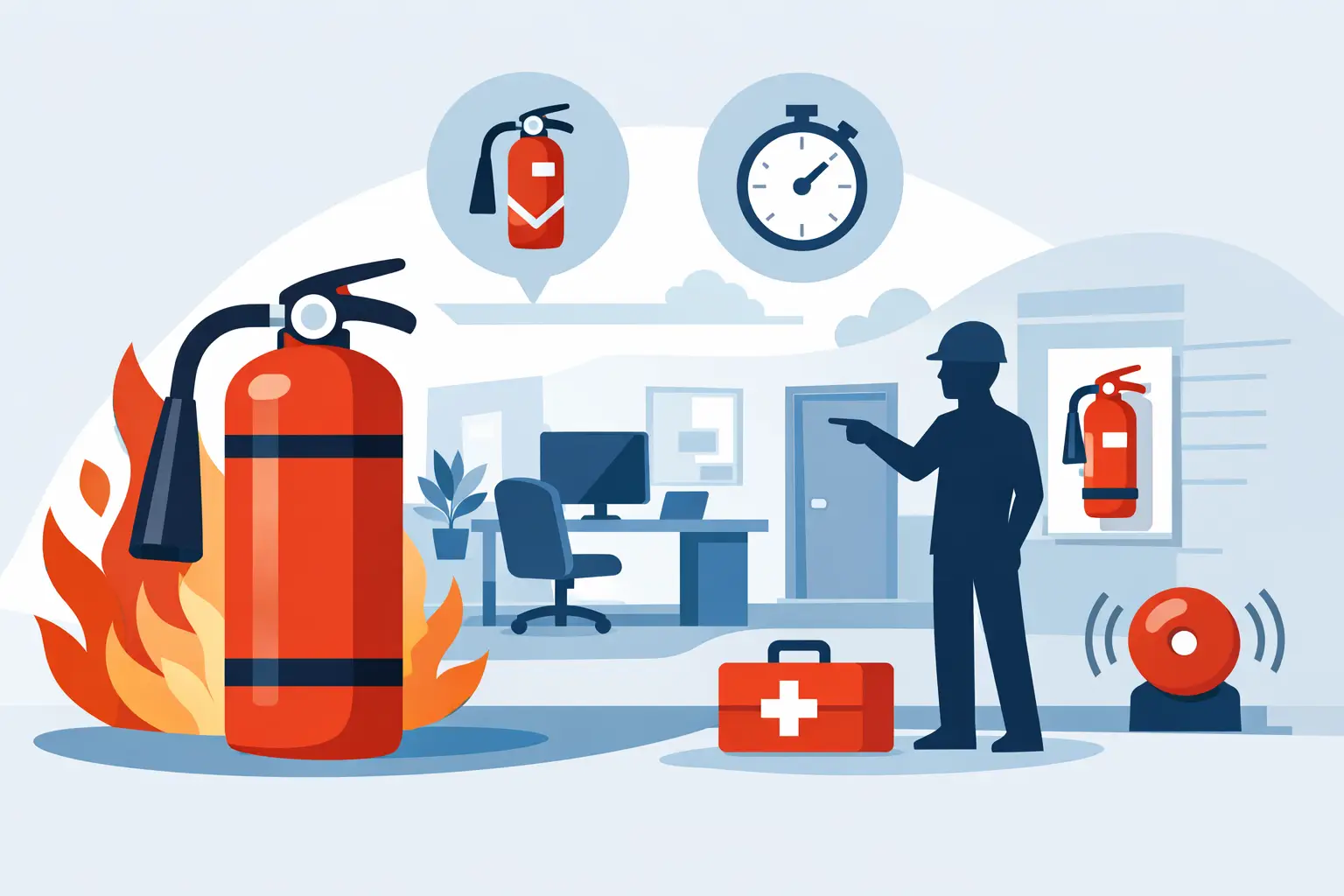
A fire extinguisher can be fully serviced, correctly commissioned and perfectly suited to the fire risk – but if it is in the wrong place, it may still fail the people relying on it. That is why a proper fire extinguisher siting guide matters. In workplaces, location affects response time, visibility, compliance and, in a real incident, whether a small fire is tackled early or allowed to grow.
For most duty holders, extinguisher siting is where fire safety becomes practical. It is not just about having the right number of units on site. It is about placing them where people can reach them quickly, identify them easily and use them safely without moving towards unnecessary danger. That means taking account of the building layout, the type of work carried out, the ignition risks present and the expectations set by BS 5306.
What a fire extinguisher siting guide should achieve
A useful fire extinguisher siting guide does more than tell you to hang extinguishers on a wall. It helps you make sensible placement decisions that support life safety and legal compliance at the same time.
In most workplaces, extinguishers should be positioned so they are available on escape routes, near exits and close to identified fire hazards where a small fire may be tackled without placing the user at excessive risk. The principle is straightforward. People should be able to access firefighting equipment quickly, but they should also have a safe route behind them if they need to withdraw.
This is where poor siting often creates problems. Extinguishers are sometimes hidden in cupboards, blocked by stock, placed behind doors, or mounted in corners that are technically inside the building but operationally useless. A unit that cannot be seen or reached immediately may as well not be there in the first moments of an emergency.
Fire extinguisher siting guide – the main placement rules
The starting point is to treat extinguisher siting as part of the wider fire risk assessment. There is no single layout that suits every premises. An office floor, a kitchen, a warehouse and a workshop all present different hazards, different travel routes and different practical constraints.
That said, some core rules apply widely. Extinguishers should be visible, readily accessible and positioned where they are less likely to suffer damage or obstruction. They should normally be located on escape routes, on floor landings, near room exits and at points where people are likely to notice them without searching.
Travel distance matters as well. For Class A fire risks, people should not need to travel excessive distances to reach an extinguisher. In practice, this means siting has to reflect how the building is actually used, not just how it appears on a drawing. A long, open-plan area may need units distributed differently from a series of smaller rooms, even if the floor area is similar.
Height and mounting also affect usability. Extinguishers should be mounted or stored so that they are secure but easy to remove. If they are placed too low, they can be kicked, damaged or missed. Too high, and they become awkward to handle quickly, particularly for smaller staff members or visitors unfamiliar with the premises.
Clear signage is part of correct siting, not an afterthought. Even where an extinguisher is visible, signage helps identify its location from a distance and supports faster recognition in a stressful situation.
Matching extinguisher location to the hazard
General coverage and hazard-specific siting are not the same thing. A business may have extinguishers located for ordinary combustible risks, but still fall short if specialist risks are not covered properly.
For example, a water extinguisher may be suitable for general Class A materials in an office or retail environment, but it is not the right choice beside live electrical equipment or a kitchen area with cooking oils. A CO2 extinguisher is commonly sited near electrical equipment because it helps deal with that specific risk without leaving residue. Wet chemical units are typically required where deep fat frying creates a Class F hazard. In some industrial settings, powder may be considered, although its use indoors requires careful thought because discharge can reduce visibility and create contamination issues.
This is where siting depends on both fire type and user safety. An extinguisher should be near the hazard it is intended to protect, but not so close that a person has to approach a developing fire to retrieve it. That balance is important. If a unit is mounted directly beside a high-risk appliance, it may become inaccessible at the very moment it is needed.
Common siting mistakes in workplaces
The most frequent mistakes are rarely dramatic. They are ordinary oversights that build up over time.
One common issue is treating extinguishers as static fixtures while the workplace changes around them. A unit that was correctly positioned last year may now be hidden by racking, photocopiers, seasonal stock or a new partition wall. Another problem is clustering too many extinguishers at the main entrance while leaving remote work areas underprotected. This can happen when equipment is installed for convenience rather than according to risk and travel distance.
There is also a tendency to place extinguishers where they look tidy rather than where they will be useful. Reception cupboards, locked plant rooms and behind-the-scenes storage areas may keep equipment out of sight, but that defeats the point. During an emergency, nobody should need a key, an escort or prior site knowledge to access basic firefighting equipment.
A further issue arises when businesses focus on quantity rather than siting quality. More extinguishers do not automatically mean better protection. Poorly located units can still leave critical gaps, while overprovision can confuse occupants and complicate maintenance.
How BS 5306 influences extinguisher siting
BS 5306 provides the recognised framework for selection, installation and maintenance of portable fire extinguishers in the UK. For duty holders, the practical value of the standard is that it turns general responsibility into clear expectations.
The standard influences where extinguishers should be sited, how they should be identified, and how coverage should relate to floor area and fire risk. It also reinforces the need for commissioning, routine inspection and ongoing servicing, because siting is only one part of operational readiness.
Compliance is not simply about avoiding criticism during an audit. Incorrectly sited or poorly maintained extinguishers can affect emergency response, undermine confidence during evacuation and create difficulties with insurers following an incident. If equipment is not suitable, accessible or serviceable, its presence offers little protection.
For many businesses, the sensible approach is to have siting reviewed as part of regular extinguisher maintenance. That way, changes in layout, occupancy or process can be picked up before they create a compliance gap.
Siting decisions for different premises
In offices, the main concern is usually straightforward Class A cover, with CO2 units near electrical equipment such as server rooms, comms cabinets and photocopier points. In these settings, extinguishers should be easy to find on circulation routes and near exits without creating clutter.
In retail premises, visibility is especially important. Equipment can be obscured by displays, promotional stands or seasonal stock. Siting needs to account for public access, staff response and the likelihood of changing layouts throughout the year.
Warehouses and industrial units require closer attention to travel distance, stock configuration and operational hazards. High racking, loading areas, battery charging points and machinery can all affect what is needed and where it should go. Here, a site-specific approach is essential.
For landlords and those managing common parts, extinguisher siting should reflect shared escape routes, plant areas and any responsibilities identified in the fire risk assessment. It is not enough to assume each tenant’s arrangements will cover the wider premises.
When professional siting advice matters
Some decisions are simple. Others are not. Mixed-use premises, multi-storey buildings, workshops, kitchens and changing layouts all introduce variables that make generic advice less reliable.
That is where specialist support becomes valuable. A competent provider can assess the risks, confirm suitable extinguisher types, position them in line with BS 5306 and ensure they are commissioned and maintained properly. For businesses across Scotland, that removes uncertainty and helps keep both compliance records and equipment standards in order.
EXSERVICE works with workplaces that need this done properly – not just supplied, but sited, maintained and kept ready for use.
The right extinguisher in the wrong place is a weak point you may not notice until it matters. Getting the siting right is one of the simplest ways to strengthen your fire safety arrangements before an emergency puts them to the test.
Leave a Reply