

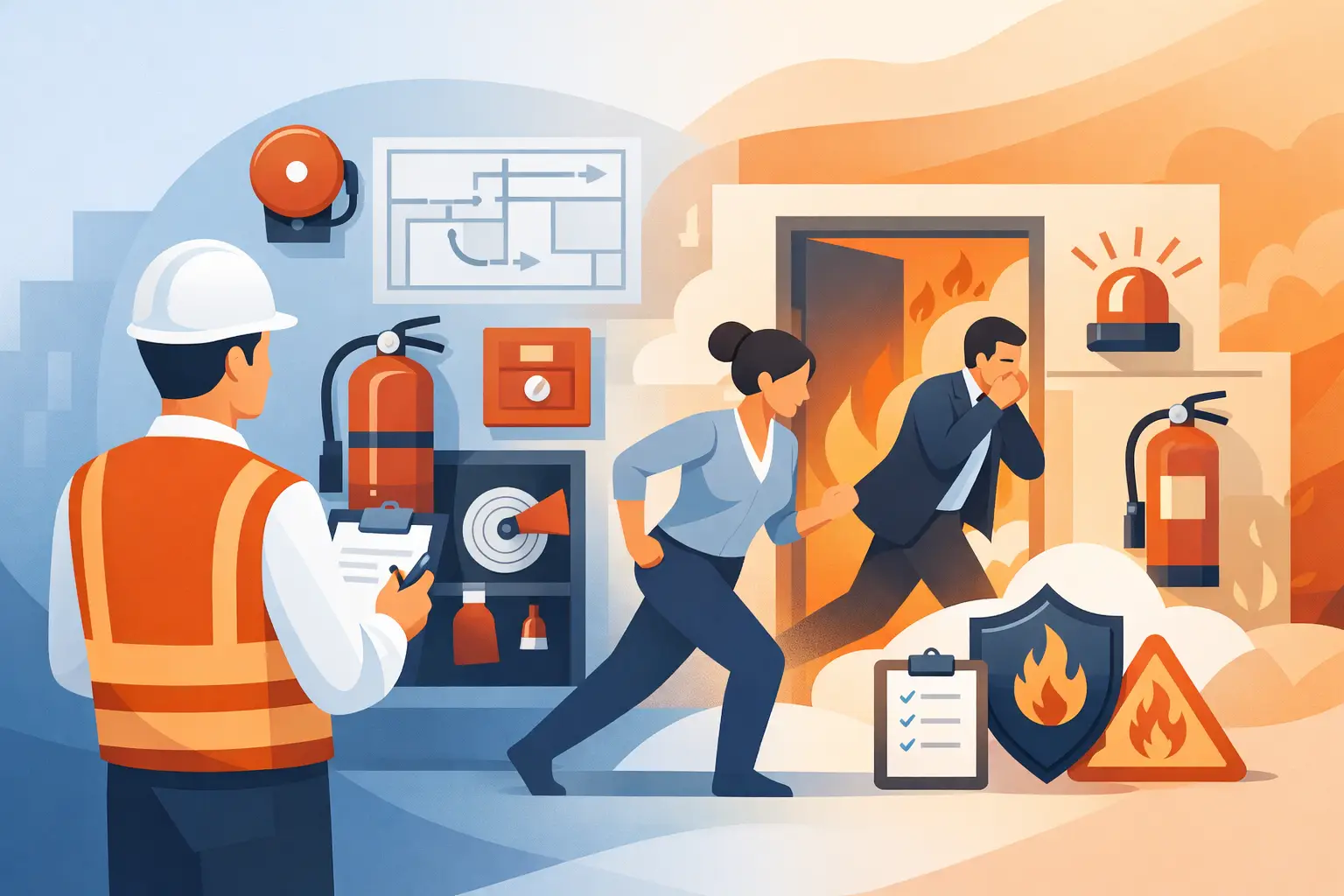
A fire extinguisher mounted on the wall is not proof of compliance. If it is the wrong type, in the wrong place, overdue for service or staff do not know when to use it, it may do very little when a fire starts. That is why fire safety at work regulations matter to every business premises, from small offices and shops to warehouses, workshops and multi-tenant buildings.
For most duty holders, the difficulty is not accepting the importance of fire safety. It is understanding what the law expects in practice. The rules are not only about having equipment on site. They are about assessing risk, putting suitable precautions in place, maintaining those precautions and making sure people can act safely in an emergency.
What fire safety at work regulations actually require
In Scotland, workplace fire safety duties sit mainly under the Fire (Scotland) Act 2005 and the Fire Safety (Scotland) Regulations 2006. These laws place responsibility on the duty holder to take reasonable steps to reduce fire risk and protect relevant persons on the premises.
That responsibility often falls to an employer, owner, landlord, occupier or anyone with control over part of the building. In shared premises, duties can overlap. A landlord may control common areas, while individual tenants remain responsible for their own units. On construction sites or industrial premises, responsibility may be split between several parties. That is where confusion starts, and it is also where gaps in compliance appear.
The law does not prescribe a single identical setup for every workplace. It expects precautions to be appropriate to the building, the people using it and the risks present. A low-risk office will not need the same arrangements as a garage, commercial kitchen or manufacturing unit. The principle is simple enough – fire precautions must match the real conditions on site.
The core duties behind fire safety at work regulations
The starting point is a fire risk assessment. This is the foundation of compliance because it identifies hazards, people at risk, existing controls and any further action needed. If the assessment is weak or out of date, everything built on it can be unreliable.
A suitable fire risk assessment should consider ignition sources, combustible materials, means of escape, alarm arrangements, emergency lighting, compartmentation, staff training and the provision of firefighting equipment. It should also reflect how the premises are actually used. A building that has changed layout, taken on new machinery or increased storage levels may no longer be adequately protected by an old assessment.
From there, the duty holder must implement and maintain fire precautions. That includes keeping escape routes clear, ensuring fire doors function properly, providing appropriate warning systems and making sure extinguishers are both suitable and serviceable. Records matter as well. If an insurer, enforcing authority or investigator asks for evidence of maintenance and inspection, verbal assurances are not enough.
Training is another area that is often underestimated. Staff do not need to become fire safety experts, but they do need to know what to do if a fire is discovered, how to raise the alarm, where to evacuate and whether extinguishers are for first-aid firefighting only. In many workplaces, the safest instruction is to leave the building rather than attempt to tackle a fire. That depends on the risk, the size of the fire and the level of training provided.
Fire extinguishers and workplace compliance
Portable fire extinguishers remain one of the most visible parts of workplace fire protection, but they are frequently misunderstood. Their presence is not enough on its own. The type, number, siting and ongoing maintenance all need to be right.
BS 5306 provides the recognised standard for the selection, installation and maintenance of portable fire extinguishers. For businesses, this matters because it gives practical structure to what suitable provision looks like. A compliant setup should reflect the classes of fire risk on the premises. Water extinguishers may be suitable for ordinary combustibles such as paper and wood, while CO2 units are commonly used near electrical risks. Foam, powder and wet chemical extinguishers each have their place, but they are not interchangeable.
The wrong extinguisher can make a fire worse or put a user at risk. Equally, an extinguisher placed too far from the hazard, obstructed by furniture or stock, or discharged and not replaced is a compliance problem as well as a safety problem.
Maintenance is not optional. Extinguishers require routine checks by the responsible person and periodic servicing by a competent provider. Annual maintenance is a standard expectation, and some units require extended service or replacement at defined intervals. If an extinguisher reaches end of life, it should not remain in place simply to satisfy a visual check. It must be replaced with a suitable operational unit.
For many businesses, this is where specialist support becomes valuable. A dependable servicing programme reduces the risk of missed inspections, undocumented maintenance and equipment that is no longer fit for purpose.
Where businesses commonly fall short
Most non-compliance is not deliberate. It happens because fire safety gets treated as a one-off job rather than an ongoing responsibility. A business moves furniture, changes occupancy, converts a stock room, installs new electrical equipment or takes over a unit with existing extinguishers and assumes everything is still in order.
One common issue is relying on outdated equipment layouts. Another is poor documentation. A site manager may know the extinguishers were checked at some point, but if there is no service label, no maintenance record and no evidence of the standard followed, that creates unnecessary exposure.
Shared buildings can be particularly awkward. Tenants sometimes assume the landlord covers all fire safety duties, while landlords assume tenants are managing their own compliance. The result can be blind spots around common corridors, plant areas or final exit routes.
There is also the question of practicality. Some businesses overprovide equipment in the hope that more means safer. Others keep unsuitable legacy extinguishers because replacing them feels inconvenient. Neither approach is ideal. Effective fire protection is about suitability, visibility and reliability, not clutter.
Maintenance, records and insurer expectations
Legal compliance is one part of the picture. Insurance is another. After a fire, insurers may look closely at whether precautions were maintained properly and whether the business took reasonable steps to manage known risks.
That does not mean every paperwork issue invalidates cover, but poor records can make an already serious incident harder to resolve. If extinguishers were not serviced, staff were not trained, or a known defect had been left unaddressed, questions will follow.
Good records support more than compliance. They help businesses demonstrate due diligence, plan replacements, manage contractor visits and keep responsibility clear across multiple sites. For facilities managers and landlords, that visibility is often the difference between a controlled maintenance programme and a last-minute scramble before an audit or inspection.
A practical approach to meeting regulations
The most reliable way to meet fire safety at work regulations is to treat them as a management issue, not a box-ticking exercise. Start with a current fire risk assessment that reflects the actual use of the premises. Review whether extinguishers are suitable for the hazards present and whether they are positioned where people can access them quickly.
Check that regular in-house visual inspections are taking place and that annual servicing is carried out by a competent engineer. Confirm that damaged, discharged or expired units are replaced promptly. Make sure staff know the site fire procedure and understand the limits of extinguisher use.
If your premises have changed in layout, occupancy or risk profile, revisit the assessment and equipment provision rather than assuming the existing arrangement still works. A small operational change can alter the fire risk significantly.
For Scottish businesses, especially those managing multiple obligations across sites, the sensible route is often to work with a specialist provider that can supply, site, commission and maintain extinguishers in line with BS 5306 while keeping service records in order. That gives duty holders clearer oversight and reduces the chance of hidden compliance gaps.
EXSERVICE works with workplaces across Glasgow and the wider Scottish market on exactly that basis – keeping firefighting equipment correctly located, properly maintained and ready to use when it matters.
Fire safety is rarely judged by what was intended. It is judged by what was in place on the day it was needed, so the safest position is to make sure your precautions stand up before that moment arrives.
Leave a Reply